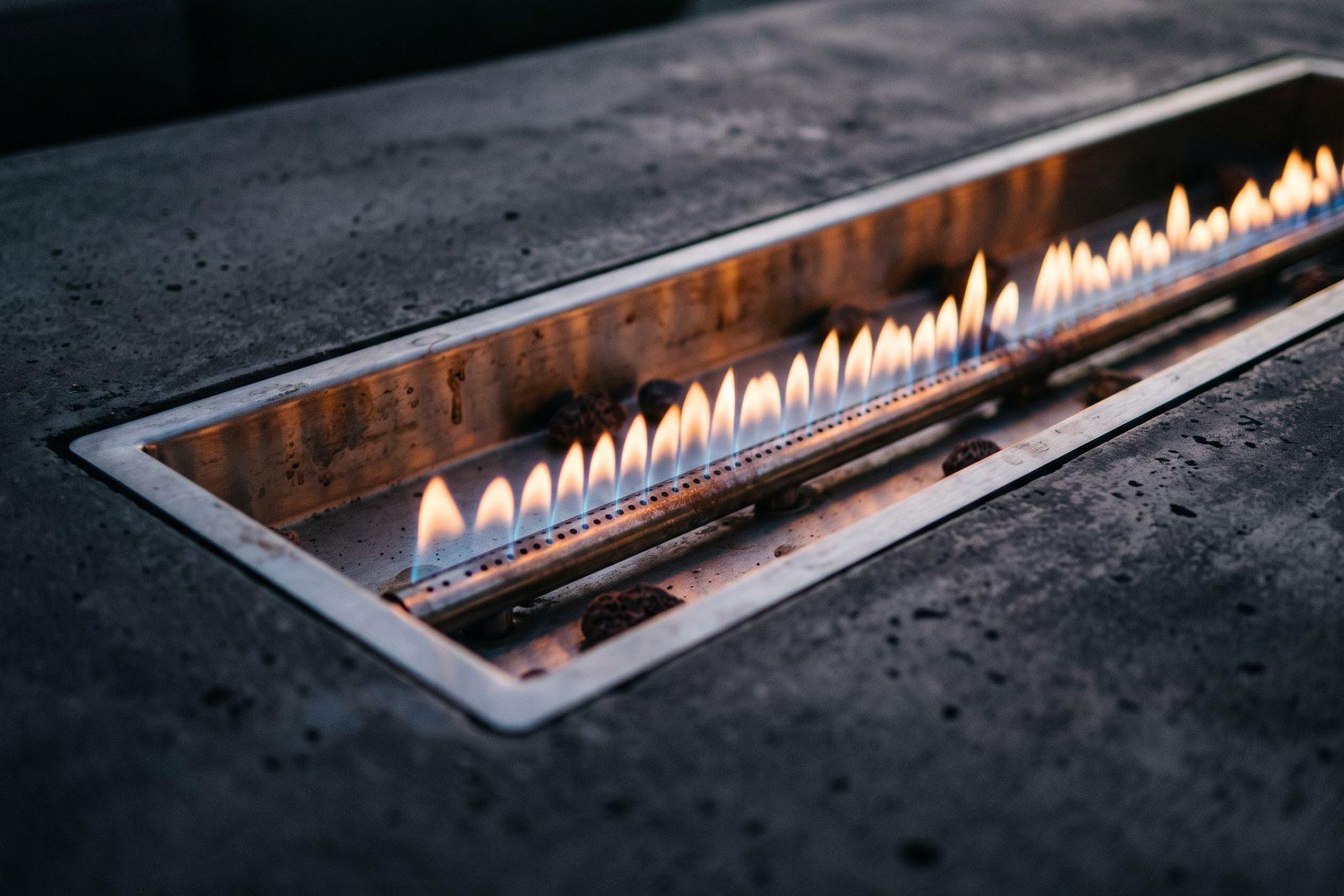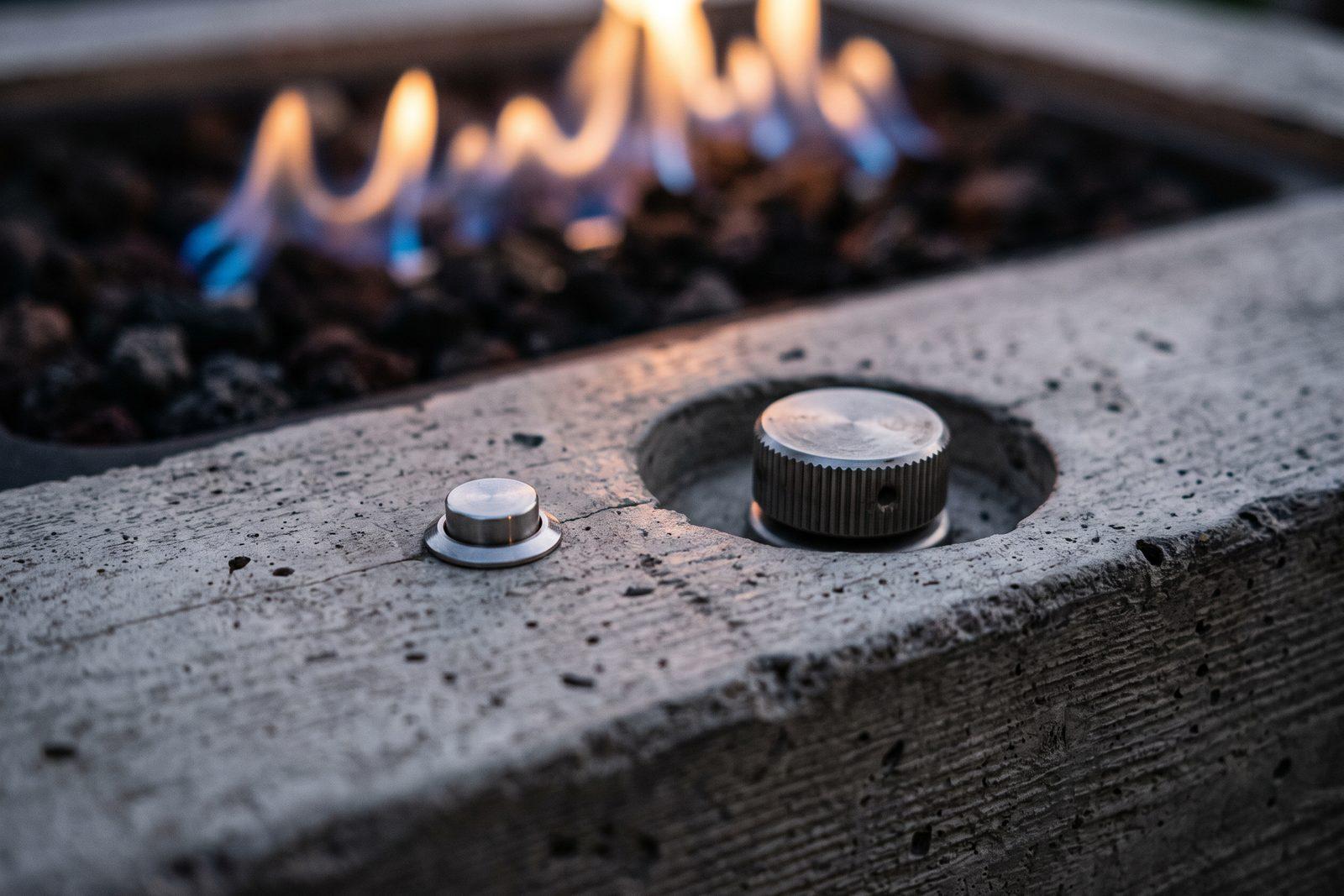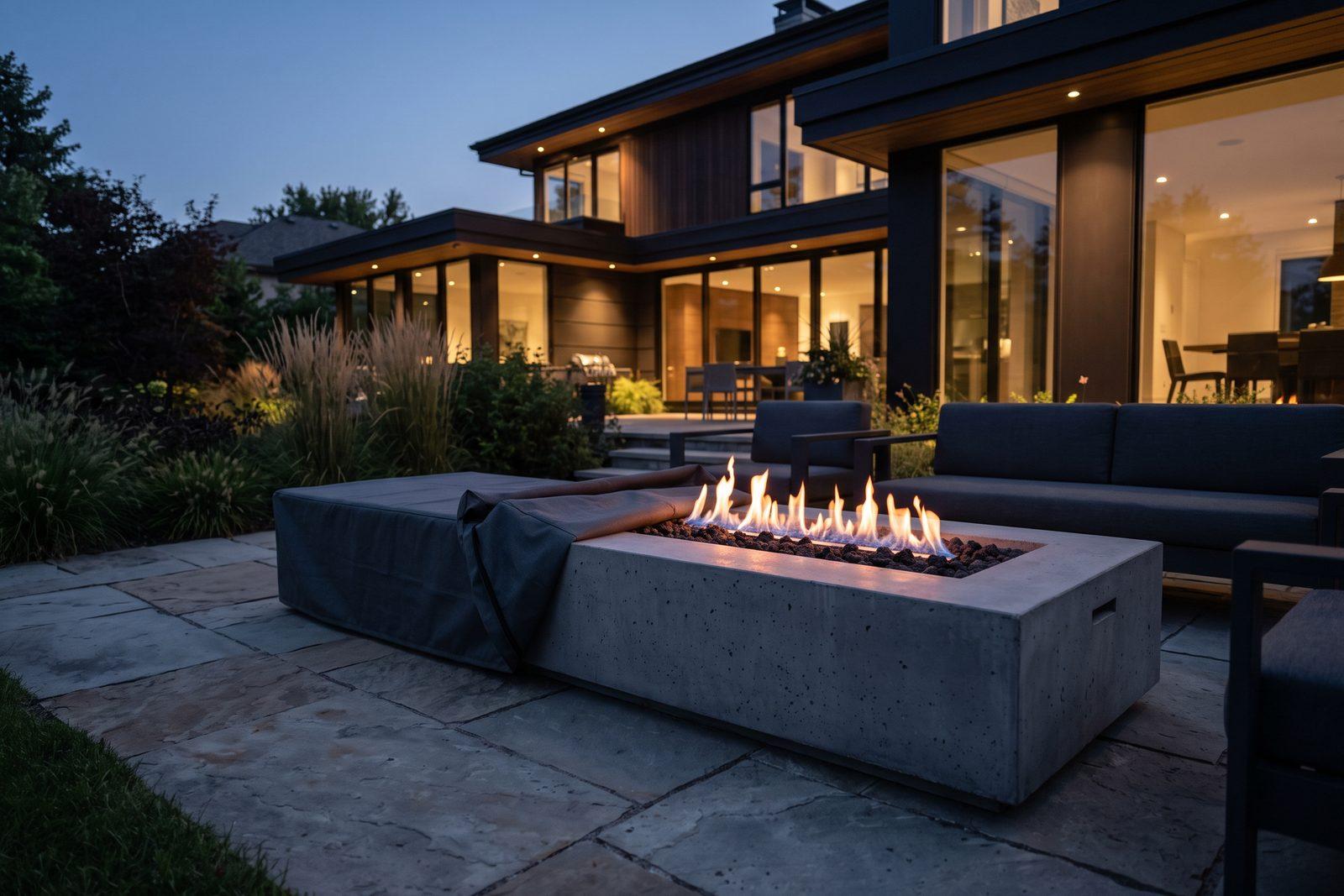

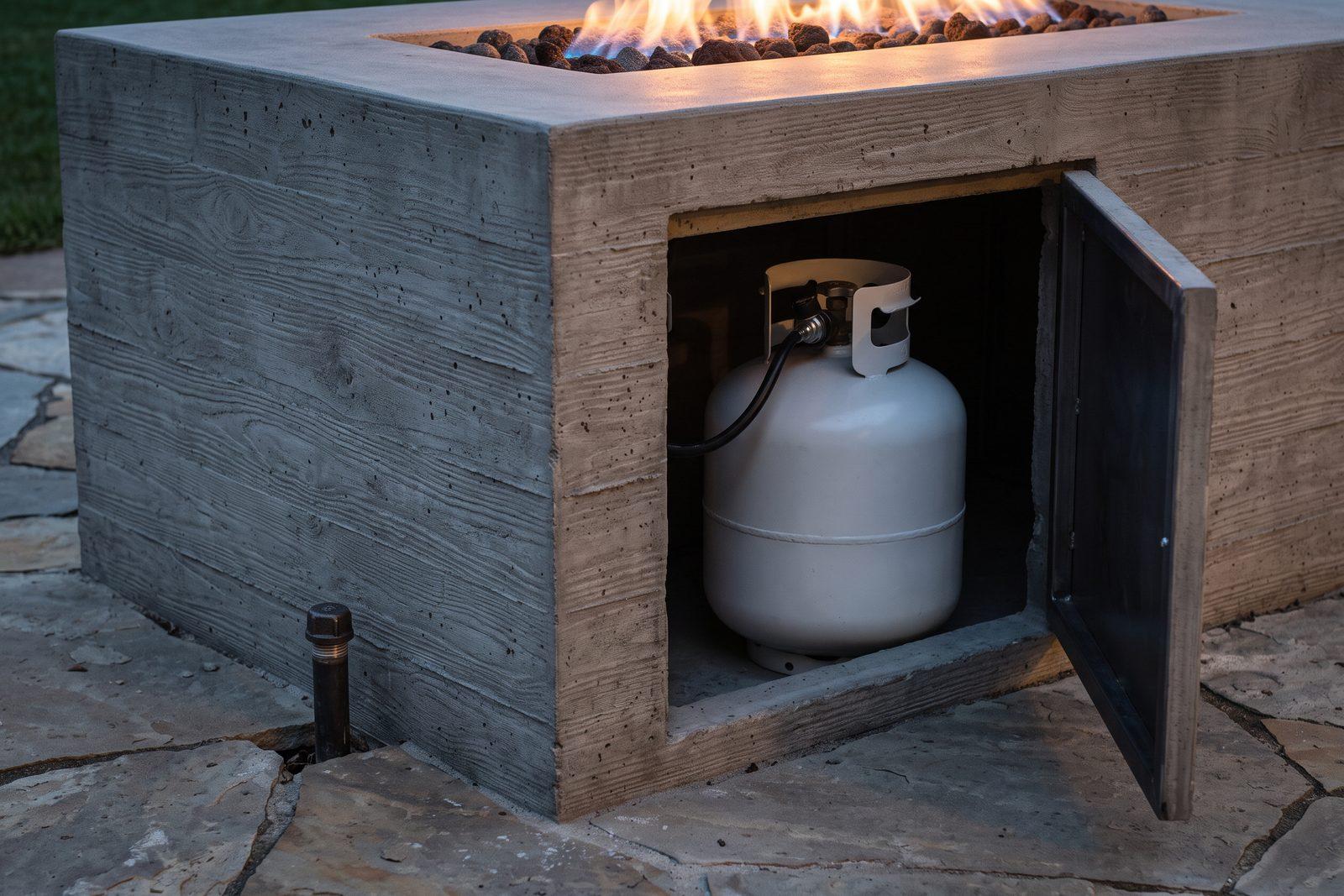
If natural gas already reaches your house and the fire feature will stay where you build it, natural gas is usually the better fuel. It doesn't run out partway through an evening, and nobody has to swap a cylinder. Propane is the right call when there's no gas service, when the piece has to move, or when the burner is small enough that one cylinder lasts the evening.
Both fuels make the same heat once they burn. The differences are how much gas the burner has to move, how big the pipe has to be, how long a tank lasts and who does the work. Every figure below comes from the fuel gas code, the propane industry's technical guide or a manufacturer's manual, each dated in the sources.
Heat per Cubic Foot and per Gallon
| Measure | Natural gas | Propane |
|---|---|---|
| Heat in one cubic foot of gas | 1,036 Btu (EIA). The fuel gas code's sizing example uses 1,000 | 2,488 Btu (PERC) |
| Heat in one gallon of liquid | Not sold by the gallon | 91,500 Btu (PERC). EIA lists 91,452 |
| Specific gravity, where air is 1.0 | 0.60, lighter than air | 1.50, heavier than air |
Sources: U.S. Energy Information Administration (EIA); International Fuel Gas Code (IFGC) 2027; Propane Education & Research Council (PERC), Propane Technical Pocket Guide.
A burner's rating is heat per hour, so a 65,000 Btu/h burner puts out the same heat on either fuel. Propane carries about 2.4 times the energy in each cubic foot, so on natural gas the burner has to move about 2.4 times the volume of gas. Most of the differences in this guide come from that ratio. Natural gas burners use larger orifices: Firegear's Pro H-burners take a #68 injector (0.031 inch) on natural gas and a #72 (0.025 inch) on propane. Natural gas lines also have to be bigger for the same load.
Ratings can differ by fuel, so read the one for the fuel you'll use. Prism Hardscapes lists its Moderno bowls at 65,000 Btu/h on either fuel. Firegear rates its 60-inch Pro H-burner at 180,000 Btu/h on natural gas and 200,000 on propane.
Pay attention to the specific gravity row. HPC's fire pit insert manual warns that "LP-gas is heavier than air and may settle in low places while dissipating." The venting rules below exist for that reason.
Natural Gas Needs the Bigger Pipe
| Schedule 40 steel, 50 ft run | Natural gas | Propane |
|---|---|---|
| 1/2 inch pipe | 72,000 Btu/h | 122,000 Btu/h |
| 3/4 inch pipe | 151,000 Btu/h | 255,000 Btu/h |
Source: IFGC 2027, Tables 402.4(2) and 402.4(25) (402.4(2) and 402.4(28) in the 2024 edition). Natural gas at 1,000 Btu per cubic foot, propane at 11 inches water column after the regulator, both at a 0.5 inch water column pressure drop.
A 65,000 Btu/h bowl at the end of a 50-foot natural gas run fits on half-inch pipe. Nearly double the load to 120,000 and the same run needs three-quarter inch.
Check these before you settle on a pipe size.
- Size for everything on the line. The code sizes a run for the total input of every appliance it feeds (IFGC 402.2). Tee a fire pit off the line that feeds your grill and you size for both.
- The manual can be stricter than the code table. Firegear's reference chart in its Pro H manual allows 46,000 Btu/h of natural gas on half-inch pipe at 50 feet, against 72,000 in the code table. Your installer will look at both.
- Altitude. Above 2,000 feet the code requires the gas flow to be adjusted (IFGC 402.2).
Supply pressure differs by fuel too. HPC and The Outdoor Plus both list a supply pressure of 3.5 to 7.0 inches water column for natural gas and 8.0 to 11.0 for propane on their match-lit inserts.
The gas line sizing calculator runs the code's sizing equation for your load and length and shows the next size up.
How Long a Propane Tank Lasts
A cylinder is named by the propane it holds, so a 20 lb cylinder holds 4.7 gallons. A gallon holds 91,500 Btu. Divide by the burner's rating and you have hours. Larger ASME tanks are filled to 80% of their water capacity, so a 500-gallon tank holds 400 gallons when full.
Container (propane in a full fill), 50,000 Btu/h, 65,000 Btu/h, 200,000 Btu/h
20 lb cylinder (4.7 gal)
- 50,000 Btu/h
- 8.6 h
- 65,000 Btu/h
- 6.6 h
- 200,000 Btu/h
- 2.2 h
30 lb cylinder (7.1 gal)
- 50,000 Btu/h
- 13.0 h
- 65,000 Btu/h
- 10.0 h
- 200,000 Btu/h
- 3.2 h
100 lb cylinder (23.8 gal)
- 50,000 Btu/h
- 43.6 h
- 65,000 Btu/h
- 33.5 h
- 200,000 Btu/h
- 10.9 h
500 gal ASME tank (400 gal)
- 50,000 Btu/h
- 732.0 h
- 65,000 Btu/h
- 563.1 h
- 200,000 Btu/h
- 183.0 h
The burners in the table are real products: Real Flame's Forest Ridge fire table (50,000 Btu/h, built for a 20 lb tank), Prism Hardscapes' Moderno bowls (65,000) and Firegear's 60-inch Pro H-burner on propane (200,000). Cylinder capacities are Manchester Tank's, and the 80% fill is PERC's. Hours assume full flame until the tank is empty.
On a typical 50,000 to 65,000 Btu/h table, a 20 lb cylinder covers one long evening or two short ones. Under a 200,000 Btu/h burner it lasts about two hours. On a cold night it can fall short before it's empty, because a tank turns liquid into gas more slowly as the air gets colder and the tank gets emptier (PERC). HPC limits small-tank use to select models of its match-lit and push-button inserts.
The propane tank runtime calculator runs this for your burner and your season.
Converting From One Fuel to the Other
Many fire features can be converted from one fuel to the other. It takes a change of parts, and these three manufacturers handle it three ways.
- The Outdoor Plus sells a kit in each direction. Natural gas to propane: an LP air-mixing orifice, a coupling, and a propane regulator with hose. Propane to natural gas: a natural gas orifice, a coupling and a half-inch whistle-free hose. Its match-lit insert manual advises against converting often, and says owners moving off propane need a proper natural gas line, preferably installed by a licensed contractor.
- HPC Fire Inspired fits its MLFPK match-lit inserts with an orifice set to one fuel or the other. A collar closes its venturi holes for natural gas or opens them for propane, and the orifice insert turns to match. The manual calls for the orifice and fittings to be leak-checked every year by an NFI certified technician.
- Firegear sells its Pro H-burners as separate natural gas and propane models, with the different injector sizes above.
On propane, these open burners draw in air through an air mixer or open venturi holes. The Outdoor Plus warns that more than half an inch of media over the burner can create back pressure that pushes propane out of the air mixer to pool under the fire pit.
Buy the unit configured for the fuel you'll use. If you do convert, do it once, with the manufacturer's own kit, and have a qualified installer make the change and leak-test it.
Vent Every Built Enclosure
All three manuals require vents in a built enclosure so heat and any leaked gas can escape. The Outdoor Plus and HPC both call for at least two vents of 18 square inches each, on at least two sides. Firegear calls for at least 18 square inches of cross ventilation per side. The Outdoor Plus and Firegear both rule out filling the cavity with gravel or rock. The rules apply on both fuels, and they matter most on propane because it settles.
If the cylinder sits in its own enclosure, HPC wants that enclosure at least 54 inches from the fire pit, with vent openings at the top and bottom sized to the cylinder: 20 and 10 square inches for a 20 lb cylinder.
Fuel Cost per Therm, From Your Own Bills
Fuel prices change with the season and differ by utility and supplier, so I'm not printing one. Compare your own bills instead. EIA defines a therm as 100,000 Btu, and a gallon of propane holds 91,500 Btu, so a gallon is about 0.915 therm.
- Divide your propane price per gallon by 0.915. That's your propane price per therm.
- Put it next to the per-therm rate on your gas bill. If your utility bills per hundred cubic feet (ccf), one ccf is about 1.04 therms at EIA's average heating value.
- For cost per hour of fire, divide the burner's Btu/h by 100,000 to get therms per hour. A 65,000 Btu/h burner uses 0.65 therm an hour, or about 0.71 gallon of propane.
Use the price you'll actually pay, whether that's a cylinder exchange, a refill or a tank delivery.
When to Call a Licensed Gas Fitter
- Any new or extended gas line, natural gas or a plumbed propane system, including a tee off an existing line. The code requires piping to be tested gastight before it's put in service or covered (IFGC 404.20), and underground piping to sit at least 12 inches below grade, or 8 inches for an individual line to an outdoor appliance where your building official approves it (IFGC 404.12 and 404.12.1). Permits are local.
- Converting between fuels. Orifices, air mixers and regulators are gas components. HPC requires service by a qualified installer, service agency or gas supplier, and I'd hold every brand to that.
- Setting a propane tank larger than a cylinder, with its regulators and line. That starts with your propane supplier.
Firegear says gas installation should be done by a qualified installer, service agency or gas supplier. HPC recommends, and The Outdoor Plus suggests, installers licensed for gas piping by the local authority. What you can usually do yourself is connect a cylinder to a self-contained unit following its manual and check the connection with soapy water, as HPC's manual describes. Your state and city decide who may legally do gas work, so ask your building department before anyone digs.
Which Fuel Fits Your Project
Natural gas makes sense when gas service is already at the house, the fire feature is permanent, you'll use it often, or the burner is large. You pay once for the line and stop thinking about refills.
Propane makes sense when there's no gas service, the piece is portable or self-contained, or you light it a few times a season at a moderate output. It also makes sense when the run from the meter is long enough that the trench would be the biggest job in the project.
If gas is at the house and the feature is staying put, run the line. I'd talk you out of a cylinder under a big burner, because at 200,000 Btu/h a 20 lb cylinder gives you about two hours. For a large burner with no gas service, put in a proper tank with your propane supplier. Whichever fuel you choose, buy the unit built for it.
Sources
- U.S. Energy Information Administration, Energy Explained, Units and calculators: 1 cubic foot of natural gas = 1,036 Btu; 1 therm = 100,000 Btu; 1 gallon of propane = 91,452 BtuChecked
- International Code Council, 2027 International Fuel Gas Code, Chapter 4: Section 402.2 (total connected load; altitude above 2,000 ft), Table 402.4(2) (Schedule 40 metallic pipe, natural gas, specific gravity 0.60), Table 402.4(25) (Schedule 40 metallic pipe, undiluted propane, 11.0 in. w.c., specific gravity 1.50), Sections 404.12 and 404.12.1 (burial depth) and 404.20 (testing). The same tables are 402.4(2) and 402.4(28) in the 2024 editionChecked
- International Code Council, 2027 International Fuel Gas Code, Appendix A, Section A106.1, Example 1 (natural gas heating value of 1,000 Btu per cubic foot)Checked
- Propane Education & Research Council, The Propane Technical Pocket Guide, 4482-BR-21 v3: Table 1A (2,488 Btu per cubic foot), Table 1C (91,500 Btu per gallon), Vaporization Rates (printed p. 9)Checked
- Propane Education & Research Council, Storing Propane Fuel, Lesson 9, Objective 3 (fill to 80 percent of capacity)Checked
- Manchester Tank & Equipment Co., Portable DOT Steel LP Gas Cylinders 5 lb to 100 lb, Catalog 49500 (09/2022), LPG capacity rowChecked
- Manchester Tank & Equipment Co., Aboveground Propane Tanks spec sheet, Rev. 4/11/2025 (500 gallon water capacity)Checked
- Real Flame, Forest Ridge Fire Table manual, model C1600LP, Specifications (20 lb LP tank; 50,000 BTU/hr)Checked
- Prism Hardscapes, Moderno Series Installation Guide, Section 3.1 (gas input 65,000 BTU/hr, natural gas and propane)Checked
- Firegear, Outdoor Fire Pit Pro H-Burners & Kits, Installation and Operating Instructions, REV. D: input ratings, Table 2 (injector sizes), Table 3 (gas pressures), Table 4 (gas pipe sizing chart), ventilation and installer requirementsChecked
- The Outdoor Plus, Match Lit Fire Pit Insert Manual (2024): installation, supply pressure, enclosure venting, liquid propane media warnings, gas conversionChecked
- The Outdoor Plus, Gas Conversion Kit product page (natural gas to liquid propane, and liquid propane to natural gas)Checked
- HPC Fire Inspired (Hearth Products Controls Co.), MLFPK Series Match Lit Fire Pit Insert, Installation & Operation Instructions, 870-MLFPK: safety information, supply pressure, enclosure venting, remote LP tank enclosure, UGO orifice gas style settingChecked
About the Author
James Darren Writes the Firepit HQ guides on fire features, fuel and fire codes. Every figure in them is cited to its source with the date it was checked.