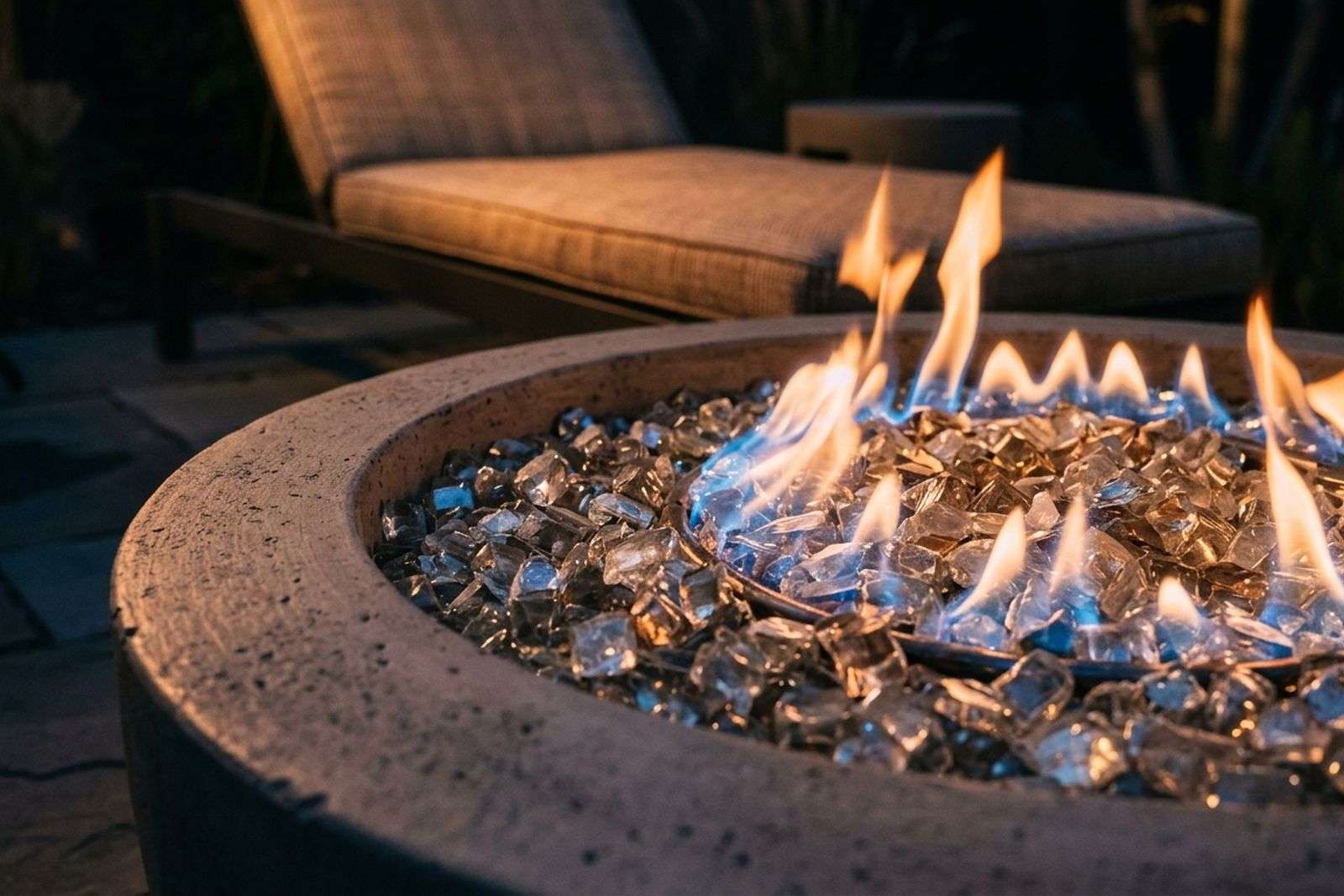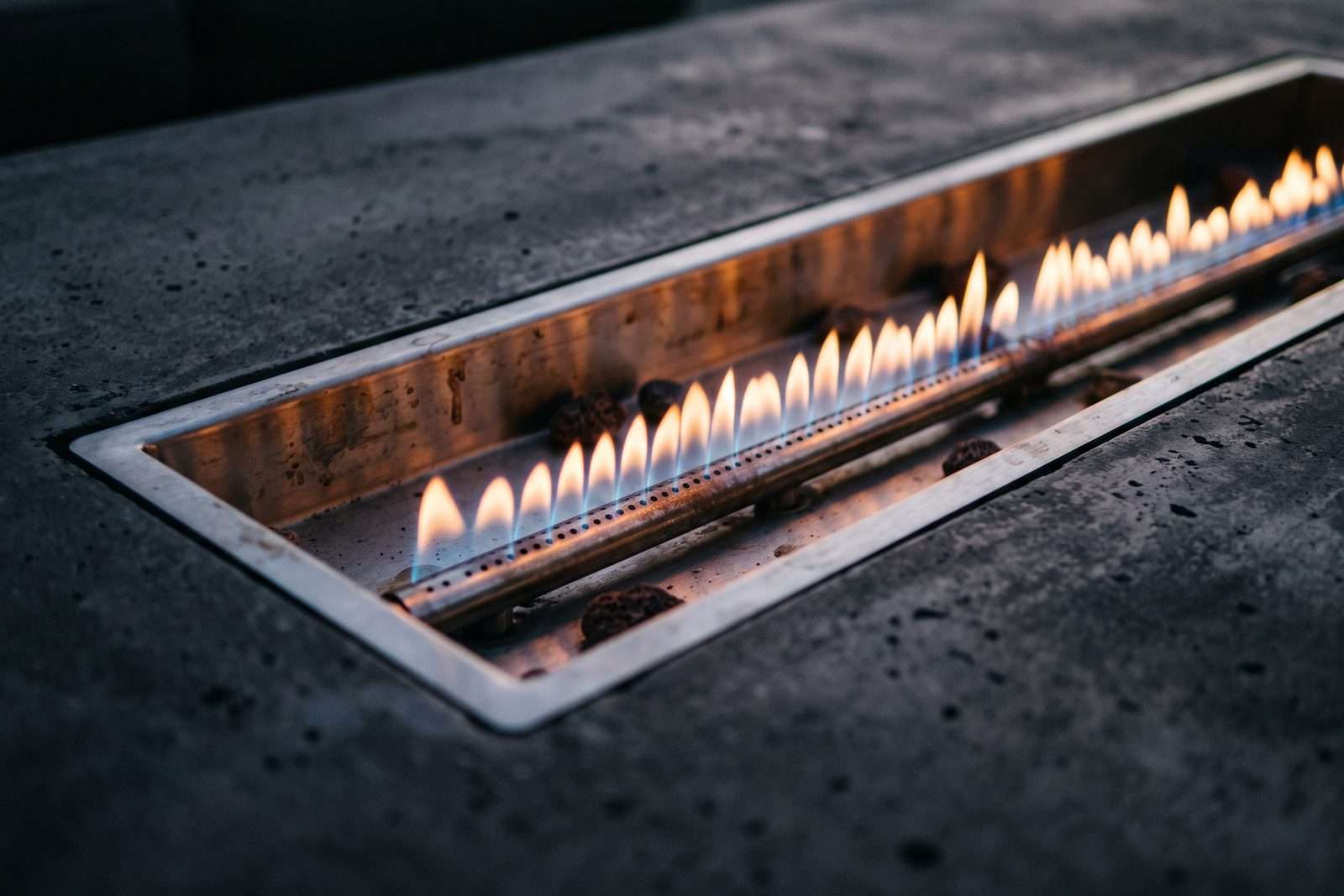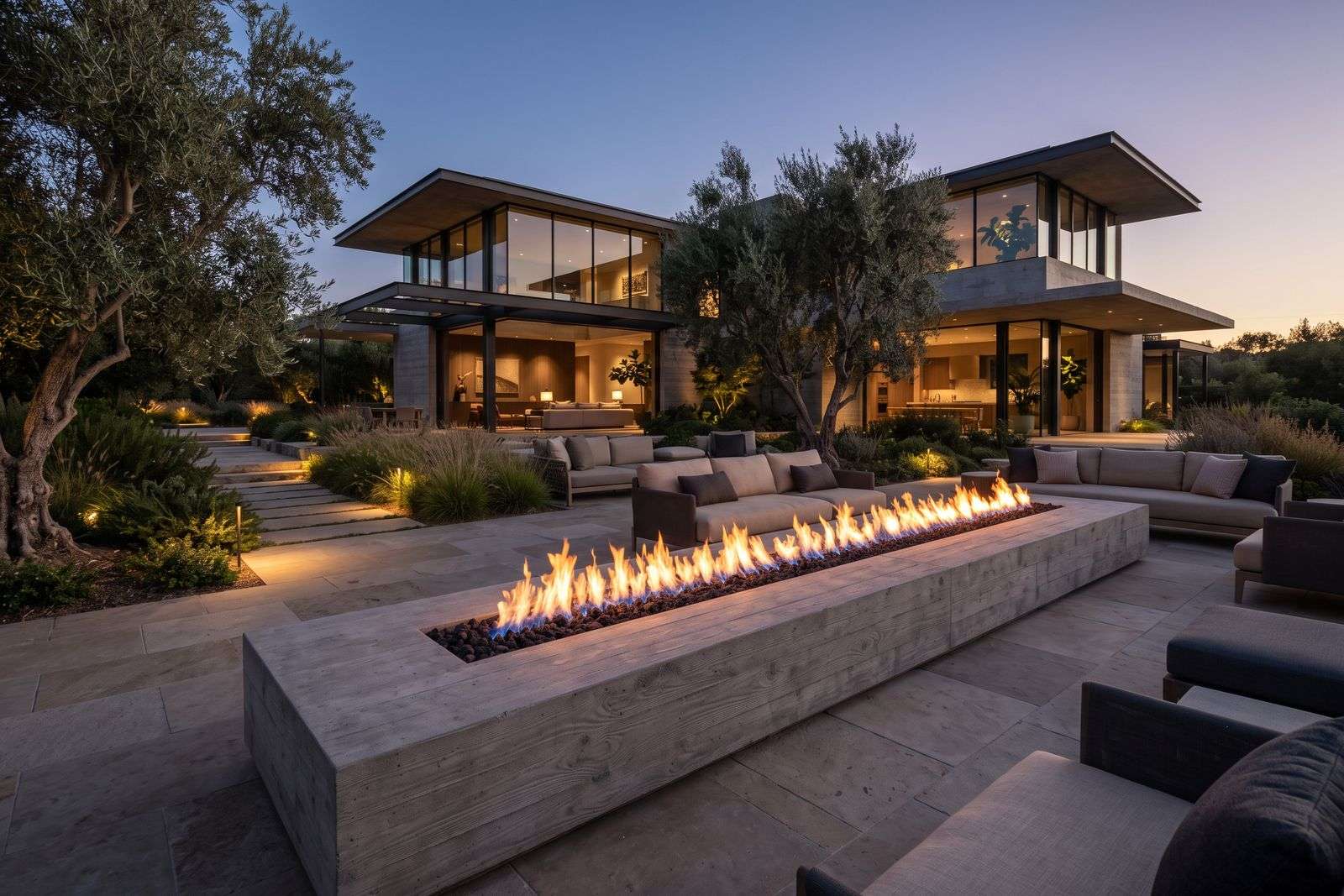

A natural gas fire pit needs a gas line from your meter, run and tested by a licensed gas fitter, with a shutoff valve at the unit and a code-approved connection to the burner. The line is sized for the burner's rated input plus every other appliance on it. Where your city or county requires a permit, the gas work needs it, and the model code has the inspector see buried pipe before the trench is backfilled.
This guide covers what that work involves, from the 2024 International Fuel Gas Code (IFGC) and the installation manuals of four makers. The ICC has since published a 2027 edition. Every fuel gas code section cited here sets the same requirement under the same number in it, except the underground inspection rule, which moves from 111.2 to 109.2. What governs your job is the edition your jurisdiction adopted, with its local amendments. This guide names no pipe size, because pipe size comes from your load, your run length and that adopted code. The gas line sizing calculator shows the method. Firepit HQ has not tested any of these products.
What Does a Natural Gas Fire Pit Installation Involve?
The order matters, because several steps are hard to redo once the pit is built around them.
- Confirm the supply. Ask your gas utility what flow and pressure reach your property and who connects what.
- Size the line. A licensed gas fitter adds up the load and sizes the pipe for the run.
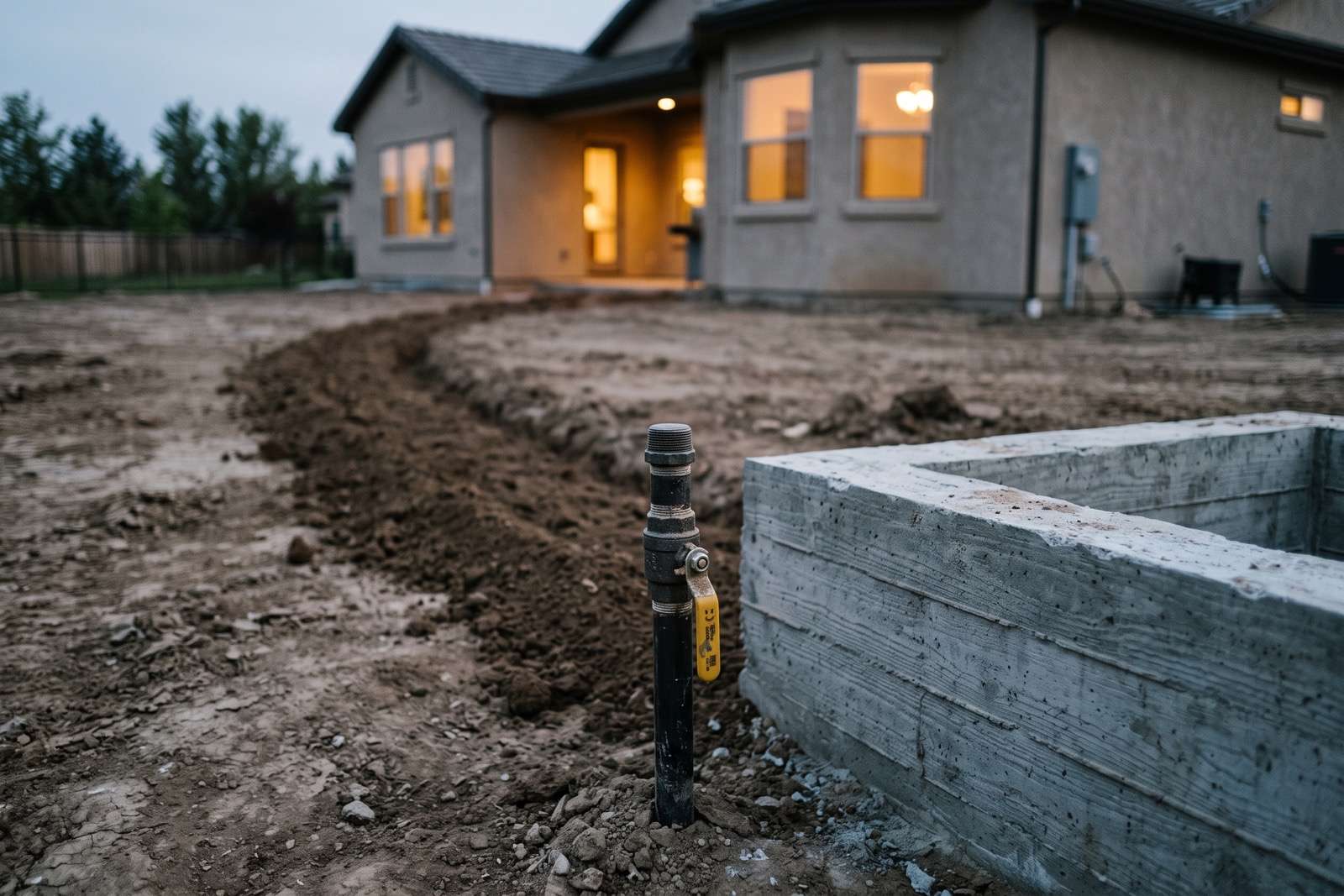
- Locate and dig. Utility lines are marked before the trench opens, and the line goes in at the depth your adopted code requires.
- Run the pipe and stub it out. The pipe ends in a shutoff valve where the pit will stand.
- Test the piping. The code requires a gastight test before the system is put in service or concealed (IFGC 404.20).
- Inspect. Where a permit applies, the model code calls for an underground inspection once the trench is dug and bedded and the pipe is in, before backfill (IFGC 111.2).
- Connect the burner and build the enclosure. The enclosure needs vents, which the burner kit guide covers.
Prism Hardscapes' installation guide follows the same order. It has a gas professional run the line underground before the fire feature is positioned, test it, then cover the pipe and level the ground.
Who Owns the Gas Line Past the Meter?
Your utility's own rules decide, so ask it where its responsibility ends. UGI Utilities, a gas utility, tells its customers that "each customer is responsible for the maintenance of all customer-owned piping beyond the meter." It adds that only qualified plumbing and heating contractors should inspect, maintain or repair that piping, and it says to call 8-1-1 at least three business days before excavating so underground pipes can be located and marked. That notice period is UGI's, so use the one your own utility gives you.
Prism's guide says to check with your gas supplier to verify the gas flows and pressures available at the installation. A fitter can size a pipe, but the utility is the one to ask what the meter and the service behind it can deliver.
How Is the Gas Line Sized?
The IFGC starts from demand. Piping must supply enough gas for maximum demand and deliver it to each appliance inlet at no less than the minimum pressure the appliance requires (402.1). The load for sizing is the sum of the maximum input of every appliance served, assuming all of them could run at full capacity at once (402.2). Above 2,000 feet of elevation the flow is adjusted. Pipe is then sized from the code's tables or equations, from a listed piping system's own tables, or by engineering methods (402.3).
The makers put the sizing on the installer. The Outdoor Plus and HPC each say fuel line sizing is the installer's responsibility and must supply the stated maximum Btu/h of the unit. HPC's troubleshooting table lists an undersized natural gas supply line as a cause and says the pipe, flex line and shutoff valve must be sized to deliver the fire pit's input pressure and Btu requirement. Firegear's sizing chart note recommends consulting a licensed plumber or gas fitter, and says that an existing line has to be judged on its own capacity.
Here are rated inputs on natural gas from two of the manuals, with the gas volume each implies. The U.S. Energy Information Administration puts one cubic foot of natural gas at 1,036 Btu, and the volume is that division.
| Burner | Rated input, natural gas | About cubic feet per hour |
|---|---|---|
| Prism Hardscapes Moderno, natural gas section of the manual | 65,000 Btu/h | 62.7 |
| Firegear Pro H-Burner, 24 in. | 80,000 Btu/h | 77.2 |
| Firegear Pro H-Burner, 60 in. | 180,000 Btu/h | 173.7 |
| Firegear Pro H-Burner, 80 in. | 250,000 Btu/h | 241.3 |
Sources: Prism Moderno manual Section 3.1.1; Firegear Pro H manual cover page and Table 2; EIA. Checked 2026-10-20. The volumes are arithmetic for context, and a fitter sizes from your code and your utility's supply.
The 30 in. Pro H-Burner is left out because Firegear's manual disagrees with itself: its cover lists 90,000 Btu on natural gas and its Table 2 lists 95,000. Read the data plate on the burner you buy, and ask Firegear which figure applies before the line is sized.
Loads add. Two Moderno units and a 60 in. Pro H-Burner on one run total 310,000 Btu/h, or about 299 cubic feet per hour, and the pipe has to carry that, not the largest burner alone. The same rule applies to a grill or a patio heater tied into the line, and the guide to what a natural gas patio heater needs covers the heater side. The natural gas versus propane guide has the code's pipe capacity tables for both fuels. The calculator takes a combined load and a run length and returns the smallest size that carries it, plus the next size up, and shows the formula and source it uses.
What Supply Pressure Do Natural Gas Fire Pits Need?
Pipe size is half the question. The other half is the pressure at the burner, and the makers do not agree.
Maker and product, Minimum inlet, Maximum inlet, Other
The Outdoor Plus, match-lit insert
- Minimum inlet
- 3.5 in. w.c.
- Maximum inlet
- 7.0 in. w.c.
- Other
HPC Fire Inspired, MLFPK inserts
- Minimum inlet
- 3.5 in. w.c.
- Maximum inlet
- 7.0 in. w.c.
- Other
Firegear, Pro H-Burners
- Minimum inlet
- 5.0 in. w.c.
- Maximum inlet
- 10.5 in. w.c.
- Other
- Normal inlet 7.0 in. w.c.
Prism Hardscapes, Moderno
- Minimum inlet
- Not stated
- Maximum inlet
- Not stated
- Other
- Gas pressure 7 in. w.c.
Sources: The Outdoor Plus manual p. 2; HPC 870-MLFPK Section 1; Firegear Pro H manual Table 3; Prism Moderno guide Section 3.1.1. Checked 2026-10-20.
A line that works for one maker's burner can sit below another's minimum. Read the pressure range in the manual for your exact model, and give it to the fitter and the utility. Firegear bases its Btu listings on 7.0 in. w.c. at the burner orifice and says flex line size and pipe sizing also affect output, so the input a burner actually gets can vary slightly from the table.
Where Does the Shutoff Valve Go?
The 2024 IFGC requires every appliance to have a shutoff valve, placed under one of three sections (409.5). The first puts it in the same room as the appliance, within 6 feet of it and upstream of the union, connector or quick disconnect it serves (409.5.1). The other two cover vented decorative appliances and room heaters (409.5.2) and valves at a manifold, within 50 feet (409.5.3). None of the three is written for an appliance in a yard. That is a reading of the code text, not a rule in it, and it leaves the outdoor arrangement to your inspector.
The makers are more specific, and they differ.
- The Outdoor Plus: every fire pit must have a gas shutoff on the outside of the exterior of the fire pit for emergency shutoff and maintenance. It also warns that consumer-grade valves from home-improvement stores may not pass enough gas, so the valve's Btu rating must match or exceed the unit's.
- HPC: the supply line must have a gas shutoff on the exterior of the enclosure. The valve is for emergency shutoff and maintenance and should not be used to adjust flame height.
- Firegear: its hard piping steps call for a manual shutoff valve at the exterior house wall. Its typical installation drawing also shows the gas shutoff, which Firegear does not supply, inside the enclosure where the supply pipe meets the flex line to the key valve. That primary shutoff needs a 1/2 in. male flared fitting for the stainless steel flex line.
- Prism Hardscapes: the stubbed-out end of the underground pipe is fitted with a 1/2 in. NPT ball valve shutoff rated for gas, then a flare fitting sized for the gas hose.
All four put a shutoff at the pit. The Outdoor Plus and HPC put it outside the enclosure, Firegear's drawing shows it inside, and Firegear adds a second valve at the house wall. Which arrangement your inspector accepts is local.
Connector, Hose or Hard Pipe to the Burner?
The IFGC lists the ways to connect an appliance in 411.1. They include rigid metallic pipe, corrugated stainless steel tubing installed to its maker's instructions, listed and labeled outdoor appliance connectors to ANSI Z21.75/CSA 6.27 installed to their maker's instructions, and listed quick-disconnect devices used with listed connectors. A connector may not exceed 6 feet overall, and only one is allowed per appliance, with an exception for rigid pipe that is sized as part of the piping system (411.1.3.1). Connectors are also required to be protected against physical damage (411.1.2).
Two manuals add detail.
- The Outdoor Plus: any flex line from the permanent supply to the unit must be rated to the unit's maximum Btu/h and certified to ANSI Z21.75/CSA 6.27. It says to use only whistle-free hoses, since yellow corrugated flex hoses will whistle, and to use as few elbows and connectors as possible if the unit is hard piped.
- HPC: avoid sharp bends with the flex line to prevent whistling, and apply joint compound to male pipe fittings only, never to flared fittings.
The burner's own listing matters too. The IFGC requires permanently fixed-in-place outdoor decorative appliances to be listed to ANSI Z21.97 and installed according to the manufacturer's instructions (635.1). That gives the manual's connection details the weight of the code.
How Deep Does a Gas Line to a Fire Pit Have to Be Buried?
The 2024 IFGC sets a minimum of 12 inches below grade for underground piping (404.12). It allows individual lines to outdoor lights, grills and other appliances to sit 8 inches below finished grade, provided the installation is approved and located where it is not susceptible to physical damage (404.12.1). Both numbers are the model code's, and your jurisdiction may have amended them.
A few other provisions shape the trench.
- Above-ground outdoor pipe has to stand at least 3 1/2 inches off the ground, be securely supported and be protected from physical damage (404.9).
- Steel pipe underground needs corrosion protection. Zinc coating is not accepted as adequate for underground gas piping (404.11.1).
- Plastic pipe may be installed only outdoors and underground, with narrow exceptions such as premanufactured risers that bring it above ground outside the building. A yellow insulated copper tracer wire of at least 18 AWG, or an approved equivalent, goes beside it, and metal-to-plastic transitions underground use specified transition fittings (404.17.1 to 404.17.3).
Pipe material is the fitter's call, made from your adopted code and your route.
Testing the Line Before Anything Is Connected
The IFGC says any piping system must be tested to ensure it is gastight before it is put in service or concealed (404.20). The test pressure is at least 1 1/2 times the proposed maximum working pressure, and never less than 3 psig (406.4.1). An appliance designed for operating pressures below the test pressure is disconnected and the outlet capped. Closing its shutoff valve is enough only when the appliance is designed for the test pressure or more (406.3.3 and 406.3.4). The test is the fitter's and the inspector's work.
The manuals point the same way. The Outdoor Plus and HPC say to unhook the fire pit from the gas supply for pressure leak tests. Firegear says its appliance must be isolated by closing its manual shutoff valve during tests at or below 1/2 psi, and it describes no valve isolation above that. The code's 3 psig minimum is six times that 1/2 psi, so a test at the code minimum falls outside the one isolation method Firegear describes, and under 406.3.3 the burner comes off the line unless it is designed for the test pressure. That is a reading of the stated figures, not a sentence in any one document, so confirm it with your fitter.
Manuals add their own checks. Prism's manual calls for testing the gas lines for leaks and loss of pressure over a 24-hour period before the pipe is covered. The Outdoor Plus and HPC both call for leak tests at every connection with a detector or leak reactant, repeated once the unit is lit and again with the media in place.
Do You Need a Permit to Run a Gas Line to a Fire Pit?
The model fuel gas code says an owner or contractor who wants to install, alter or repair an installation it regulates must apply to the code official and obtain the required permit (2024 IFGC 105.1). It exempts portable heating appliances (105.2). A natural gas line to a fixed fire feature is not a portable appliance, but the code does not say how a given jurisdiction classifies a fire pit, so the local office decides.
State and city rules then decide who may do the work. Texas shows how much they vary.
- Texas law: the Texas Occupations Code defines plumbing to include piping used to supply gas (1301.002). A Texas city of more than 5,000 inhabitants must regulate such piping by ordinance, and a city that does must require a permit before a person performs plumbing (1301.551). The only exceptions are leak repairs and replacing faucets, ballcocks, water control valves, garbage disposals or water closets. In Texas, a property owner need not hold a state plumbing license to do plumbing in the owner's homestead (1301.051).
- Corpus Christi, Texas: the city's homeowner permit rule says a permit shall not be issued to a property owner for natural gas service systems unless the owner is a State of Texas licensed master plumber. Its form is revised 10/2025.
- Dallas, Texas: a homeowner plumbing permit requires a homestead exemption on file and that the owner own and occupy the property. A homeowner who pulls one must meet the same plumbing code requirements as a contractor.
These rules are Texas only. Ask your building department what permit the gas line needs, who may pull it and whether an inspection is required before backfill. The Texas code page has the permit rules and city examples, and the state code library covers other states. Editions and codes differ by state, so the section numbers here are the model code's.
The permit for the gas line is separate from fire-code questions about where the pit stands. The guide on how far a gas fire pit must be from the house covers clearances and burn rules.
Who Does What
- Licensed gas fitter or plumber: sizing, pipe, shutoff valve, connector, tests and the permit. The makers word the requirement differently. Prism requires a contractor or qualified installer licensed or certified where the product sits. The Outdoor Plus suggests professionals locally licensed in gas piping. HPC recommends the same. Firegear says a qualified installer, service agency or gas supplier. Hold every unit to the strictest of those.
- Gas utility: what the meter and service can deliver in flow and pressure, which Prism's manual says to verify with your gas supplier.
- Builder or mason: the enclosure, with the vents the manual calls for. The Outdoor Plus calls for a metal outlet box inside the enclosure for electronic ignition models, which may bring in a licensed electrician.
- You: the unit built for natural gas, the manual on file and a qualified annual inspection. The Outdoor Plus and Firegear both ask for inspection at least yearly by a qualified service person, and HPC says annual servicing should be handled by NFI-certified professionals.
What to Have Ready Before You Call a Gas Fitter
- The burner's rated input in Btu/h, from the data plate or the manual, for natural gas.
- The inlet pressure range the manual prints for your exact model.
- Every other appliance that will share the line, with its rated input.
- The route: from the meter or the existing branch to the pit, with the length along the pipe and not in a straight line.
- Your elevation, since the code adjusts the flow above 2,000 feet.
- The adopted code and permit rules from your building department.
- Where the shutoff will go and how the enclosure will vent.
The gas fire pit buying guide puts the fuel decision in order with size, burner and ignition.
Common Questions
What size gas line do you need for a natural gas fire pit?
It depends on the burner's rated input, the length of the run, every other appliance on the line and your altitude. The 2024 International Fuel Gas Code sizes piping for the total connected load, assuming everything runs at once. Enter your load and run length in the gas line sizing tool to see the method, then have a licensed gas fitter size the pipe against your adopted code.
Do you need a permit to run a gas line to a fire pit?
The gas work is regulated locally. The model fuel gas code requires a permit to install work it regulates and exempts portable heating appliances, but your city or county decides. Texas, for example, requires cities of more than 5,000 people to regulate gas piping and require a permit before plumbing work. Ask your building department before anyone digs.
Can you run a gas line to a fire pit yourself?
That depends on where you live, and the makers say a licensed or qualified installer should do it. In Texas, for example, state law lets a property owner do plumbing in their own homestead without a state license, yet Corpus Christi will not issue a homeowner permit for natural gas service systems unless the owner is a State of Texas licensed master plumber. Ask your building department, and plan on a licensed gas fitter.
How deep does a gas line to a fire pit have to be buried?
The 2024 International Fuel Gas Code sets 12 inches below grade for underground piping. An individual line to an outdoor appliance can go 8 inches below finished grade where the installation is approved and sits where physical damage is unlikely. Your adopted code and building official have the final say, so confirm the depth with your gas fitter before the trench is dug.
Does a natural gas fire pit need a shutoff valve?
Yes. The 2024 International Fuel Gas Code requires a shutoff valve for each appliance, and all four makers covered here show a manual shutoff at the pit. The Outdoor Plus and HPC want it on the outside of the enclosure for emergency shutoff and maintenance. Firegear's drawing shows one inside the enclosure, and its steps add a manual valve at the exterior house wall. Follow your manual, and ask your inspector where the valve must sit.
Sources
- International Code Council, 2024 International Fuel Gas Code (Version 2.0), Chapter 4 Gas Piping Installations: Sections 401.1 (scope), 402.1 to 402.3 (sizing and maximum gas demand), 404.9 (above-ground outdoor piping), 404.11 (corrosion), 404.12 and 404.12.1 (burial depth), 404.17.1 to 404.17.3 (plastic pipe and tracer), 404.20 (testing), 406.3.3 and 406.3.4 (appliance disconnection and valve isolation during testing), 406.4.1 (test pressure), 409.5 to 409.5.3 (appliance shutoff valve), 411.1 (connecting appliances), 411.1.2 (protection against damage) and 411.1.3.1 (connector length)Checked
- International Code Council, 2024 International Fuel Gas Code (Version 2.0), Chapter 1 Scope and Administration: Sections 105.1 (permits where required), 105.2 (permits not required: portable heating appliances) and 111.2 item 1 (underground inspection before backfill)Checked
- International Code Council, 2024 International Fuel Gas Code (Version 2.0), Chapter 6 Specific Appliances, Section 635.1 (outdoor decorative appliances: ANSI Z21.97 listing, installation per manufacturer's instructions)Checked
- International Code Council, 2027 International Fuel Gas Code (Version 1.0), Chapter 4 Gas Piping Installations: the same section numbers and requirements as the 2024 sections cited here (401.1, 402.1 to 402.3, 404.9, 404.11 and 404.11.1, 404.12, 404.12.1, 404.17.1 to 404.17.3, 404.20, 406.3.3, 406.3.4, 406.4.1, 409.5 to 409.5.3, 411.1 items 1, 2, 5 and 7, 411.1.2, 411.1.3.1)Checked
- International Code Council, 2027 International Fuel Gas Code (Version 1.0), Chapter 1 Scope and Administration: Sections 105.1 and 105.2 unchanged in number; underground inspection before backfill at 109.2 item 1Checked
- International Code Council, 2027 International Fuel Gas Code (Version 1.0), Chapter 6 Specific Appliances, Section 635.1 (outdoor open-flame decorative appliances: ANSI Z21.97/CSA 2.41 listing, installation per manufacturer's instructions)Checked
- The Outdoor Plus, Match Lit Fire Pit Insert Manual (2024): installation by locally licensed gas piping professionals (pp. 1 to 2), natural gas supply pressure (p. 2), gas shutoff on the exterior and metal outlet box for electronic ignition models (p. 3), installer responsibility for fuel line sizing, flex line certification, disconnect for pressure leak tests, leak test sequence, whistle-free hoses and keyed shutoff valve rating (p. 4), annual inspection by a qualified service person (p. 6)Checked
- HPC Fire Inspired (Hearth Products Controls Co.), MLFPK Series Match Lit Fire Pit Insert, Installation & Operation Instructions, 870-MLFPK: Section 1 Important Safety Information (installer recommendation, annual servicing by NFI-certified professionals, natural gas supply pressure; PDF pp. 5 and 7), Section 5 Fuel line (shutoff and sizing; PDF p. 13), Section 7 Installing the Fire Pit (unhook for pressure leak tests, joint compound, flex line bends, leak test sequence; PDF p. 19), troubleshooting (undersized natural gas supply line; PDF p. 25)Checked
- Firegear Outdoors, Outdoor Fire Pit Pro H-Burners & Kits, Installation and Operating Instructions, REV. D: input ratings (cover page) and Table 2 Btu specifications (p. 4; the 30 in. natural gas burner reads 90,000 on the cover and 95K in Table 2), Table 3 gas pressures (p. 4), hard piping, shutoff valve at the house wall, installer and isolation during pressure testing (p. 5), pipe sizing chart note (p. 6), Fig. 12 typical installation with the gas shut-off at the enclosure (p. 10), annual inspection (p. 11)Checked
- Prism Hardscapes, Moderno Series Installation, Operation, & Maintenance Manual, Section 3.1 Gas Requirements and 3.1.1 Natural Gas (7 in. w.c., 65,000 Btu/h, underground line, 1/2 in. NPT ball valve shutoff, 24-hour leak and pressure loss test, check with gas supplier), PDF p. 10; installer licensing statement, PDF p. 8Checked
- U.S. Energy Information Administration, Energy Explained, Units and calculators: 1 cubic foot of natural gas = 1,036 BtuChecked
- UGI Utilities, Underground Pipe Safety: What About Gas Lines Beyond the Meter? (May 23, 2024): customer responsibility for piping beyond the meter, qualified contractors, 8-1-1Checked
- Texas Occupations Code, Chapter 1301: Section 1301.002(7) (definition of plumbing, including piping that supplies gas), Section 1301.051 (plumbing by property owner in homestead) and Section 1301.551(a) and (c) (municipal plumbing ordinances and permits)Checked
- City of Corpus Christi, Texas, Homeowner's Work Affidavit, Form DSD-1001 (Rev. 10/2025), quoting City Code Sec. 14-291 and IRC amendment R105.10.1 (homeowner permit; natural gas service systems; State of Texas licensed master plumber)Checked
- City of Dallas, Building Inspection, Plumbing and Mechanical Gas Test Guide: qualifying conditions for a homeowner plumbing permit and gas piping testChecked
About the Author
James Darren Writes the Firepit HQ guides on fire features, fuel and fire codes. Every figure in them is cited to its source with the date it was checked.