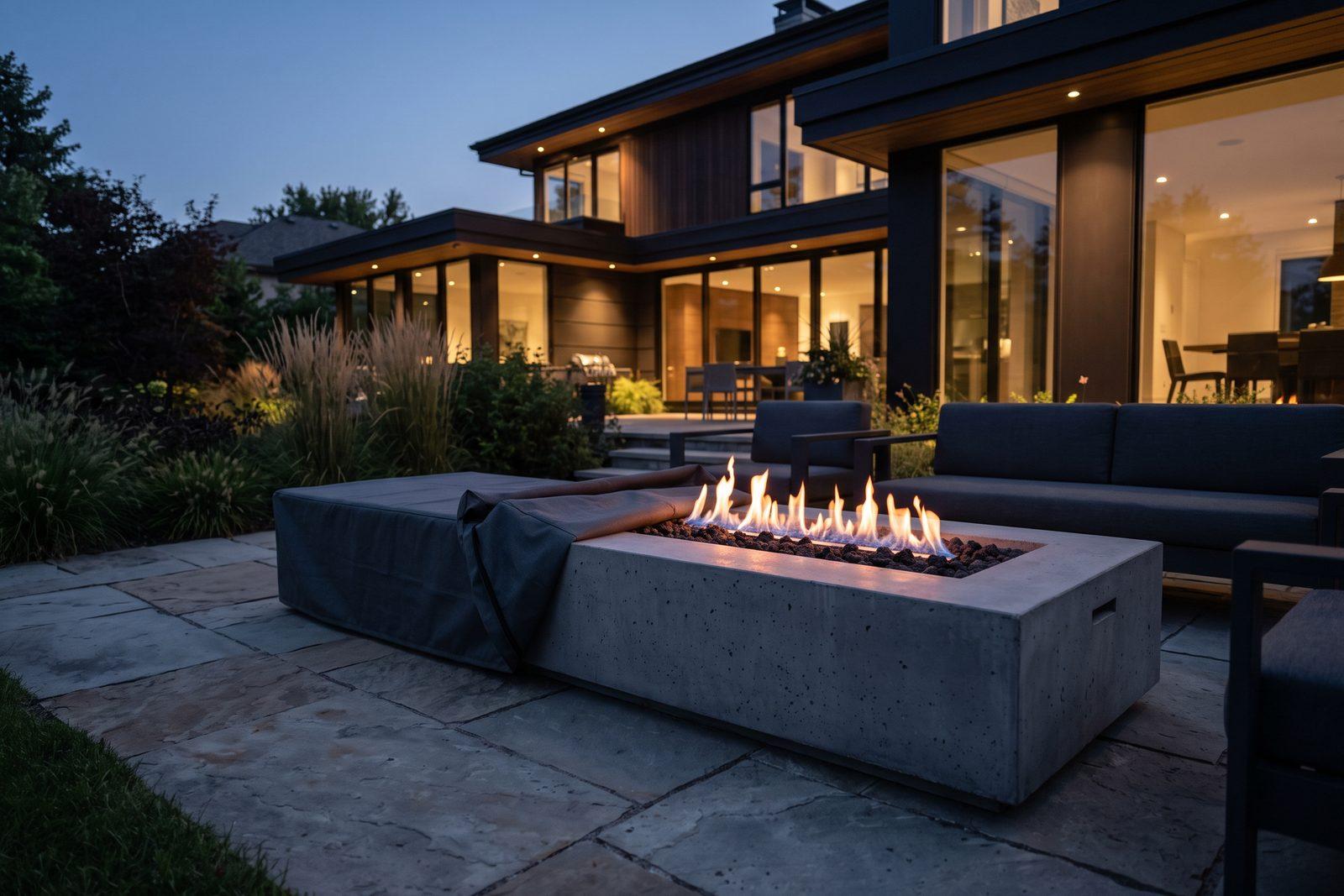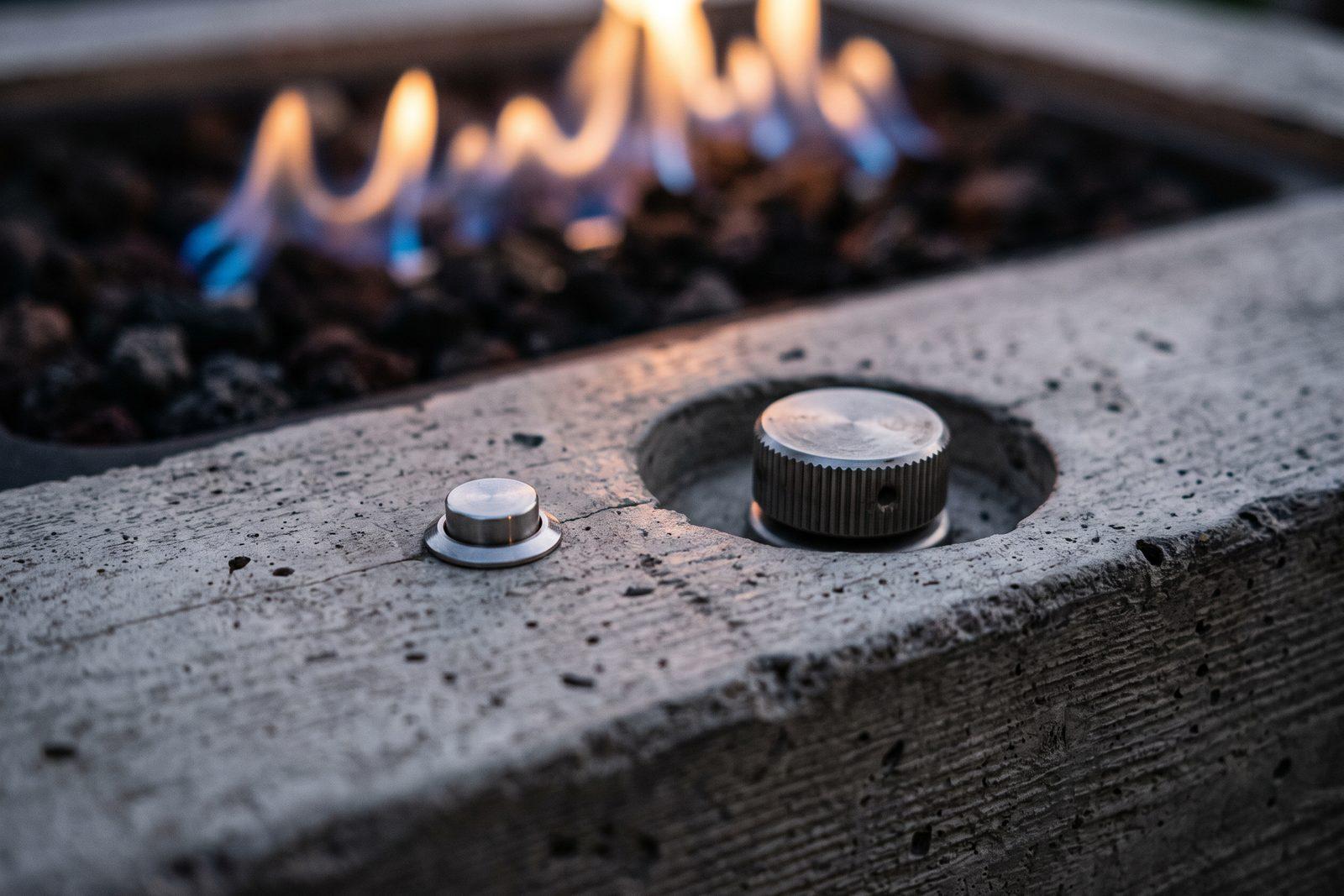

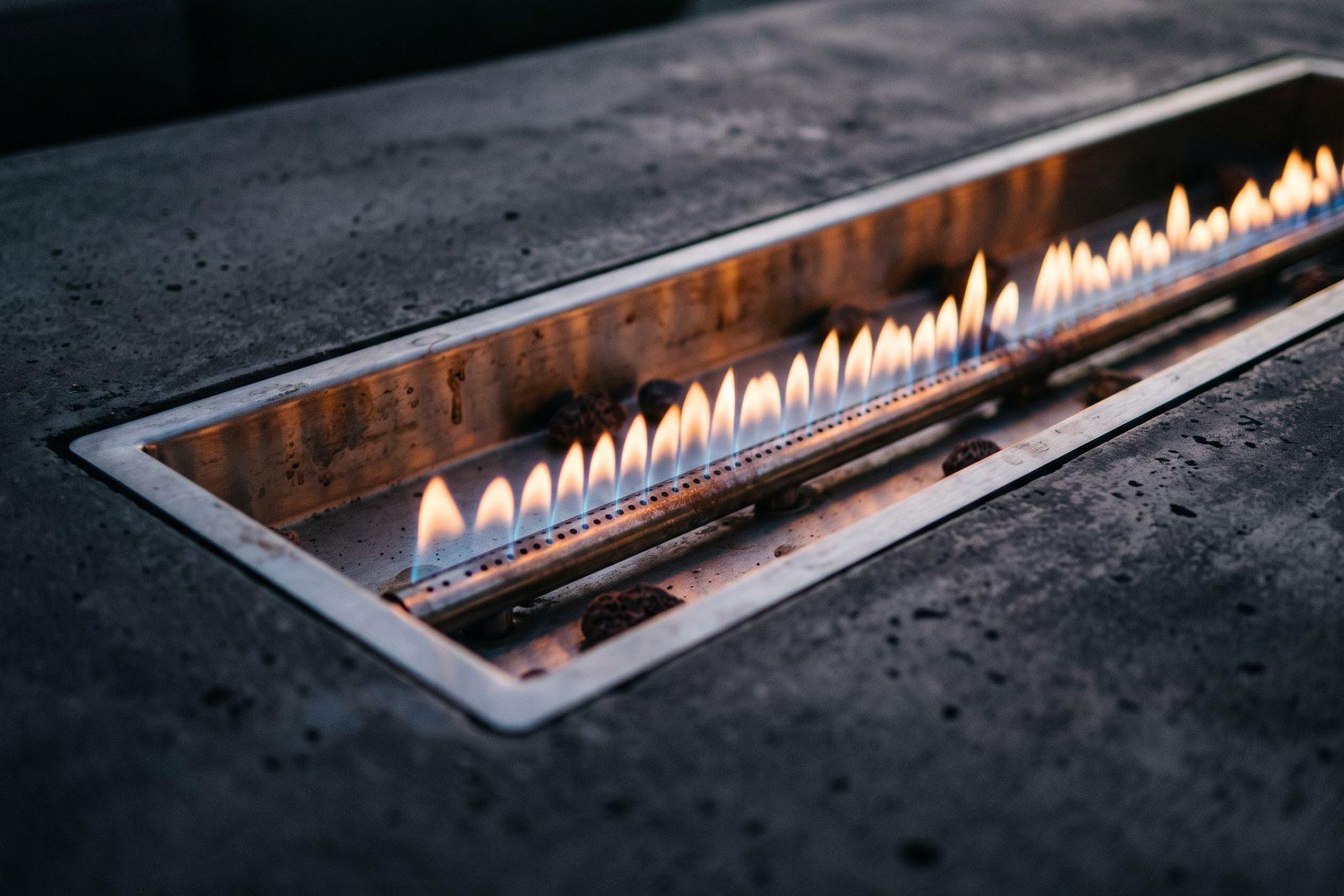
A fire pit's BTU rating is the most gas its burner can burn in an hour at full flame. It does not measure how warm you will feel. A higher rating gives you a taller flame, and it also needs a bigger gas line, empties a propane tank faster and has to sit farther from the house. Buy the rating your gas supply and your site can carry.
Run your own numbers with the gas line sizing, propane runtime and clearance tools. If you're heating a patio rather than lighting a fire, skip to the heater section and the BTU calculator.
What a BTU Rating Measures
A Btu is a unit of heat. The EIA defines it as the heat needed to raise one pound of water by one degree Fahrenheit. Fire pit ratings are in Btu per hour, which makes them a rate: how fast the burner turns gas into heat at full flame.
Manufacturers label the figure differently. Prism prints its 65,000 figure as Gas Input Flow. Real Flame prints its 50,000 figure as Rated Heat Output. For planning, treat either one as the burner's input. The fuel gas code sizes pipe from the sum of the input ratings on the line, and its own worked example converts load to flow at 1,000 Btu per cubic foot of natural gas.
The spec sheets don't say how much of that heat reaches the people sitting around the fire. None of the fire pit manuals or spec sheets we reviewed, from HPC, The Outdoor Plus, Prism, Firegear and Real Flame, states an area a fire pit heats. The Outdoor Plus and HPC both warn that wind affects the flame unpredictably. I treat a fire pit rating as a flame-size number and don't use it to judge heat.
Published Outputs by Burner Size
These are the ratings manufacturers print for their own burners and finished pieces.
Burner or product, Size, Natural gas (Btu/h), Propane (Btu/h)
Firegear Pro Spur
- Size
- 10 in.
- Natural gas (Btu/h)
- 80,000
- Propane (Btu/h)
- 95,000
Firegear Pro Spur
- Size
- 14 in.
- Natural gas (Btu/h)
- 125,000
- Propane (Btu/h)
- 160,000
Firegear Pro Spur
- Size
- 21 in.
- Natural gas (Btu/h)
- 175,000
- Propane (Btu/h)
- 175,000
Firegear Pro H-Burner
- Size
- 24 in.
- Natural gas (Btu/h)
- 80,000
- Propane (Btu/h)
- 110,000
Firegear Pro H-Burner
- Size
- 40 in.
- Natural gas (Btu/h)
- 120,000
- Propane (Btu/h)
- 150,000
Firegear Pro H-Burner
- Size
- 60 in.
- Natural gas (Btu/h)
- 180,000
- Propane (Btu/h)
- 200,000
Firegear Pro H-Burner
- Size
- 80 in.
- Natural gas (Btu/h)
- 250,000
- Propane (Btu/h)
- 240,000
Bull Slim High Profile fire pit
- Size
- 56.5 in.
- Natural gas (Btu/h)
- 35,000
- Propane (Btu/h)
- 35,000
Firegear Sanctuary 1-56 fire table
- Size
- 56 in.
- Natural gas (Btu/h)
- 75,000
- Propane (Btu/h)
- not stated
Prism Moderno fire bowls
- Size
- 30 in. and up, except the 70
- Natural gas (Btu/h)
- 65,000
- Propane (Btu/h)
- 65,000
Prism Moderno 70
- Size
- 70 in.
- Natural gas (Btu/h)
- 125,000
- Propane (Btu/h)
- 125,000
Sources: Firegear Pro Spur, Firegear Pro H, Bull, Firegear Sanctuary, Prism Moderno.
Burner size doesn't set output. A 10 inch spur and a 24 inch H-burner carry the same 80,000 natural gas rating. In Firegear's tables the propane rating is usually the higher one, but not always. The piece around the burner tells you little either: Prism uses one 65,000 rating across most of its bowls, from 30 inches up. The Outdoor Plus sells round bullet burners from 8 to 48 inches spanning 45,000 to 630,000. Ignition can move the number too. Prism's Embarcadero guide rates the same bowl at 65,000 with a key valve and 85,000 with its PH-Ignite electronic system.
Your Gas Line Sets the Real Limit
A burner only makes its rated flame if the line feeding it can deliver that much gas. Here are the natural gas capacities from the fuel gas code table for Schedule 40 steel pipe, converted at 1,000 Btu per cubic foot.
| Run length | 1/2 in. pipe | 3/4 in. pipe |
|---|---|---|
| 10 ft | 172,000 Btu/h | 360,000 Btu/h |
| 30 ft | 95,000 Btu/h | 199,000 Btu/h |
| 50 ft | 72,000 Btu/h | 151,000 Btu/h |
Source: International Fuel Gas Code, Table 402.4(2), 0.5 inch water column pressure drop.
A 65,000 bowl runs on a half-inch line 50 feet from the meter. Firegear's 40 inch Pro H-Burner, at 120,000 on natural gas, needs three-quarter inch on the same run. Some manufacturer charts are stricter than the code. Firegear's own chart allows 108,000 on a half-inch pipe at 10 feet, where the code table allows 172,000. Your installer works to both.
Supply pressure matters as well. The Outdoor Plus and HPC both call for natural gas supply pressure between 3.5 and 7.0 inches water column. Firegear's Pro H burners want at least 5.0 on natural gas and 10.5 on propane. When the supply falls short, you see the symptom in The Outdoor Plus troubleshooting table: flame too low, supply line too small. The valve and flex line count as well. The Outdoor Plus warns that consumer-grade valves may not pass enough gas, and wants the flex line rated to the product's maximum input.
Gas piping is licensed work. The code requires the system to be tested gastight before it goes into service, and your installer sizes it from the edition your jurisdiction adopted. Use the gas line sizing calculator so you know what to ask for.
How Long a 20 lb Propane Cylinder Lasts
A full 20 lb cylinder holds 4.7 gallons, and a gallon holds 91,500 Btu. That works out to about 430,000 Btu per cylinder.
| Burner at full flame | Hours from one 20 lb cylinder |
|---|---|
| 35,000 Btu/h (Bull) | 12.3 |
| 50,000 Btu/h (Real Flame Forest Ridge) | 8.6 |
| 65,000 Btu/h (Prism Moderno) | 6.6 |
| 110,000 Btu/h (Firegear Pro H 24 in., propane) | 3.9 |
| 200,000 Btu/h (Firegear Pro H 60 in., propane) | 2.2 |
The listing standard ties cylinder size to burner input. Its published scope allows one 20 lb integral cylinder below 60,000 Btu/h, up to 30 lb from 60,000, and two 20 lb cylinders from 80,000. HPC's EI Series manual says those inserts are not for small LP tanks at all.
Cold weather shortens the evening. PERC notes that a container vaporizes more slowly when the air is colder or the liquid level is lower, so a cylinder can struggle to feed a big burner on a cold night before it's empty. I couldn't find a U.S. primary source with figures for 20 to 40 lb cylinders, so I'm not giving one. The propane runtime calculator does the math for your tank.
Clearance Steps Up as Input Rises
The manuals push the fire pit farther from combustibles as the input goes up.
| Input | The Outdoor Plus fire bowls: sides / overhead | HPC EI inserts: sides / overhead |
|---|---|---|
| Up to 65,000 Btu/h | 36 in. / 96 in. | 36 in. / 84 in. |
| 66,000 to 200,000 Btu/h | 48 in. / 96 in. | 36 in. / 84 in. |
| 201,000 to 400,000 Btu/h | 48 in. / no overhead structures | 48 in. / noncombustible screen only |
Your own manual governs, and your local authority has the final word. The clearance checker lists the published minimums across more manufacturers.
Sizing a Patio Heater
Patio heater makers do publish a heated area, which is why the BTU calculator sizes heaters and leaves fire pits out. Divide each model's rated input by its stated area and you get a range.
| Area | Gas heaters (Btu/h) | Electric heaters (watts) |
|---|---|---|
| 100 sq ft | 14,000 to 26,700 | 2,000 to 6,400 |
| 200 sq ft | 28,000 to 53,300 | 4,000 to 12,800 |
| 300 sq ft | 42,000 to 80,000 | 6,000 to 19,200 |
The gas range runs from Schwank's supremeSchwank 35K (about 250 square feet) to its phantomSchwank 80K (about 300). Bromic's Tungsten Smart-Heat Gas 500 falls inside it at 43,000 Btu/h for 215 square feet, a figure Bromic marks "In ideal conditions." The electric range runs from Schwank's 2 kW unit at about 100 square feet to Infratech's SL-16 at 1,600 watts for 25.
The spread is wide because each maker measures differently. Infratech ties each figure to a mounting height of 6 to 12 feet, and Schwank states its coverage at 10 feet.
No Published Standard for Patio Heat
I looked for a standard that says how much heat a patio needs and didn't find one. ASTM F2644 is a test method that rates the effective heated area of a commercial patio heater. It rates the heater and says nothing about your patio, and I have not read its text. The most useful real-world figure I found is in Infratech's FAQ, citing testing by Pacific Gas & Electric: a good installation feels about 3 to 7 degrees warmer at 60°F, and more than 7 was too warm to sit in for long.
Wind and cold get only qualitative guidance. Infratech and Schwank both say coverage drops in extremely cold or windy conditions, and Schwank's tip is "Choose 80K / 115K BTU for colder locations." Neither says by how much. Use the range as a starting point, and have the layout designed for a covered or walled space.
The Burner Size I'd Choose
For a fire pit you sit around, I'd take a 65,000 burner on a properly sized line over a 150,000 burner starved on a half-inch pipe. The bigger burner needs a bigger line and more clearance and empties a tank faster, and on an undersized supply you get none of the extra flame. If you want to keep a seating area warm, buy a heater rated for that area and buy the fire pit for its flame.
Call a licensed gas installer before you add a burner to an existing line, run propane from a tank larger than a cylinder, or put anything under a roof. We don't sell any of the brands named here yet. Every figure above comes from the maker's own document, linked where it appears.
Sources
- U.S. Energy Information Administration, Energy Explained, British thermal units (Btu): definition of one BtuChecked
- International Code Council, 2027 International Fuel Gas Code, Chapter 4: Section 402.2 (connected load is the sum of appliance input ratings), Table 402.4(2) (Schedule 40 metallic pipe, natural gas, 0.5 in. w.c. drop, specific gravity 0.60; same table number and values in the 2024 edition), Section 404.20 (testing before service)Checked
- International Code Council, 2027 International Fuel Gas Code, Appendix A, Section A106.1, Example 1 (natural gas heating value of 1,000 Btu per cubic foot)Checked
- Propane Education & Research Council, The Propane Technical Pocket Guide, 4482-BR-21 v3: Table 1C (91,500 Btu per gallon) and Vaporization Rates (printed p. 9)Checked
- Manchester Tank & Equipment Co., Portable DOT Steel LP Gas Cylinders 5 lb to 100 lb, Catalog 49500 (09/2022), LPG capacity row (20 lb cylinder, 4.7 gal)Checked
- CSA Group, ANSI Z21.97-2017 (R2022) / CSA 2.41-2017 (R2022), Outdoor decorative gas appliances, published scope (integral cylinder sizes by appliance input)Checked
- Firegear Outdoors, Pro H-Burners and Kits, Installation and Operating Instructions, REV. D: cover page input ratings, Table 3 minimum inlet pressures (PDF p. 4), gas pipe sizing chart (PDF p. 6)Checked
- Firegear Outdoors, Pro Spur Burners and Kits, REV. D, cover page input ratingsChecked
- Firegear Outdoors, Sanctuary Series 1-56 installation manual (75,000 Btu natural gas)Checked
- Prism Hardscapes, Moderno Series Installation Guide, Section 3.1 (Gas Input Flow: 65,000 BTU/HR), PDF p. 10Checked
- Prism Hardscapes, Moderno Series product page (30 to 70 in. diameters; Moderno 70 at 125,000 BTU)Checked
- Prism Hardscapes, Embarcadero Series Installation Guide, Section 3.1 (65,000 BTU/hr manual ignition, 85,000 BTU/hr PH-Ignite), PDF p. 10Checked
- Bull Outdoor Products, Small Square Fire Pit product page (35,000 BTU)Checked
- Bull Outdoor Products, Slim High Profile Fire Pit product page (35,000 BTU)Checked
- Real Flame, Forest Ridge Fire Table manual C1600LP, Specifications (20 lb LP tank; Rated Heat Output 50,000 BTUs/hr), PDF p. 2Checked
- The Outdoor Plus, Round Stainless Bullet Burner product page (8 to 48 in., 45,000 to 630,000 BTU)Checked
- The Outdoor Plus, Fire Bowl Installation Manual, Match Lit (FB-ML-M, 2026): Clearance from Combustibles by input (PDF p. 5) and troubleshooting (PDF p. 13)Checked
- The Outdoor Plus, Match Lit Fire Pit Insert Manual (2024): supply pressures, valve and flex line ratings (PDF pp. 2 and 4)Checked
- HPC Fire Inspired (Hearth Products Controls), Electronic Ignition Fire Pit Insert, EI Series On/Off Models, 860-EI: supply pressures and small LP tank note (PDF p. 6), Table 3.1 clearances (PDF p. 9)Checked
- Bromic Heating, Product Cut Sheet, Tungsten Smart-Heat Gas (heat area 160 and 215 sq ft, in ideal conditions) and Tungsten Smart-Heat Gas product page (26,000 and 43,000 BTU)Checked
- Bromic Heating, Product Cut Sheet, Tungsten Smart-Heat Electric (heat area by wattage)Checked
- Schwank, Compare Schwank Patio Heater Models: coverage area by model at a 10 ft mounting height, coverage qualifiers and pro tip for colder locationsChecked
- Infratech, Choosing your Infratech system chart (IN999, 2025): heat coverage area and mounting height by modelChecked
- Infratech, FAQs, How much heat should I expect (perceived heat of 3 to 7 degrees at 60°F, attributed to Pacific Gas & Electric's Food Service Technology Center)Checked
- ASTM International, F2644, Standard Test Method for Performance of Commercial Patio Heaters, store page (scope only; standard text not read)Checked
About the Author
James Darren Writes the Firepit HQ guides on fire features, fuel and fire codes. Every figure in them is cited to its source with the date it was checked.