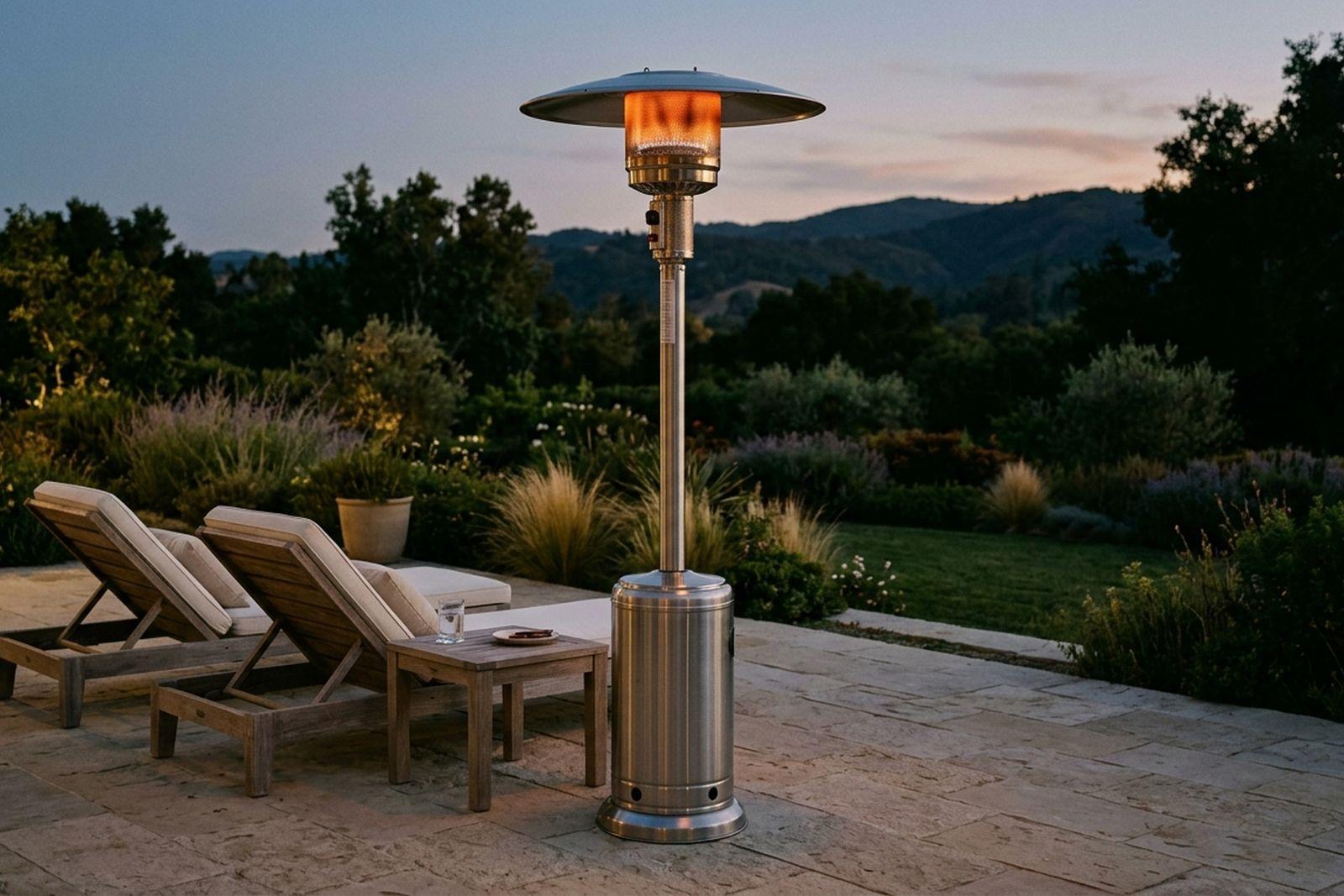

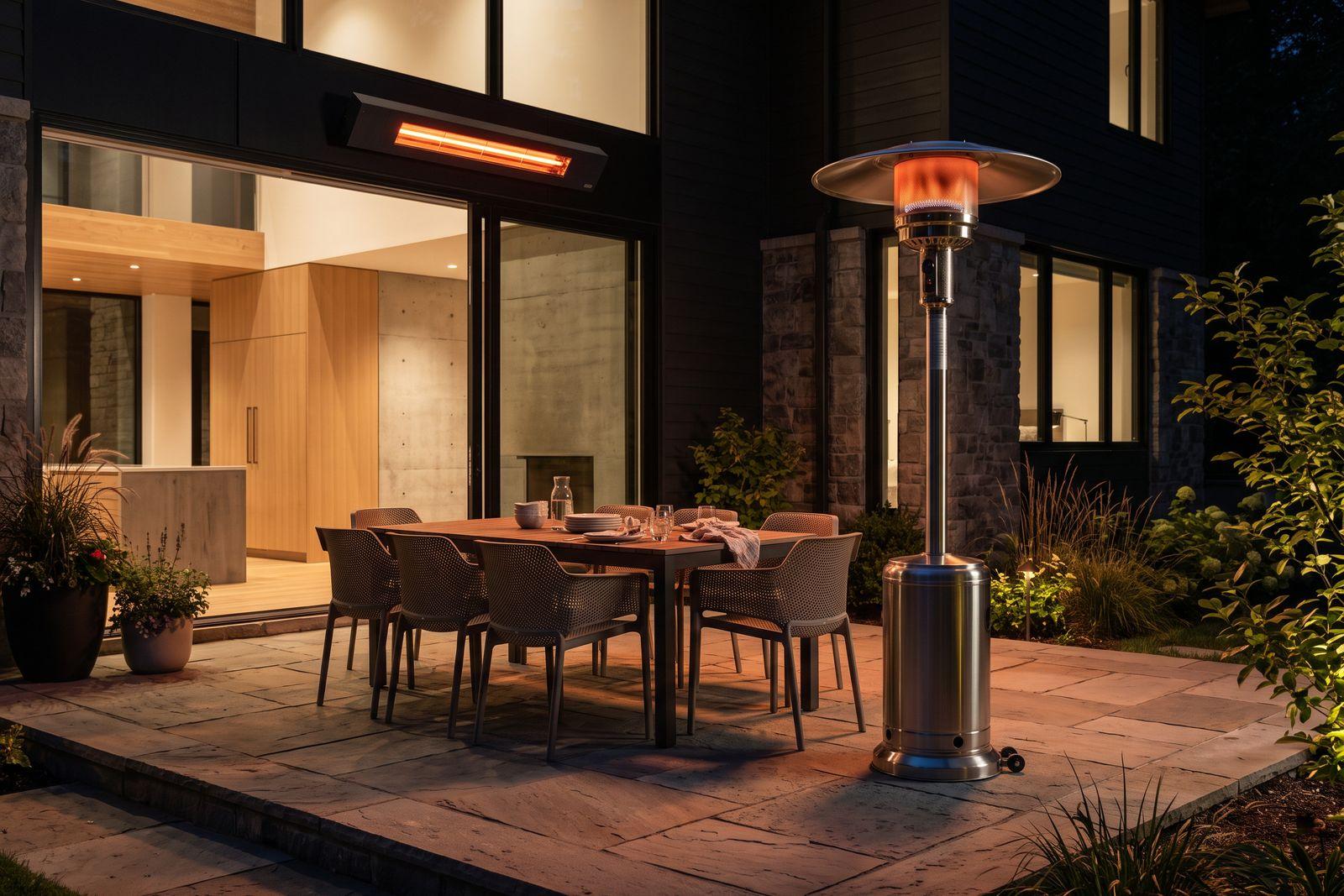
There is no standard for how many BTUs a patio needs, so the working answer is what the makers publish. Divide rated input by stated heated area for the 31 heaters in our calculator and the gas models land between 140 and 267 BTU/h per square foot, while the electric models land between 20 and 64 watts per square foot. For a 200 square foot seating zone that is about 28,000 to 53,300 BTU/h of gas, or 4,000 to 12,800 W of electric. The spread is wide because every maker measures coverage its own way.
Firepit HQ has not tested any heater. This guide explains the method behind our patio heater BTU calculator, with its constants and sources, then lists published coverage by model. Every figure comes from a maker's document or from a standards or government source listed below.
How Many BTUs Does a Patio Heater Need per Square Foot?
The calculator uses one method. For every heater in its list, it divides the rated input by the heated area the maker states. The lowest and highest results for gas or for electric become the range, and your area multiplies both ends.
- Gas list: 10 models from Bromic (Tungsten and Platinum Gas) and Schwank (supremeSchwank and phantomSchwank), rated in BTU/h.
- Electric list: 21 models from Infratech, Bromic and Schwank, rated in watts.
- Gas range: 140 BTU/h per square foot at the low end, from Schwank's supremeSchwank 35K (35,000 BTU/h over about 250 sq ft), to 266.7 at the high end, from its phantomSchwank 80K (80,000 over about 300).
- Electric range: 20 W per square foot at the low end, from Schwank's eSchwank ES/ESD 2 kW (2,000 W over about 100 sq ft), to 64 at the high end, from Infratech's SL-16 (1,600 W over 25 sq ft).
The low end is the most generous coverage claim in each list and the high end is the most cautious. A heater rated near the low end is counting on its maker's best case. The exposure setting in the calculator changes the notes under the result and leaves the numbers alone. The calculator does not size a fire pit, because fire pit makers publish no heated area. Patio heater vs fire pit covers that comparison.
Patio Heater Size by Area: Gas BTU and Electric Watts
These are the calculator's ranges for common seating zones.
Area to heat, Gas (BTU/h), Electric (W), Electric in BTU/h
50 sq ft
- Gas (BTU/h)
- 7,000 to 13,300
- Electric (W)
- 1,000 to 3,200
- Electric in BTU/h
- 3,400 to 10,900
100 sq ft
- Gas (BTU/h)
- 14,000 to 26,700
- Electric (W)
- 2,000 to 6,400
- Electric in BTU/h
- 6,800 to 21,800
150 sq ft
- Gas (BTU/h)
- 21,000 to 40,000
- Electric (W)
- 3,000 to 9,600
- Electric in BTU/h
- 10,200 to 32,800
200 sq ft
- Gas (BTU/h)
- 28,000 to 53,300
- Electric (W)
- 4,000 to 12,800
- Electric in BTU/h
- 13,600 to 43,700
300 sq ft
- Gas (BTU/h)
- 42,000 to 80,000
- Electric (W)
- 6,000 to 19,200
- Electric in BTU/h
- 20,500 to 65,500
Each row is a spread of maker claims, and none is a requirement. At 200 sq ft the top of the gas range is 1.9 times the bottom, and the top of the electric range is 3.2 times the bottom. Other guides here quote different spans because they divide different model sets, and some convert electric watts to BTU/h first. This guide keeps gas and electric separate, as the calculator does.
Here is a worked example with invented numbers, so swap in yours. A seating zone of 12 by 12 feet is 144 sq ft. The calculator range is about 20,200 to 38,400 BTU/h of gas, or 2,900 to 9,200 W of electric. Now read what real models state. Bromic's Tungsten Gas 300 states 160 sq ft for 26,000 BTU/h, in ideal conditions. Schwank's supremeSchwank 35K states about 250 sq ft at a 10 ft mounting height. Infratech's CD-60 states 121 sq ft on average, 100 cold and 144 protected, per its installation manual, so one heater covers this zone only if the space is well protected.
How Many Watts Does a Patio Heater Need?
Electric heaters are sized in watts, and the published rates run 20 to 64 W per square foot. By maker:
Maker, Models in the calculator, Watts per sq ft, Basis the maker states
Infratech
- Models in the calculator
- 11
- Watts per sq ft
- 40 to 64
- Basis the maker states
- Average coverage at a mounting height
Bromic (Tungsten and Eclipse)
- Models in the calculator
- 5
- Watts per sq ft
- 24 to 37.5
- Basis the maker states
- None stated
Schwank (eSchwank)
- Models in the calculator
- 5
- Watts per sq ft
- 20 to 37.5
- Basis the maker states
- 10 ft mounting height
Heatstrip Classic, outside the calculator
- Models in the calculator
- 2
- Watts per sq ft
- 46 to 56 outdoors, 37 indoors
- Basis the maker states
- Exposure
Heatstrip is the one maker I read that states a rule as well as a model's area. Its Classic manual says a protected outdoor area requires a minimum of 500 W per square meter, which it prints as 46 W per square foot, and recommends a minimum of 37 W per square foot for indoor spot heating. Its coverage table gives the 3,200 W model 86 sq ft indoors, 69 outdoors enclosed and 57 outdoors exposed.
Watts also decide the circuit. Infratech's reference manual lists its 6,000 W CD6024 at 240 V and 25 A, which is a panel question for a licensed electrician. The infrared patio heater guide covers voltage, amps and mounting.
How to Convert Watts to BTU/h for a Patio Heater
Multiply watts by 3.412142 to get BTU/h. NIST's conversion table gives 1 BtuIT per hour as 0.2930711 W, which inverts to that factor. EIA's 3,412 Btu per kilowatt-hour and PERC's 3,413 agree, and Infratech's own table converts at 3.412, printing 6,824 BTU for 2,000 W, 13,648 for 4,000 W and 20,472 for 6,000 W. Infratech's row for the 1,500 W C1524 prints 3,412, which does not follow that factor, so convert that one yourself.
| Watts | BTU/h, about |
|---|---|
| 1,500 | 5,120 |
| 2,000 | 6,820 |
| 3,000 | 10,240 |
| 4,000 | 13,650 |
| 6,000 | 20,470 |
Converted, the electric range of 20 to 64 W per square foot is 68 to 218 BTU/h per square foot, which overlaps the gas range of 140 to 267 without being the same claim. Going the other way, multiply BTU/h by 0.2930711. Bromic's 43,000 BTU/h Tungsten Gas 500 is about 12,600 W of input, and Schwank's 115,000 BTU/h phantomSchwank is about 33,700 W.
The conversion changes the unit and nothing else. A gas heater and an electric heater with the same BTU/h input do not necessarily put the same warmth on a chair, and I found no maker document that compares them. That is why the calculator keeps gas and electric as separate ranges.
Patio Heater Coverage Area by Model
The gas heaters in the calculator, with the maker's stated area:
Heater, Input (BTU/h), Area stated (sq ft), Basis the maker states, BTU/h per sq ft
Bromic Tungsten Gas 300
- Input (BTU/h)
- 26,000
- Area stated (sq ft)
- 160
- Basis the maker states
- Footnote "In ideal conditions"
- BTU/h per sq ft
- 162.5
Bromic Tungsten Gas 500
- Input (BTU/h)
- 43,000
- Area stated (sq ft)
- 215
- Basis the maker states
- Same footnote
- BTU/h per sq ft
- 200.0
Bromic Platinum Gas 300
- Input (BTU/h)
- 23,600
- Area stated (sq ft)
- 160
- Basis the maker states
- None stated
- BTU/h per sq ft
- 147.5
Bromic Platinum Gas 500
- Input (BTU/h)
- 39,800
- Area stated (sq ft)
- 215
- Basis the maker states
- None stated
- BTU/h per sq ft
- 185.1
Schwank supremeSchwank 23K
- Input (BTU/h)
- 23,000
- Area stated (sq ft)
- Up to about 150
- Basis the maker states
- 10 ft mounting height
- BTU/h per sq ft
- 153.3
Schwank supremeSchwank 35K
- Input (BTU/h)
- 35,000
- Area stated (sq ft)
- Up to about 250
- Basis the maker states
- 10 ft mounting height
- BTU/h per sq ft
- 140.0
Schwank supremeSchwank 50K
- Input (BTU/h)
- 50,000
- Area stated (sq ft)
- Up to about 350
- Basis the maker states
- 10 ft mounting height
- BTU/h per sq ft
- 142.9
Schwank phantomSchwank 50K
- Input (BTU/h)
- 50,000
- Area stated (sq ft)
- Up to about 200
- Basis the maker states
- 10 ft mounting height
- BTU/h per sq ft
- 250.0
Schwank phantomSchwank 80K
- Input (BTU/h)
- 80,000
- Area stated (sq ft)
- Up to about 300
- Basis the maker states
- 10 ft mounting height
- BTU/h per sq ft
- 266.7
Schwank phantomSchwank 115K
- Input (BTU/h)
- 115,000
- Area stated (sq ft)
- Up to about 500
- Basis the maker states
- 10 ft mounting height
- BTU/h per sq ft
- 230.0
Gas heaters published outside the calculator's list:
Heater, Input (BTU/h), Area stated (sq ft), BTU/h per sq ft
Bromic Tungsten Freestanding
- Input (BTU/h)
- 38,500
- Area stated (sq ft)
- Up to 215
- BTU/h per sq ft
- 179.1
Heatstrip wall-mounted and portable gas
- Input (BTU/h)
- 32,225
- Area stated (sq ft)
- 172
- BTU/h per sq ft
- 187.4
Lava Heat Italia Positano Capri
- Input (BTU/h)
- 42,000
- Area stated (sq ft)
- 400
- BTU/h per sq ft
- 105.0
Lava Heat Italia Positano Lava Lite
- Input (BTU/h)
- 56,000
- Area stated (sq ft)
- 350
- BTU/h per sq ft
- 160.0
Lava Heat Italia Positano 2G
- Input (BTU/h)
- 66,000
- Area stated (sq ft)
- 500
- BTU/h per sq ft
- 132.0
Lava Heat Italia's comparison table gives its smallest tower, the 42,000 BTU/h Capri, more area than the 56,000 BTU/h Lava Lite, and our Lava Heat Italia profile found coverage figures that differ between the brand's own pages and catalog. Ask the maker which figure applies before you size from it. A selection of the electric heaters:
Heater, Input, Area stated (sq ft), Basis the maker states, W per sq ft
Infratech C-15
- Input
- 1,500 W
- Area stated (sq ft)
- 25
- Basis the maker states
- 5 by 5 ft, 6 to 7 ft mounting height
- W per sq ft
- 60.0
Infratech C-30
- Input
- 3,000 W
- Area stated (sq ft)
- 64
- Basis the maker states
- 8 by 8 ft, 7 to 9 ft mounting height
- W per sq ft
- 46.9
Infratech C-40
- Input
- 4,000 W
- Area stated (sq ft)
- 100
- Basis the maker states
- 10 by 10 ft, 8 to 10 ft mounting height
- W per sq ft
- 40.0
Infratech CD-60
- Input
- 6,000 W
- Area stated (sq ft)
- 121
- Basis the maker states
- 11 by 11 ft, 8 to 12 ft mounting height
- W per sq ft
- 49.6
Bromic Tungsten Electric
- Input
- 2,000 W
- Area stated (sq ft)
- 65
- Basis the maker states
- None stated
- W per sq ft
- 30.8
Bromic Tungsten Electric
- Input
- 6,000 W
- Area stated (sq ft)
- 160
- Basis the maker states
- None stated
- W per sq ft
- 37.5
Bromic Eclipse
- Input
- 2,900 W
- Area stated (sq ft)
- 121
- Basis the maker states
- None stated
- W per sq ft
- 24.0
Schwank eSchwank ES/ESD
- Input
- 2,000 W
- Area stated (sq ft)
- Up to about 100
- Basis the maker states
- 10 ft mounting height
- W per sq ft
- 20.0
Schwank eSchwank ES/ESD
- Input
- 6,000 W
- Area stated (sq ft)
- Up to about 160
- Basis the maker states
- 10 ft mounting height
- W per sq ft
- 37.5
Schwank eSchwank Ghost ESM
- Input
- 6,000 W
- Area stated (sq ft)
- Up to about 200
- Basis the maker states
- 10 ft mounting height
- W per sq ft
- 30.0
The calculator lists all 31 of its models with sources, and each rate above is the input divided by the area, with no adjustment.
Does Wind or Exposure Change the Number?
Makers say yes and mostly stop short of a figure. Infratech's chart and Schwank's page carry nearly the same note: indoor or well-protected environments will generally exceed average coverage, and heaters may (Schwank says can) provide less than average coverage in extremely cold or windy conditions. Infratech's FAQ adds that colder or draftier areas may require more heat and protected or warmer areas less. None of them gives a wind speed or a temperature.
Infratech's installation manual for its C and CD series does print cold and protected columns beside the average one, in square feet.
Infratech model, Mounting height, Cold, Average, Protected
C-2024, 2,000 W
- Mounting height
- 7 to 8 ft
- Cold
- 16
- Average
- 36
- Protected
- 64
C-3024, 3,000 W
- Mounting height
- 7 to 9 ft
- Cold
- 36
- Average
- 64
- Protected
- 100
C-4024, 4,000 W
- Mounting height
- 8 to 10 ft
- Cold
- 64
- Average
- 100
- Protected
- 144
CD-6024, 6,000 W
- Mounting height
- 8 to 12 ft
- Cold
- 100
- Average
- 121
- Protected
- 144
For the 4,000 W C-4024 that works out to 62.5 W per square foot in the cold column, 40 on average and 27.8 protected. The calculator uses the chart's average figure and does not apply these columns. Heatstrip publishes the same idea by exposure. Its 2,400 W Classic covers 65 sq ft indoors, 52 outdoors enclosed and 43 outdoors exposed. Heatstrip also says coverage drops by up to 40 percent when the Classic is mounted on a wall at an angle.
Some gas makers publish wind speeds instead. Bromic's Tungsten Gas manual says the heater is designed to function in winds up to 10 mph and is subject to reduced performance or failure in high wind or extreme saturation, while its product page says up to 8 mph. The two Bromic documents disagree. The calculator cites the manual, and Bromic can say which figure applies to your site. The Platinum Gas cut sheet says up to 12 mph. Heatstrip's brochure gives its gas heaters a wind protection rating of 16 km/h, which it prints as 10 m an hour. Schwank's tip for its phantomSchwank line is to choose the 80K or 115K BTU/h model for colder locations.
None of these documents says how many square feet a given wind takes away. Reasoning from them, I would size an open, breezy patio from the high end of the range and a walled one from the low end.
Mounting Height Changes Coverage Too
Every coverage figure assumes a mounting height. Infratech pairs 6 to 7 ft with its 25 sq ft heater and 8 to 12 ft with its 121 sq ft one. Schwank states its areas at 10 ft. Heatstrip says to follow its maximum mounting heights or performance may be reduced, and says that bringing a heater from above 2.7 m (8 ft 10 in.) down to between 2.3 and 2.5 m (7 ft 6 in. to 8 ft 2 in.) increases its effectiveness.
Sizing for the People on the Patio
Infratech's FAQ cites testing by Pacific Gas & Electric's Food Services Testing Center. A good patio installation, gas or electric, provides 3 to 7 degrees of perceived heat at 60°F, and more than 7 was too warm to sit in for long. Plan for that. A covered patio will not feel like indoors.
Two maker notes help with layout. Infratech says the best comfort comes from heating from two sides instead of one. Heatstrip says the most effective method for most outdoor layouts is to spot heat a table, and its table diagrams pick from one to four heaters for common residential table settings. For a large zone, plan more than one heater.
ASTM's F2644 is a test method for commercial gas and electric radiant patio heaters that measures energy input rate, preheat, temperature distribution and effective heated area. It rates a heater and says nothing about how large your patio is, and I read only its store summary.
What to Check Before You Pick a Size
- The zone: measure the seating area in square feet, not the whole patio.
- The mounting height: note what you can actually reach, because it decides which published areas apply.
- The exposure: choose the upper part of the range for open, windy sites and the lower part for walled ones.
- The basis: read whether the maker's area assumes ideal conditions, a mounting height or an exposure.
- The supply: a fixed gas heater needs a gas line sized for its input, so run the gas line sizing calculator before you buy, and have a licensed gas fitter do the line. An electric heater needs a circuit a licensed electrician sizes.
- The roof: gas heaters have open-air rules, which outdoor heaters for covered patios goes through, and how to choose a patio heater covers fuel and mounting.
- Local rules: check your local code and the installation manual for the model, starting with the fire code library.
Common Questions
How many BTU do I need for a patio heater?
No standard sets it, so use the makers' published coverage. Divide rated input by stated area for the 10 gas models in our calculator and you get 140 to 267 BTU/h per square foot. A 200 square foot seating zone works out to about 28,000 to 53,300 BTU/h. The wide range reflects how differently each maker measures coverage, so check the basis behind the area before you compare models.
How many watts do I need for a patio heater?
The 21 electric models in our calculator state areas that work out to 20 to 64 watts per square foot, so a 200 square foot zone is 4,000 to 12,800 W. Heatstrip's Classic manual sets a minimum of 46 W per square foot for a protected outdoor area. Infratech's models run 40 to 64 W per square foot. Read each maker's mounting height and exposure first.
How do you convert watts to BTU for a patio heater?
Multiply watts by 3.412142 to get BTU per hour. NIST's conversion factor is 0.2930711 W per Btu/h, which inverts to that figure, and EIA's 3,412 Btu per kilowatt-hour agrees. So 4,000 W is about 13,650 BTU/h and 6,000 W is about 20,470. The conversion changes the unit only, and a gas and an electric heater of equal input do not necessarily warm a chair equally.
Does wind change how many BTUs a patio heater needs?
Makers say it does and publish few numbers. Infratech and Schwank both say heaters may cover less in extremely cold or windy conditions. Infratech's manual prints a cold column that cuts its 4,000 W C-4024 from 100 to 64 square feet. Bromic's Tungsten Gas manual gives a 10 mph design wind, its product page says 8 mph, and its Platinum Gas cut sheet gives 12 mph. None ties coverage to a wind speed.
How many square feet does a patio heater heat?
It depends on the model and on what the maker assumes. Bromic states 160 and 215 square feet for its 26,000 and 43,000 BTU/h Tungsten Gas heaters, Schwank states about 150 to 500 for its gas heaters at a 10 foot mounting height, and Infratech states 25 to 121 for its electric heaters, with a mounting height for each.
Is there a patio heater BTU calculator?
Firepit HQ's patio heater BTU calculator takes your area and returns the input range implied by the heated areas Bromic, Schwank and Infratech publish, with every model and source shown. It does not size a fire pit, because fire pit makers do not publish a heated area. Treat the result as a range of maker claims and not a requirement.
Sources
- Bromic Heating, Product Cut Sheet, Tungsten Smart-Heat Gas: 26,000 and 43,000 BTU, heat area 160 and 215 sq ft with the footnote 'In ideal conditions' under the specifications tableChecked
- Bromic Heating, Tungsten Smart-Heat Gas product page: wind resistance up to 8 mph, 300 Series at 26,000 BTU and 500 Series at 43,000 BTUChecked
- Bromic Heating, Tungsten Smart-Heat Gas Installation, Instruction and Service Manual (V2.3, USA and Canada): designed for winds up to 10 mph, reduced performance or failure in high wind or extreme saturation (PDF p. 6)Checked
- Bromic Heating, Product Cut Sheet, Platinum Smart-Heat Gas: 23,600 and 39,800 BTU, heat area 160 and 215 sq ft with no conditions footnote, wind speeds up to 12 mphChecked
- Bromic Heating, Product Cut Sheet, Tungsten Smart-Heat Freestanding: 38,500 BTU, heat area up to 215 sq ftChecked
- Bromic Heating, Product Cut Sheet, Tungsten Smart-Heat Electric: 2,000, 3,000, 4,000 and 6,000 W with heat areas of 65, 100, 130 and 160 sq ftChecked
- Bromic Heating, Product Cut Sheet, Eclipse Smart-Heat Electric: 2,900 W, heat area 121 sq ftChecked
- Infratech, Choosing your Infratech system chart (IN999, 2025): heat coverage area, mounting height and wattage by model, note on protected environments, cold and windChecked
- Infratech, All Weather C-Series and CD-Series Installation, Use & Care Manual (IN038, July 2024): single and dual element areas covered, average, cold and protected, by model, and heat from two sides (p. 6)Checked
- Infratech, Reference Manual (IN_refmanual_022625_dj): C-Series Heater Clearance and Dimensions table with watts, volts, amps and BTU columns (printed p. 5, PDF p. 8)Checked
- Infratech, FAQs, How much heat should I expect (3 to 7 degrees of perceived heat at 60°F, attributed to Pacific Gas & Electric's Food Services Testing Center; colder or draftier areas may require more heat)Checked
- Schwank, Compare Schwank Patio Heater Models: BTU/h and kW by model, coverage area by model stated at a 10 ft mounting height, coverage qualifiers, phantomSchwank tip for colder locationsChecked
- Heatstrip, Classic (X-THHUS-A) Product Manual, Rev 6: coverage by exposure and the 46 W per sq ft minimum (PDF p. 7), table layout (PDF p. 8), mounting position and heights (PDF p. 9), maximum mounting heights (PDF p. 13)Checked
- Heatstrip, 2025 US Brochure: wall-mounted natural gas and portable LPG heaters, wind protection rating of 16 km/h, 10 m per hour (PDF pp. 20 and 22), 32,225 BTU, heating area 16 m2 and 172 sq ft (PDF pp. 21 and 23)Checked
- Lava Heat Italia, Positano Flame Tower Collection page: 2G Tower, Lava Lite and Capri output (66,000, 56,000 and 42,000 BTU) and coverage (500, 350 and 400 sq ft) in the comparison tableChecked
- NIST, Guide for the Use of the International System of Units (SI), Appendix B.9 conversion factors: 1 BtuIT per hour is 0.2930711 WChecked
- U.S. Energy Information Administration, Units and calculators, sample Btu conversion factors: 1 kilowatthour is 3,412 BtuChecked
- Propane Education & Research Council, The Propane Technical Pocket Guide, 4482-BR-21 v3: Table 1C, electricity at 3,413 Btu per kWhChecked
- ASTM International, F2644-07(2019), Standard Test Method for Performance of Commercial Patio Heaters, store summary (scope only: energy input rate, preheat, temperature distribution, effective heated area; standard text not read)Checked
About the Author
James Darren Writes the Firepit HQ guides on fire features, fuel and fire codes. Every figure in them is cited to its source with the date it was checked.