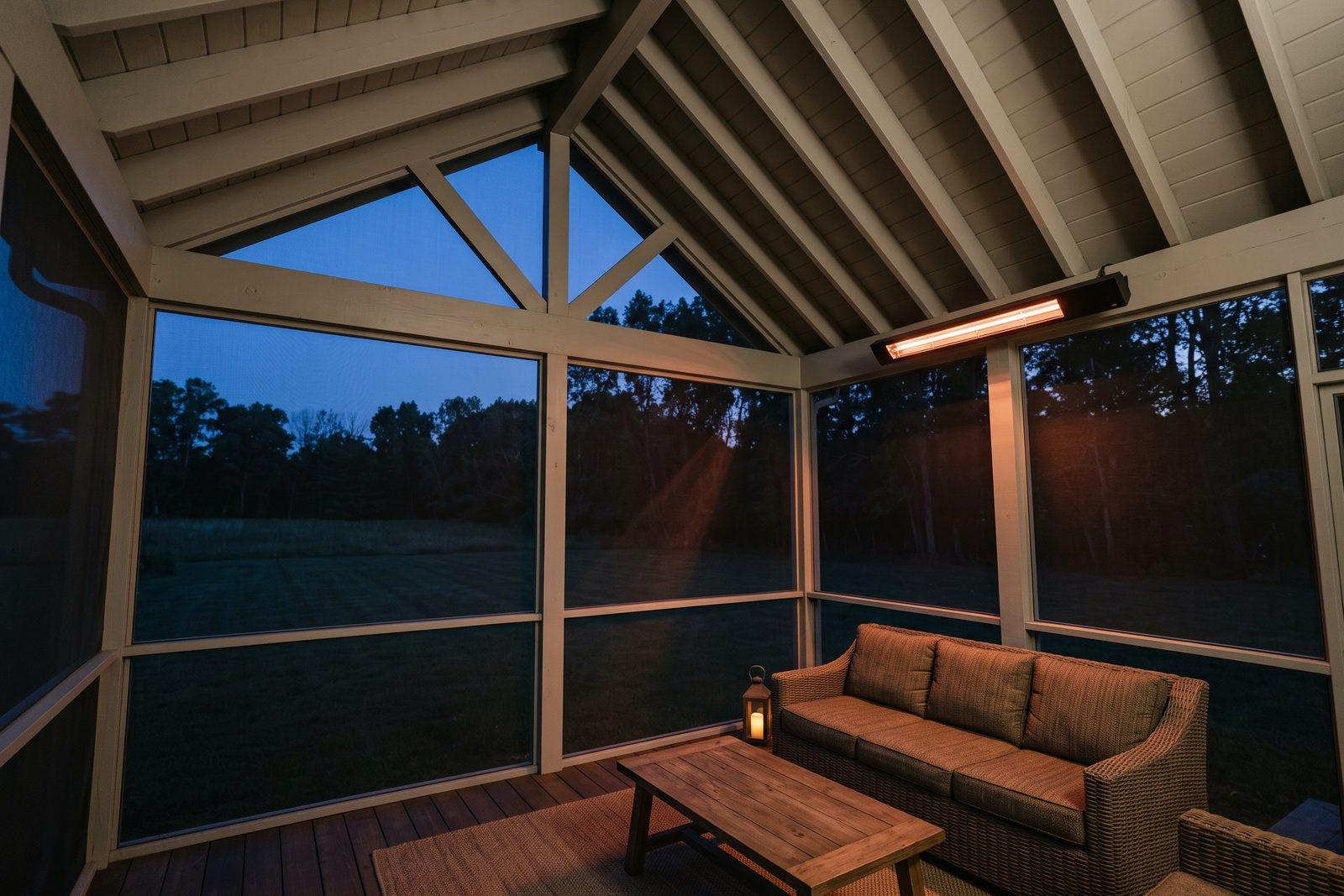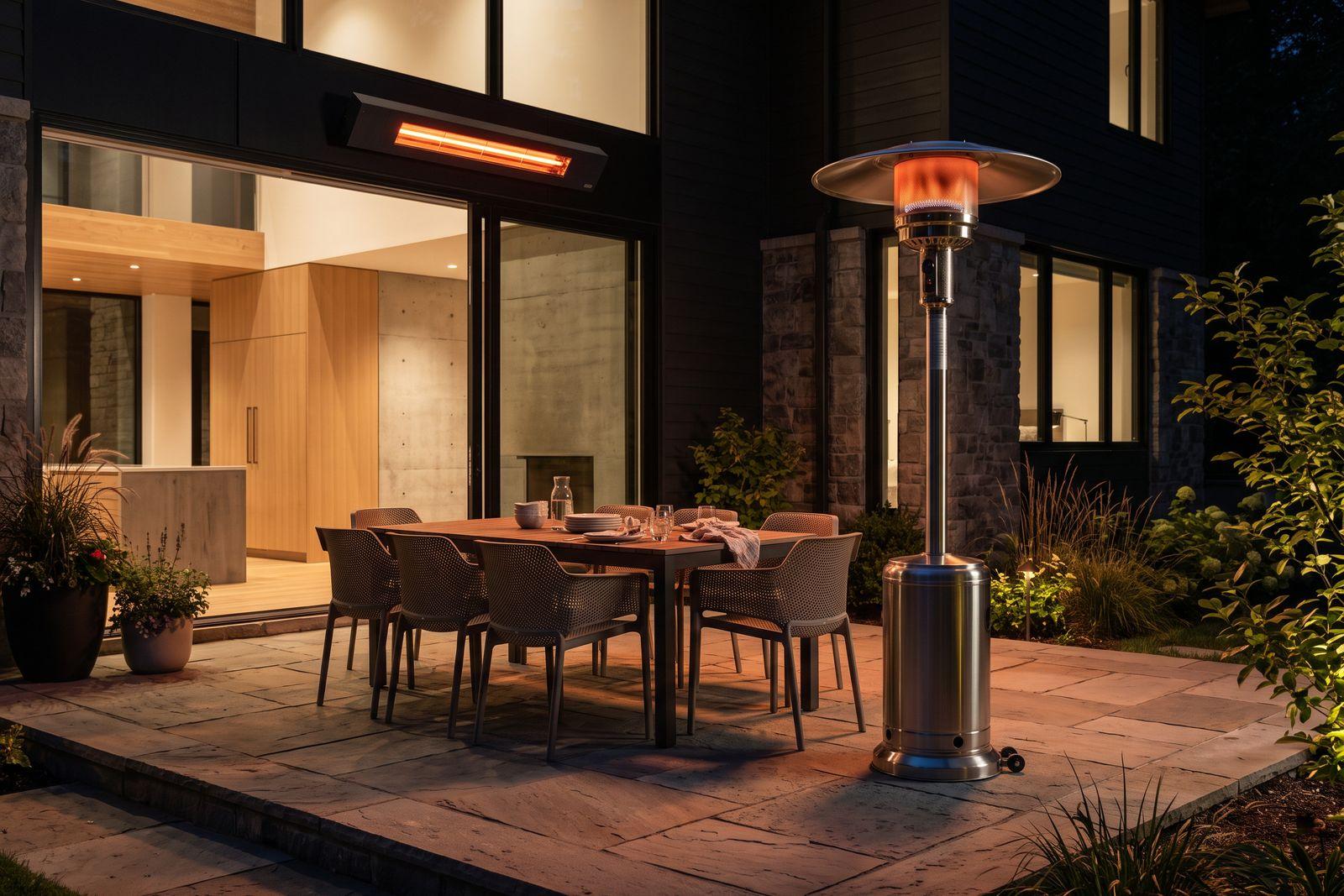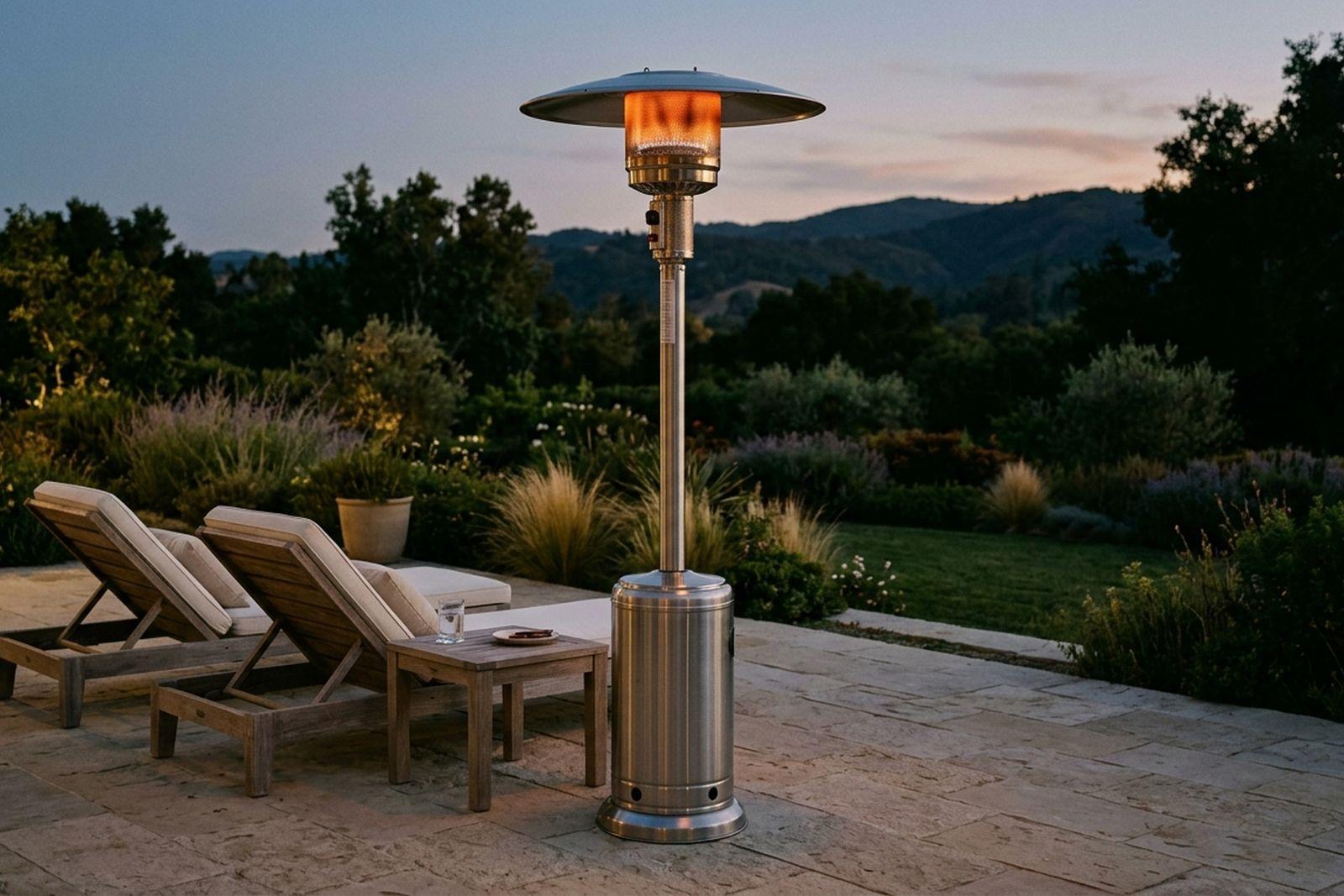

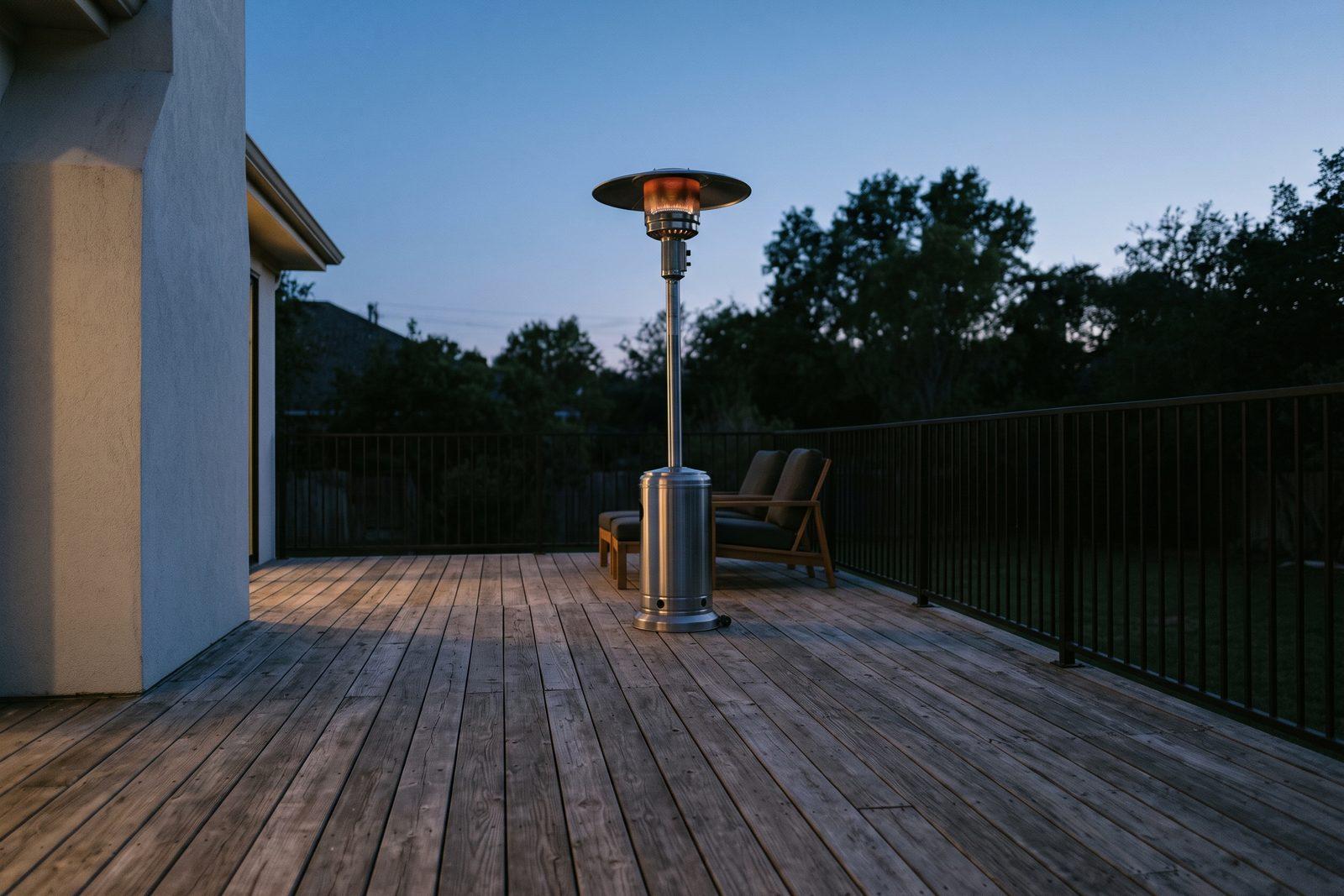
You can use some patio heaters on a deck, and the type decides which. The 2024 International Fire Code (IFC) keeps a portable propane heater at least 5 ft from buildings and exits and bars it from exterior balconies. Heatstrip's portable propane manual wants a hard, level, non-combustible surface such as concrete, rock or stone. Wood is not among its examples, and it does not say how composite boards rate. A hardwired electric heater on a wall or post avoids the cylinder and the base-on-boards questions, and brings clearances and wiring in their place.
This guide compares published manuals, decking maker documents and the model fire code. Firepit HQ has not tested any heater, and your manual, your decking maker and your fire official decide.
Can You Use a Patio Heater on a Wood or Composite Deck?
For a gas heater, the surface line in the manual is the one that counts, and the makers word it differently.
| Document | What it says about the surface under the heater |
|---|---|
| Heatstrip X-DGR32PLP, PDF pp. 4 and 5 | Place it on level firm ground, and always use it on a hard, level, non-combustible surface such as concrete, rock or stone |
| Mi-T-M propane patio heater, PDF p. 20 | The operation checklist says the heater is on a hard and level surface |
| Lava Heat Italia support page | Hard, level ground, not grass or a soft surface, with all four base feet touching, so the anti-tilt switch lets it light |
| Bromic Tungsten Portable, PDF p. 24 | Lists a base that is not on a level surface as a cause of an unevenly glowing emitter |
A deck is hard and can be level, so most of those lines are met. A Lava Heat Italia tower that will not light on boards that slope may be its anti-tilt switch at work, which the propane patio heater troubleshooting guide covers. Heatstrip's is the one a deck may not meet: its examples are concrete, rock and stone, wood is not among them, and it does not say how composite boards rate. No maker's document names a deck.
The decking makers write their heat limits around fires, not heaters. Trex's limited warranty excludes damage from direct or indirect contact with heat sources over 275°F (135°C), and its installation guide covers gas and wood fire pits and grills. TimberTech's installation guide lists fire, hot ashes or embers, fire pits, grills and reflected sunlight from Low-E glass among the external heat sources to watch, and warns that extreme surface temperatures can possibly make its boards melt, sag, warp or discolor. Fiberon warns that an improperly installed fire feature can damage its decking through flame or excessive radiated heat. I found no mention of patio heaters in any of those documents, and no heater maker I read prints the temperature of the floor under its heater.
So the question of how hot the boards under your heater get has no published answer. Ask the heater maker and the decking maker in writing, and keep the answers with your receipts. Bromic adds one more reason for care on any floor. Its portable manual says certain items stored under or near the heater will be subjected to radiant heat and could be seriously damaged. Cushions and furniture covers left nearby fit that description, by my reading. For a fire pit on the same deck, see gas fire pit on a wood or composite deck.
How Far From the House Does a Portable Propane Heater Have to Be?
The IFC covers this under portable outdoor gas-fired heating appliances, the kind with the cylinder built into the base. Section 4103.1.2.1 sets these distances.
- Buildings: not less than 5 ft.
- Exits and exit discharges: not within 5 ft.
- Overhangs: not beneath, or closer than 5 ft to, combustible decorations and combustible overhangs, awnings, sunshades or similar combustible attachments to buildings.
Section 4103.1.2 also limits the container to 20 lb and requires a listing to ANSI Z83.26/CSA 2.37 and a tip-over switch that shuts off the gas at more than 15 degrees of tilt. Section 4101.1 applies the chapter to portable equipment used for temporary heating, so whether it reaches a home deck, and how your official measures the 5 ft, are local calls.
Here is the arithmetic on an invented deck. The heater has to clear the house by 5 ft. It also has to clear a wood railing by the maker's side distance. Heatstrip says to stay at least 3 ft from any wall or surface and from combustible objects, with vinyl or wood siding and fences as its examples. Mi-T-M's text says 2 ft from the sides while its checklist says 3.3 ft, so I used the largest of these figures, 3.3 ft. I treated the heater as a point, and a real one has a footprint.
| Deck depth, house wall to outer rail | Where the heater can sit, measured from the house wall | Band left |
|---|---|---|
| 12 ft | 5 ft to 8.7 ft | 3.7 ft |
| 10 ft | 5 ft to 6.7 ft | 1.7 ft |
| 8 ft | 5 ft to 4.7 ft | None |
A deck 8 ft deep cannot take a portable propane heater under those numbers. The side rails and any furniture shrink the band further, and the 5 ft from exits and exit discharges can reach the stairs to the yard, depending on how your official reads them.
Can You Use a Patio Heater on a Balcony?
A portable propane heater, no, under the model fire code. Section 4103.1.2.1.1 prohibits portable outdoor gas-fired heating appliances on exterior balconies, and the section carries an exception "as permitted in Chapter 61." I read Chapter 61 and found nothing about balconies in it.
The IFC's definitions chapter defines neither a balcony nor a deck, and the 2024 International Residential Code's definitions chapter has no entry for either. Whether your raised deck counts as a balcony is a question for your fire official, and your lease or association may ban propane heaters whatever the code says.
Heatstrip's manual adds a balcony rule of its own. Where a roofed space has more than two walls, it asks for at least 25 percent of the total wall area to be completely open and 30 percent of the remainder open and unrestricted, and for a balcony at least 20 percent of the total wall area to be and remain open and unrestricted.
Electric heaters have their own section. A portable electric space heater is allowed under IFC Section 4102.1 if it is listed and labeled and used only in locations for which it is listed. It goes directly into an approved receptacle, not an extension cord, and stays 3 ft from combustibles.
Open Deck, Covered Deck or Both?
Rain is where a gas heater and an open deck part ways. Heatstrip's manual says the heater should not be installed in open locations subject to rain. Bromic's portable and wall-mounted gas manuals both say to protect the heater from rain and to install it under a protective cover, on top of their open-air rules. A heater parked on an uncovered deck in the weather is not what those pages describe.
A deck with a roof brings the roof rules. Heatstrip's warnings say not to use its heater under any overhead or near unprotected combustibles. Bromic allows a roof with no more than two walls, or more walls only when its open-area percentages are met. Outdoor heaters for covered patios goes through both, with the ceiling distances. If the roofed deck is screened in, patio heater in a screened porch works through what counts as open.
Electric heaters are the ones the manuals welcome under a roof. Infratech's installation manual says to hang its heaters under a protective roof or weather cover whenever possible, and that they last longer and look better out of rain and snow.
Wind on an Exposed Deck
Mi-T-M's operation checklist asks for wind below 10 mph. Bromic's Tungsten Gas manual says the heater is designed to work in winds up to 10 mph and is subject to reduced performance or failure in high wind. Its troubleshooting table lists drafty conditions as a cause of a heater that turns on and then cycles, and says to stop using the heater in high wind. A deck raised well above the yard is usually less sheltered than a patio at grade. That is my reasoning and no maker says it. The BTU guide covers how makers treat exposure and wind in coverage.
Electric Heaters on a Deck
A hardwired electric infrared heater trades the floor and cylinder questions for these.
- Mounting height: Infratech's wall and ceiling mounts sit at least 6 ft from the floor if the label says UL Listed and 8 ft if it says UL/CUL Listed. Heatstrip's Classic installation steps say at least 6 ft above ground level in the USA, while its specification table lists a minimum mounting height of 6 ft 10 3/4 in. (2.1 m). On a deck 8 ft above the yard, "ground level" read as the yard and read as the deck floor are 8 ft apart. Measuring from the deck floor, to the higher Heatstrip figure, is the stricter reading, and your maker and electrician can confirm it.
- Clearances: Infratech asks for at least 6 in. behind the heater, 18 in. at the sides and ends and 36 in. in front, measured to combustibles, plus 18 in. from adjacent walls on a wall mount.
- Siding: Bromic's gas manual names plastic, vinyl siding and canvas as low heat tolerance materials that may degrade below the temperature its clearance assumes. If the wall behind your deck is vinyl or wood siding, ask the maker about it.
- A post instead of a wall: Infratech's W and WD heaters have a pole mount with an 8 ft pole and a 12 in. by 12 in. base. The documents I read do not say how to anchor a base to deck framing, so that is a question for the maker and a builder.
- Wiring: Infratech's and Heatstrip's manuals both call for installation by a licensed electrician, and Infratech marks any heater over 240 V as commercial use only. The infrared patio heater guide covers voltage, amps and circuits.
Cylinders on a Deck
Heatstrip says not to store a spare cylinder under or near its heater, and PERC says the same about a spare near any propane appliance. PERC also says never to use or store a small cylinder in an enclosed area. The IFC limits the cylinder on a portable heater to 20 lb.
Mi-T-M says propane vapor is heavier than air and can accumulate in low places. A leak on a deck could sink through the gaps between boards into the space beneath it. No maker or code document I read addresses that, so it is my reasoning and not a rule. It is one more reason to leak-test the connections as the manual describes.
What to Check Before You Buy
- Read the exact model's manual for the surface, the clearances and the rain rule, and ask the maker in writing about a wood or composite deck.
- Ask your decking maker whether a patio heater's radiant heat affects the warranty.
- Measure the deck. After the 5 ft from the house and the maker's side distances, see whether any band is left for a portable propane heater.
- Ask your fire official how your deck is classified, whether it counts as a balcony and how the 5 ft is measured.
- For electric, check the voltage, the listing, the mounting height measured from the deck floor and the siding behind the heater.
- Hire a licensed electrician for a hardwired heater and a licensed gas fitter for any gas line, and check your local code starting with the fire code library. Heatstrip and Bromic are profiled in the brand library.
Common Questions
Can you use a patio heater on a wood deck?
It depends on the heater and the manual. Heatstrip's portable propane manual says to use its heater on a hard, level, non-combustible surface such as concrete, rock or stone. Wood is not among its examples. Mi-T-M asks for a hard and level surface and Lava Heat Italia for hard, level ground. None of them names decks, so ask the maker in writing before you set a gas heater on boards.
Can you use a propane patio heater on a composite deck?
No decking maker I read names patio heaters. Trex's warranty excludes damage from direct or indirect contact with heat sources over 275°F (135°C), TimberTech lists fire pits, grills and hot embers among the heat sources to watch and warns that extreme surface heat can possibly melt or warp its boards, and Fiberon warns about excessive radiated heat from fire features. No heater maker I read prints a floor temperature, so ask both makers.
How far does a patio heater need to be from the house?
For a portable propane heater with its cylinder in the base, the 2024 International Fire Code says at least 5 feet from buildings, from exits and exit discharges, and from combustible overhangs, awnings and similar attachments. Your local code may differ. A hardwired electric heater follows its own manual instead: Infratech wants 18 inches from adjacent walls on a wall mount and a mounting height of at least 6 feet for a UL Listed label or 8 feet for UL/CUL Listed.
Can you use a patio heater on a balcony?
A portable propane heater, no. The 2024 International Fire Code prohibits portable outdoor gas-fired heating appliances on exterior balconies, and the code does not define a balcony, so ask your fire official whether your deck counts as one. Heatstrip's manual also says that on a balcony at least 20 percent of the total wall area must be and remain open and unrestricted. Electric heaters have other rules.
What kind of patio heater suits a deck?
On a deck attached to a house, a hardwired electric infrared heater on a wall or post avoids the cylinder, the base on the boards and the 5-foot rules that govern a portable propane heater. It brings clearances, a mounting height and wiring by a licensed electrician. Infratech makes a pole mount for its W and WD heaters. Bromic's and Heatstrip's gas manuals also ask for open air and shelter from rain.
Sources
- International Code Council, 2024 International Fire Code (Version 2.1, Feb 2026), Chapter 41, Temporary Heating and Cooking Operation: Section 4101.1 (scope), 4102.1 (portable electric space heaters), 4103.1.2.1.1 (prohibited locations, including exterior balconies), 4103.1.2.1.2 (5 ft from buildings), 4103.1.2.1.3 (combustible overhangs and attachments), 4103.1.2.1.4 (5 ft from exits and exit discharges), 4103.1.2.2.1 (listing to ANSI Z83.26/CSA 2.37), 4103.1.2.2.3 (tip-over switch) and 4103.1.2.3.3 (20 lb container limit)Checked
- International Code Council, 2024 International Fire Code (Version 2.1, Feb 2026), Chapter 2 Definitions: no definition of balcony or deckChecked
- International Code Council, 2024 International Fire Code (Version 2.1, Feb 2026), Chapter 61 Liquefied Petroleum Gases (the exception in Section 4103.1.2.1.1 points here; no balcony text found)Checked
- International Code Council, 2024 International Residential Code, Chapter 2 Definitions: no definition of deck or balcony (the only deck entry is Roof Deck)Checked
- Heatstrip, X-DGR32PLP Head and Stand US Manual (portable propane): 20 lb cylinder rules and spare cylinder (PDF p. 3), level firm ground, shelter rules and the balcony 20 percent figure (p. 4), For Your Safety warnings: hard, level, non-combustible surface, 3 ft from walls, surfaces and combustible objects such as vinyl or wood siding and fences (p. 5), installation clearances: not in open locations subject to rain (p. 6)Checked
- Mi-T-M Corporation, Propane Patio Heaters Operator's Manual MH-0042-PM11 (37-1494-E-071322): clearances to combustibles (PDF pp. 9 and 18), propane vapors heavier than air (p. 18), operation checklist with wind below 10 mph, hard and level surface and clearances (p. 20)Checked
- Lava Heat Italia, Troubleshooting & Diagnostics (owner support page): anti-tilt switch needs hard, level ground, not grass or a soft surface, with all four feet touchingChecked
- Bromic, Tungsten Smart-Heat Portable Heater Installation, Instruction and Service Manual (cover: Version 2.2 USA / CAN; the file name says V1.8): radiant heat on items stored near the heater (PDF p. 4), protect from rain and install under a protective cover (p. 5), level base (p. 24)Checked
- Bromic, Tungsten Smart-Heat Gas Installation, instruction and service manual, Version 2.3 USA - Canadian: protect from rain (PDF p. 5), 10 mph wind rating (p. 6), vinyl siding and low heat tolerance materials (p. 7), cycling in drafty conditions (p. 25)Checked
- Trex Company, Decking, Fascia & Cladding Limited Warranty (2023 update, TXA1952), Exposure to Heat: heat sources over 275°F/135°C, PDF p. 1Checked
- Trex Company, 2024 Decking Installation Guide: grill placement (PDF p. 7) and Installing Fireplaces and/or Fire Pits With Trex Decking (p. 8); no mention of patio heatersChecked
- TimberTech (AZEK), Decking Installation & Maintenance Guide, Composite and Specialty Decking, REV 09/23, Extreme Heat Warning, PDF p. 3: heat from fire, hot ashes or embers, fire pits, grills and Low-E reflection can melt, sag, warp or discolor boardsChecked
- Fiberon, General FAQs, Will heat from cooking grills or fire pits harm Fiberon decking: flame or excessive radiated heat from improperly installed fire features can damage the surfaceChecked
- Infratech, All Weather C-Series and CD-Series Installation, Use & Care Manual (IN038, July 2024): clearances and mounting heights from the floor (p. 2) and hanging under a protective roof or weather cover (p. 7)Checked
- Infratech, Reference Manual (IN_refmanual_022625_dj): mounting options and UL and CUL listing heights (PDF p. 47) and Pole Mount Installation for W and WD series, 8 ft pole with a 12 in. by 12 in. base (p. 56)Checked
- Heatstrip, Classic US product manual (X-THHUS-A, Rev 6): fixed installation by a licensed electrical professional and at least 6 ft above ground level in the USA (PDF p. 3), minimum mounting height of 6 ft 10 3/4 in. (2.1 m) in the specification table (p. 4)Checked
- Propane Education & Research Council, Safety Guide for Propane Users (PRC-101063D, 2025): keep spare cylinders away from propane appliances and never use or store a small cylinder in an enclosed area (printed p. 19)Checked
About the Author
James Darren Writes the Firepit HQ guides on fire features, fuel and fire codes. Every figure in them is cited to its source with the date it was checked.