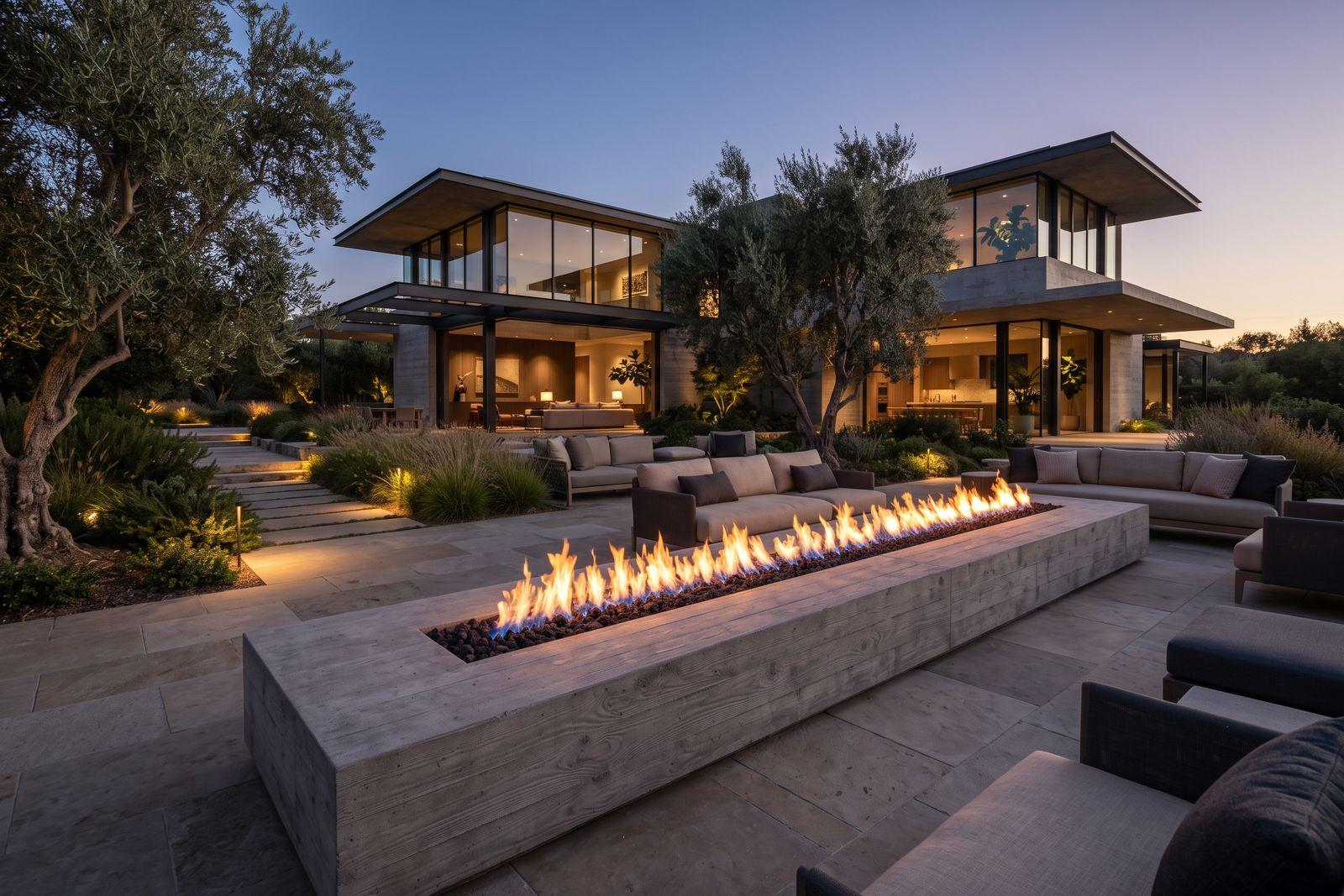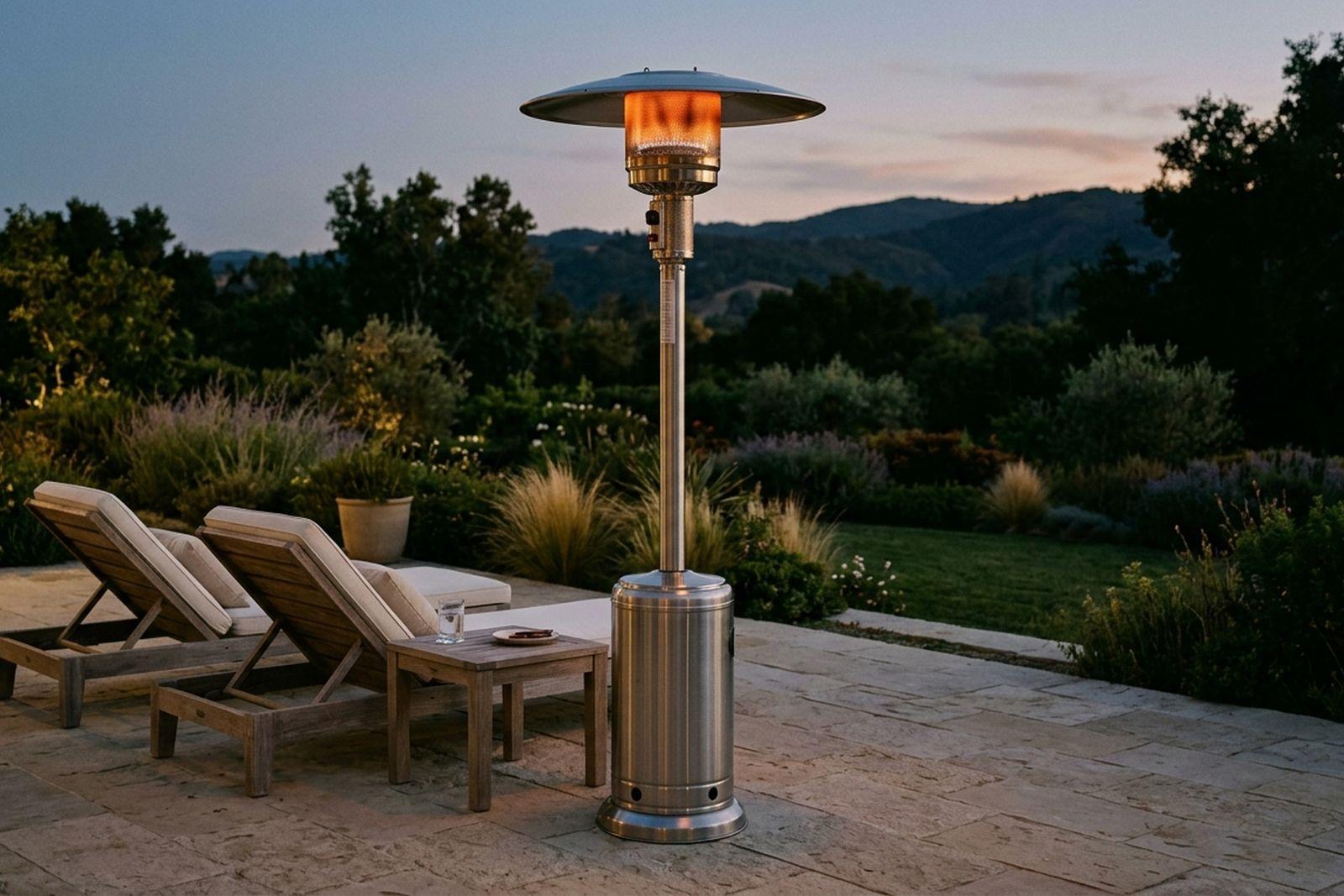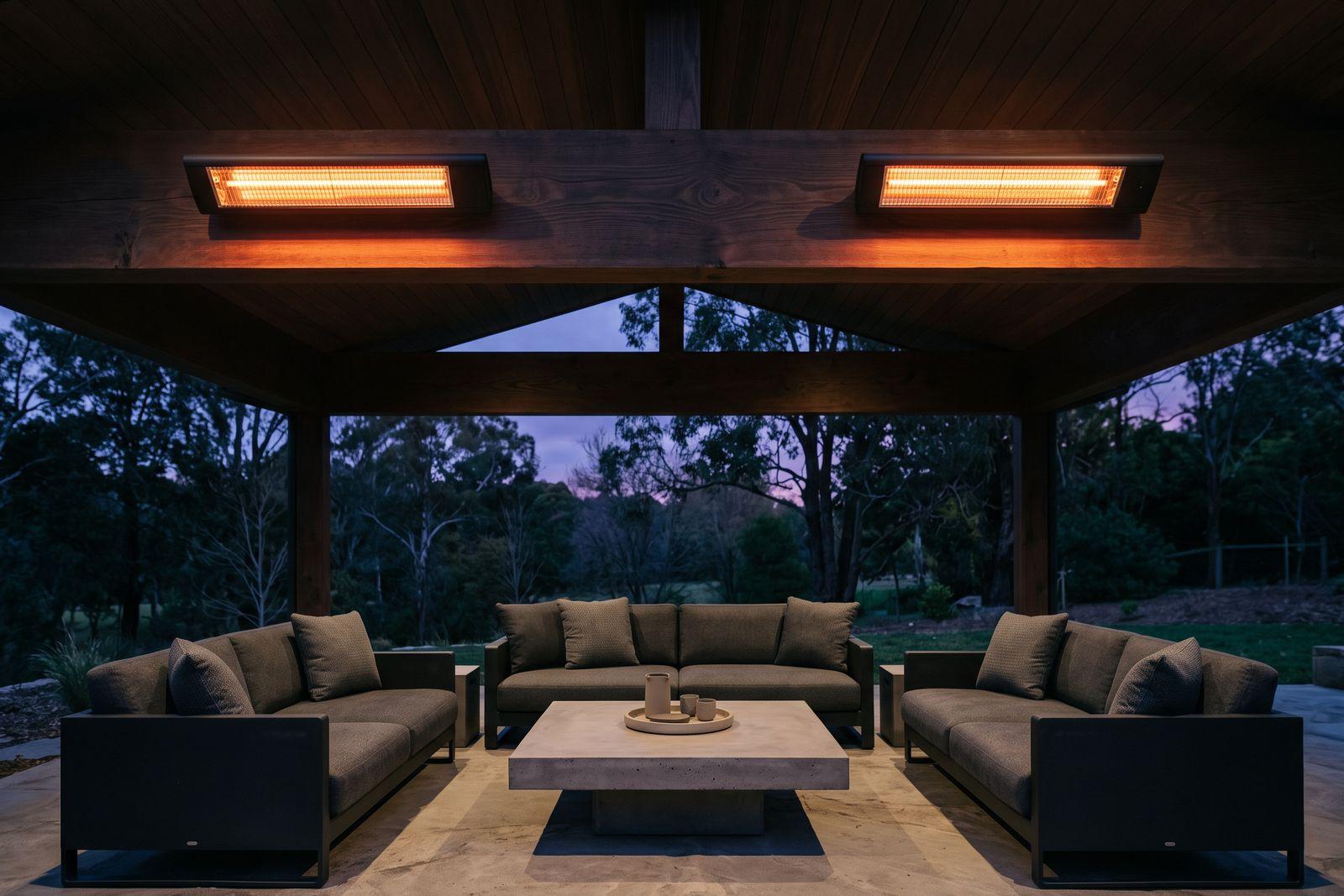

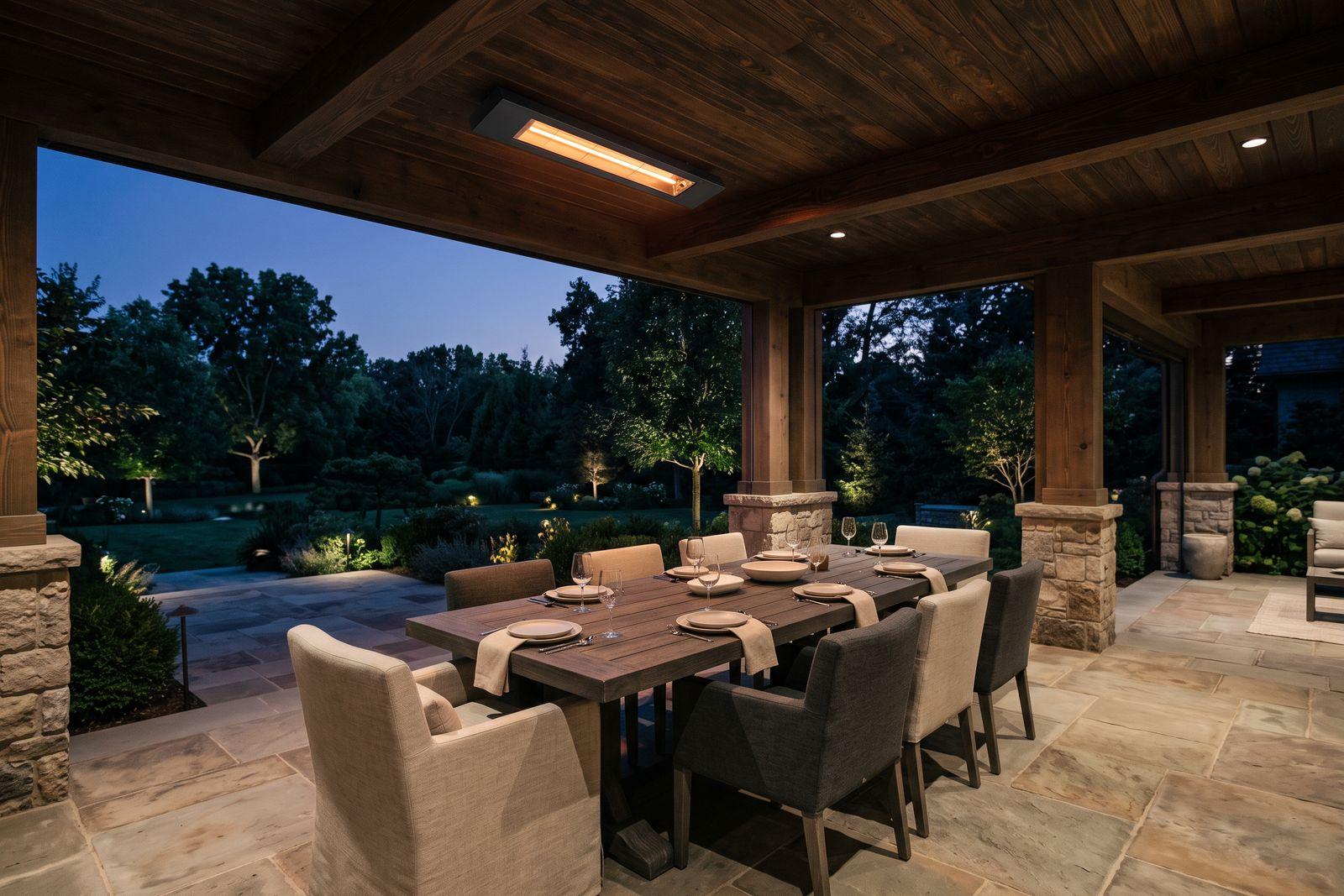
A covered patio can take a heater, and the type of heater decides which one. Hardwired electric infrared heaters are made to hang under a roof, and their manuals give ceiling and mounting distances in inches. Gas heaters need open air. The portable propane heater with a cylinder in its base is the hardest fit: the 2024 International Fire Code bars it from beneath combustible overhangs, and one maker's manual caps it at three walls with 30 percent of the perimeter open.
This guide compares published manuals, spec sheets and the model fire code. I have not tested any of these heaters, and your heater's own manual and your local inspector outrank anything here.
Can You Use a Patio Heater on a Covered Patio?
It depends on the type, and the documents sort heaters into four groups.
| Heater type | Under a roof? | What the documents say |
|---|---|---|
| Hardwired electric infrared | Yes, made for it | Bromic and Infratech both recommend installing theirs under cover. |
| Gas radiant, wall or ceiling mount | Yes, with open sides and a tall ceiling | Bromic's Tungsten Gas manual allows a roof with no more than two walls. |
| Freestanding gas tower | Only if the ceiling is tall enough | Lava Heat Italia and Bromic print minimum ceilings of 8 ft 0.5 in. to 10 ft 1 in. |
| Portable propane heater, cylinder in the base | Rarely | The 2024 International Fire Code (IFC) bars it from beneath combustible overhangs. |
The split follows one fact. An electric heater burns nothing, so there is nothing to vent. Bromic's product pages say its electric Tungsten heaters need no ventilation because no gases are released, while its Platinum Gas heater does need it because potentially harmful byproducts go into the air. That is why every gas manual below talks about open air.
How Close Can a Patio Heater Be to the Ceiling?
Electric heaters can sit closer than gas ones. These are the distances each maker prints.
Heater, Above the heater, Sides and front, Mounting height or ceiling, Document
Bromic Tungsten Gas, 300 and 500
- Above the heater
- 3 ft, or 14 in. with the heat shield
- Sides and front
- 3 ft to the side
- Mounting height or ceiling
- 8 ft minimum mounting height
- Document
- Manual v2.3, p. 7
Bromic Tungsten Freestanding
- Above the heater
- 36 in.
- Sides and front
- 36 in.
- Mounting height or ceiling
- 121 in. minimum floor clearance
- Document
- Cut sheet
Infratech C, CD, W and WD (electric)
- Above the heater
- 12 in. wall mount, 6 in. ceiling mount
- Sides and front
- 18 in. to adjacent walls and ends, 36 in. in front, 6 in. behind
- Mounting height or ceiling
- 6 ft if labeled UL Listed, 8 ft if labeled UL/CUL Listed
- Document
- Manual, p. 2
Heatstrip Classic (electric)
- Above the heater
- 3 15/16 in. (100 mm)
- Sides and front
- Combustibles 3 ft or more in front
- Mounting height or ceiling
- 6 ft 10 3/4 in. (2.1 m) minimum, 7 ft 6 1/2 in. to 8 ft 2 7/16 in. recommended
- Document
- Manual, pp. 4 and 10
Lava Heat Italia Positano
- Above the heater
- 24 in.
- Sides and front
- 24 in. each side
- Mounting height or ceiling
- Ceiling 8 ft 0.5 in. (Capri) or 9 ft 8.5 in. (2G, Lava Lite)
- Document
- Maker's Positano page
Mi-T-M portable propane patio heater
- Above the heater
- 3 ft (checklist page: 2.3 ft)
- Sides and front
- 2 ft (checklist page: 3.3 ft)
- Mounting height or ceiling
- Not stated
- Document
- Manual, PDF pp. 9 and 20
Bromic also prints minimum floor clearances of 72 in. (wall) and 96 in. (ceiling) for Tungsten Electric, and 96 in. for Platinum Gas. Its FAQ recommends a heat deflector on Platinum Gas when the space above is under 1,100 mm (about 43 in.).
Four cautions on reading the table.
First, the distances stack. Bromic's gas manual wants 3 ft above the heater and, separately, 8 ft from the ground to the heater, so with the heater's own height the ceiling has to be taller than 11 ft. With the optional heat shield the figure above drops to 14 in., and the ceiling has to clear 9 ft 2 in. plus the heater.
Second, Infratech sets minimum mounting height by label: 6 ft for UL Listed and 8 ft for UL/CUL Listed. Read the label on the exact model, because that decides whether it fits under your ceiling.
Third, the distance still lets heat reach the ceiling. Bromic's manual says its distance represents a surface 149°F above room temperature, that plastic, vinyl and canvas can degrade sooner, and that protecting adjacent materials is the installer's job. Measure to the lowest combustible thing overhead, which may be a beam or a hanging fixture and not the ceiling.
Fourth, Heatstrip's diagrams say lights, fans and sprinklers must not sit below the heater.
Electric Infrared Heaters Under a Roof
Electric is the group the manuals welcome under cover. Infratech's manual says to hang its heaters under a protective roof or weather cover whenever possible, because they last longer out of rain and snow. Bromic recommends building its Tungsten Electric heaters in under cover. Heatstrip's Classic manual calls the heater suitable for indoor or outdoor areas and rates it IP55.
The electric manuals reviewed set no open-wall rule, because nothing burns. They do set clearances and wiring rules. Infratech says its heaters must be hardwired by a licensed electrician and marks any heater over 240 V as commercial use only.
Both makers publish coverage that grows when the space is protected.
Infratech model, Mounting height, Average coverage, Cold coverage, Protected coverage
C-2024, 2,000 W
- Mounting height
- 7 to 8 ft
- Average coverage
- 6 x 6 ft (36 sq ft)
- Cold coverage
- 4 x 4 ft (16 sq ft)
- Protected coverage
- 8 x 8 ft (64 sq ft)
C-3024, 3,000 W
- Mounting height
- 7 to 9 ft
- Average coverage
- 8 x 8 ft (64 sq ft)
- Cold coverage
- 6 x 6 ft (36 sq ft)
- Protected coverage
- 10 x 10 ft (100 sq ft)
C-4024, 4,000 W
- Mounting height
- 8 to 10 ft
- Average coverage
- 10 x 10 ft (100 sq ft)
- Cold coverage
- 8 x 8 ft (64 sq ft)
- Protected coverage
- 12 x 12 ft (144 sq ft)
Heatstrip's Classic manual makes the same point with different labels: the 2,400 W model covers 52 sq ft in an enclosed outdoor area and 43 sq ft in an exposed one, and the 3,200 W model covers 69 and 57. The BTU calculator turns published areas like these into a wattage range, and the infrared and electric patio heater guide covers voltage, amps and mounting.
Gas Radiant and Freestanding Heaters: Open Sides and Tall Ceilings
Bromic's Tungsten Gas manual treats a roof as fine and a closed room as not. The 300 is rated 26,000 BTU and the 500 is rated 43,000. The manual says the heater is for above-ground, open-air use with natural ventilation and no stagnant areas, is not approved for indoor use and should go under a protective cover to keep rain off it. The shelter rules are in the table below.
Freestanding towers are a ceiling-height problem first. Lava Heat Italia lists its Positano 2G and Lava Lite at 92.5 in. tall and the Capri at 72.5 in., with 24 in. required overhead and on every side. That gives minimum ceilings of 9 ft 8.5 in. and 8 ft 0.5 in., and the page says "a standard 8-foot covered patio will not take any of these." Bromic's freestanding Tungsten, at 38,500 BTU, needs a ceiling of at least 121 in. by its cut sheet, and its FAQ says it suits covered patios when the clearances are met and the covered area is well ventilated.
Heatstrip's two gas models, both 32,225 BTU/hr, say to use them only in a well ventilated area and away from combustibles. The warning page in the wall-mounted model's manual goes further. It says not to use the heater under any overhead or near unprotected combustibles, and it lists a garage, porch, shed and breezeway as enclosed areas. The same page asks for 3 ft from any wall or surface, on a heater sold for wall mounting, while Heatstrip's brochure gives that heater 500 mm overhead. The page also appears in the freestanding model's manual. Ask Heatstrip which clearances apply to a roofed installation before you plan around either model.
Why Portable Propane Patio Heaters Rarely Fit Under a Roof
The 2024 IFC covers this style by name: a portable outdoor gas-fired heating appliance with its fuel container built into the unit. Section 4103.1.2 prohibits these positions.
- Inside any occupancy while connected to the container, inside tents, canopies and membrane structures, or on exterior balconies.
- Within 5 ft of a building, or within 5 ft of an exit or exit discharge.
- Beneath, or within 5 ft of, combustible overhangs, awnings, sunshades or similar attachments to a building.
The code also requires a listing to ANSI Z83.26/CSA 2.37, a tip-over switch, a guard over the heating element and a container of 20 lb or less. The 2021 edition numbered this rule 605.5, and Charleston's fire marshal still publishes it that way, so a local page may not match the 2024 numbers. Your city may also be on an older edition or amend it.
Read that list against a roofed patio. If the roof is wood-framed and attached to the house, it is a combustible overhang or attachment to a building, and the heater cannot sit beneath it. Section 4101.1 scopes the chapter to portable equipment used for temporary heating, so whether it reaches a home patio, and how your official reads your roof, are local calls.
The manuals add their own limits. Mi-T-M's propane patio heater manual says not to use the heater in a building, garage or any other enclosed area, and it asks for an opening of outside air of 3 sq ft for every 100,000 BTU/hr of heater rating. Its text gives 3 ft above and 2 ft to the sides, while its checklist gives 2.3 ft above and 3.3 ft to the sides. The manual disagrees with itself, so until the maker says which is right, plan for 3 ft above and 3.3 ft to the sides.
Two more points from the same manual. It says propane is heavier than air, so a leak sinks, and walls and a roof give it more places to collect. It also carries a carbon monoxide danger notice and says the heater consumes oxygen. The Consumer Product Safety Commission says carbon monoxide comes from the incomplete burning of fuels that include propane and natural gas, and calls it a colorless, odorless, poisonous gas. That hazard sits behind every open-air rule here. The natural gas vs propane guide has the fuel details.
How Enclosed Is Too Enclosed?
The gas manuals answer by counting walls and open area, and they use nearly the same words.
| Document | Allowed shelter for a gas heater |
|---|---|
| Bromic Tungsten Gas manual, p. 6 | Walls on all sides with at least one permanent opening at ground level (the diagram shows an open top). Or a roof with two walls or fewer. Or a roof with more walls and at least 25 percent of total wall area completely open and 30 percent of the rest open and unrestricted. |
| Heatstrip X-DGR32PLP manual, p. 4 | The same three arrangements, plus at least 20 percent of total wall area open and unrestricted for balconies. |
| Mi-T-M propane patio heater manual, PDF p. 19 | Walls on all sides with no roof and 47 in. from combustibles. A roof with two walls or fewer. A roof with three walls and at least 30 percent of the perimeter permanently open. |
| 2024 IFC, Section 4103.1.2.1.1 | For portable gas heaters, never inside tents, canopies or membrane structures, or on exterior balconies. |
Count the walls and the open area, whatever the space is called. Heatstrip's warning page lists a porch and a breezeway as enclosed areas, while Mi-T-M's manual allows a roof with two parallel walls and compares it to a breezeway.
Screened Porches and Closed-In Porches
A screened porch is a roof with three or four screened walls. None of the heater manuals reviewed says whether screening counts as open wall area. Bromic's wording asks for wall area that is completely open, and a screen is not completely open. I would not count screens toward that 25 percent without a written answer from the maker or your inspector.
An electric heater avoids the question.
A porch closed in with glass or vinyl panels is a different space. Mi-T-M and Heatstrip rule gas heaters out of enclosed areas, and Bromic's shelter list has no place for a roofed room with four closed walls. Treat it as electric only.
Which Heater Fits Which Covered Space
These pairings are my reading of the documents above; no manual states them.
- A solid-roofed patio with a ceiling around 8 ft: electric infrared. Infratech's 6 ft minimum for UL-labeled models and Heatstrip's 6 ft 10 3/4 in. minimum fit, but Infratech's 8 ft minimum for UL/CUL-labeled models does not.
- A tall roof, over 11 ft plus the heater's height, with no more than two walls: a gas wall or ceiling heater is possible if the shelter rules are met and a licensed gas fitter installs the line.
- A tall pergola or porch: a freestanding tower, with the ceiling and clearances printed for that model.
- Open space away from the house and any roof: a portable propane heater, under the 5 ft rules and the manual's clearances.
For a flame under the same roof, see the gas fire pit under a covered patio guide and the clearance checker. The guide to choosing a patio heater covers sizing, and Bromic, Infratech and Heatstrip compared on specs sets those makers side by side.
What the Inspector and the Manual Decide
The 2024 IFC requires portable heating equipment to be listed, labeled and used per its listing and the maker's instructions (Section 4101.3). For installed heating appliances, Section 605.5 requires a listing and installation per the manufacturer's instructions and the building, fuel gas, mechanical and electrical codes. So the manual is part of the code. An inspector who finds a heater closer to the ceiling than its manual allows has grounds to fail the install, whatever this guide says.
Local codes decide the rest: the edition adopted, permits, and whether your covered patio counts as outdoors. Start at the fire code library. A licensed electrician should wire a hardwired heater, and a licensed gas fitter or plumber should run any gas line.
Checklist Before You Buy
- Read the exact model's installation manual, since product pages only summarize it.
- Check that your ceiling height covers the heater's minimum mounting height plus the distance above it.
- Count the walls and the share of wall area that is open.
- Check the label for the listing and the voltage. Infratech marks anything over 240 V as commercial use only.
- For gas, ask the maker in writing about screens, closable panels and your layout.
- Look for lights, fans, sprinklers and combustible beams inside the clearance zone.
- Ask your building department about permits and the fire code edition.
Common Questions
Can you use a patio heater on a covered patio?
Some types, yes. Hardwired electric infrared heaters are made to hang under a roof, and Infratech and Bromic both say to install theirs under cover. Gas radiant heaters can go under a roof only with open sides and the maker's overhead distance. A portable propane heater is the hardest fit, because the 2024 International Fire Code bars it from beneath combustible overhangs.
How close can a patio heater be to the ceiling?
It depends on the heater. Bromic's Tungsten Gas manual sets 3 ft above the heater, or 14 in. with its heat shield. Infratech's electric manual sets 12 in. for wall mounting and 6 in. for ceiling mounting. Heatstrip's Classic sets about 4 in. Mi-T-M's propane heater manual sets 3 ft overhead. Use the figure in your own manual, measured to the lowest combustible surface.
What is the best way to heat an outdoor covered patio?
For most covered patios, a hardwired electric infrared heater mounted overhead is the easiest fit. It makes no combustion byproducts, and none of the electric manuals reviewed sets an open-wall rule. Gas wall heaters suit a tall, open-sided roof. Size the heater from the maker's coverage figures, which Infratech lists higher for protected spaces, and have a licensed electrician do the wiring.
Are patio heaters safe on a covered porch?
It depends on the type and how enclosed the porch is. Gas heaters need open air. Bromic's gas manual allows a roof with up to two walls, or more walls only with at least 25 percent of total wall area completely open and 30 percent of the rest open. Heatstrip's gas manuals print the same rule but also say never to use the heater on a porch. A closed-in porch rules gas heaters out. Electric heaters make no combustion byproducts and can be hardwired under the roof.
Can you use a propane patio heater on a screened porch?
The manuals reviewed do not give screened porches a pass. Mi-T-M's propane heater manual allows a roof with three walls only if 30 percent of the perimeter is permanently open, and Bromic's wording asks for wall area that is completely open. None says a screen counts as open, so ask the maker in writing and check the 2024 International Fire Code rule on combustible overhangs.
Sources
- International Code Council, 2024 International Fire Code (Version 2.1, Feb 2026), Chapter 41, Temporary Heating and Cooking Operations: Section 4101.1 (scope), Section 4101.3 (listed and labeled; installed, maintained and used per the listing and the manufacturer's instructions) and Section 4103.1.2 (portable outdoor gas-fired heating appliances: prohibited locations, 5 ft clearances, listing to ANSI Z83.26/CSA 2.37, tip-over switch, guard, 20 lb container limit)Checked
- International Code Council, 2024 International Fire Code (Version 2.1, Feb 2026), Chapter 6, Section 605.5 (heating appliances listed and installed per the manufacturer's instructions)Checked
- Charleston Fire Department, Fire Marshal Division, Information Bulletin IB-2020-11-16-01 (revised 12/28/2022), Portable Outdoor Gas-Fired Heating Appliances: the same rules under Section 605.5 of the 2021 International Fire Code as adopted in South CarolinaChecked
- Bromic, Tungsten Smart-Heat Gas Installation, instruction and service manual, Version 2.3 USA - Canadian: warnings (p. 4), specifications and indoor-use warning (p. 5), Installation Requirements (p. 6), Installation Clearances (p. 7)Checked
- Bromic, Tungsten Smart-Heat Freestanding product cut sheet (2026): specifications (minimum floor clearance 121 in., 38,500 BTU) and Clearances diagramChecked
- Bromic, Tungsten Smart-Heat Electric product cut sheet (2026): specifications (minimum floor clearance wall 72 in., ceiling 96 in.)Checked
- Bromic, Platinum Smart-Heat Gas product cut sheet (2026): specifications (minimum floor clearance 96 in.)Checked
- Bromic, Platinum Smart-Heat Gas product page, FAQ (ventilation, heat deflector when clearance above is under 1,100 mm)Checked
- Bromic, Tungsten Smart-Heat Freestanding product page, FAQ (use under covered patios, ventilation)Checked
- Bromic, Tungsten Smart-Heat Electric product page, FAQ (best built in under cover, no ventilation required)Checked
- Infratech, All Weather C-Series and CD-Series Installation, Use & Care Manual (IN038, July 2024): clearances and mounting heights (p. 2), coverage areas (p. 6), location suggestions (p. 7)Checked
- Infratech, All Weather W-Series and WD-Series Installation, Use & Care Manual (IN038, July 2024): clearances and mounting heights (p. 2)Checked
- Heatstrip, Classic US product manual (X-THHUS-A, Rev 6): specifications and mounting heights (p. 4), selection guide and coverage (p. 7), installation location clearances (p. 10)Checked
- Heatstrip, X-DGR32PLP head and stand US manual: Outdoor Areas Safety Appliance Locations (p. 4) and For Your Safety warnings (p. 5)Checked
- Heatstrip, X-DGR32WNG wall-mounted radiant gas heater US manual (09/2025 v1): Outdoor Areas Safety Appliance Locations (p. 4) and For Your Safety warnings (p. 5: not under any overhead, 3 ft from any wall or surface, never in a garage, porch, shed or breezeway)Checked
- Heatstrip, 2025 US Brochure, Wall Mounted Gas: 500 mm overhead clearance with the standard reflectorChecked
- Lava Heat Italia, Positano Flame Tower Collection page: heights, minimum ceilings, 24 in. side and overhead clearanceChecked
- Mi-T-M Corporation, Propane Patio Heaters Operator's Manual MH-0042-PM11 (37-1494-E-071322; conforms to CSA/ANSI Z83.26-2020/CSA 2.37-2020): ventilation opening (PDF p. 5), clearances and propane weight (PDF p. 9), shelter rules (PDF p. 19), checklist (PDF p. 20)Checked
- U.S. Consumer Product Safety Commission, Carbon Monoxide Fact Sheet: sources, symptoms and enclosed-space warningsChecked
About the Author
James Darren Writes the Firepit HQ guides on fire features, fuel and fire codes. Every figure in them is cited to its source with the date it was checked.