
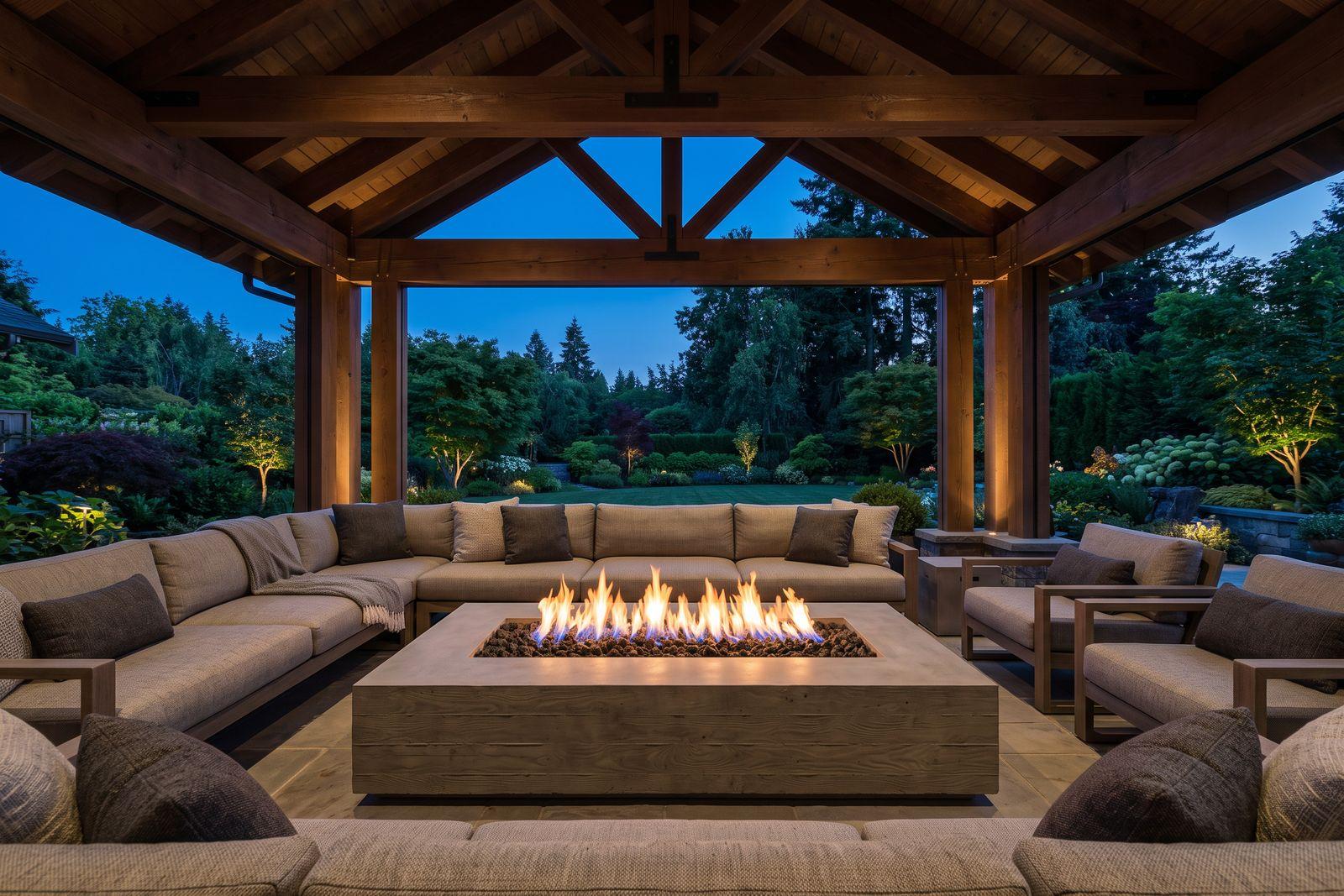
Some gas fire pits and fire tables can go under a roof, and some cannot. In the manuals compared here the overhead clearance runs from 72 to 120 inches, and Real Flame's manuals say not to place its tables under any overhead structure at all. Three things decide whether your covered patio works: the overhead clearance in your manual, how many sides are walled in, and the burner's Btu/h rating.
This guide compares published manuals and the model fuel gas code. I have not tested any of these products, and I have not read the listing standard itself, which is paid. The manual for the exact unit you buy sets its own minimums, and your inspector decides the rest.
Can You Put a Gas Fire Pit Under a Covered Patio?
Yes, when the manual for that fire pit allows it and the space stays open enough. A covered porch or covered deck is judged the same way. Most of the manuals reviewed accept a roof with enough clearance above the flame, and a roof plus walls on most sides is where they start saying no.
Three limits show up again and again.
- Overhead distance. Every maker that allows a roof prints a figure, from 72 to 120 inches.
- Closed sides. The makers that state a limit allow two closed sides, and one allows a third with 30 percent of the side wall area open.
- Btu/h tier. Bigger burners get bigger numbers. At the top tier The Outdoor Plus allows no overhead structure, and HPC allows only noncombustible screening.
A fourth limit sits above all of them. Firegear's manual says its burners are not for use in an enclosed space, and every other manual reviewed carries outdoor-only or enclosed-space warnings.
How Much Overhead Clearance Does a Gas Fire Pit Need?
It depends on the maker and the burner. This table lists what each document prints.
Maker and document, Burner input, Above the fire pit, Sides, What it says about a roof
HPC Fire Inspired, MLFPK and EI inserts
- Burner input
- Up to 200,000 Btu/h (MLFPK to 65,000)
- Above the fire pit
- 84 in.
- Sides
- 36 in. (12 in. for noncombustible)
- What it says about a roof
- Overhead structure means a roof, overhang, pergola or screen
HPC Fire Inspired, EI inserts
- Burner input
- 201,000 to 400,000 Btu/h
- Above the fire pit
- Noncombustible screen only; Figure 2 shows 120 in. to a solid structure
- Sides
- 48 in. (24 in. for noncombustible)
- What it says about a roof
- Noncombustible material with at least 50 percent free air space, such as a screen or pergola
The Outdoor Plus, FB-ML-M fire bowl
- Burner input
- Up to 65,000 / 66,000 to 200,000 / 201,000 to 400,000
- Above the fire pit
- 96 in. in every tier
- Sides
- 36 in. / 48 in. / 48 in.
- What it says about a roof
- No overhead structures or obstructions above 200,000 Btu/h
Prism Hardscapes, Moderno
- Burner input
- 65,000 Btu/h
- Above the fire pit
- 6 ft from the top
- Sides
- 4 ft
- What it says about a roof
- Not addressed in the pages reviewed
Firegear Pro H-burners
- Burner input
- 80,000 to 150,000 / 160,000 to 250,000
- Above the fire pit
- 96 in. / 120 in. (combustible ceiling)
- Sides
- 36 in. side wall, 18 in. floor
- What it says about a roof
- Not to be used in an enclosed space
Outdoor GreatRoom, FAQ
- Burner input
- Not stated
- Above the fire pit
- 72 in. above the top of the burner
- Sides
- 24 in. from the burner edge
- What it says about a roof
- Partial-enclosure rules, below
Real Flame, Baltic Rectangle and Forest Ridge
- Burner input
- 65,000 and 50,000 Btu/h
- Above the fire pit
- 60 in. from the top
- Sides
- 48 in. on all sides
- What it says about a roof
- "Do not place this fireplace under any overhead structure or vegetation."
Read the table three ways.
First, the makers measure from different points. HPC says above the product, Outdoor GreatRoom says above the top of the burner, and Prism and Real Flame say from the top. Look at the diagram in your manual, measure to the lowest combustible thing overhead, and add the height of the piece.
Second, a noncombustible ceiling does not shorten the number. HPC cuts its side figure from 36 to 12 in. for noncombustible walls, but its overhead figure has no such line. The Outdoor Plus applies the same side figure to noncombustibles. None of the manuals reviewed prints a shorter overhead distance for metal or masonry.
Third, Btu/h changes the numbers and the fuel does not. None of the manuals reviewed prints a different clearance for natural gas than for propane, but ratings can differ by fuel: Firegear's 80 in. H-burner is 250,000 Btu/h on natural gas and 240,000 on propane. A burner that fits under your roof at 65,000 Btu/h may not at 250,000. The fire pit BTU ratings guide explains how to read a rating, and the clearance checker lists the published minimums across more makers for your input.
A Worked Example
Take a fire table whose burner sits 24 in. off the floor. That height is a placeholder, so use your model's number. Adding it to each published overhead figure gives a first-pass ceiling.
| Maker | Published overhead figure | Ceiling needed with the burner 24 in. up |
|---|---|---|
| Prism and Outdoor GreatRoom | 72 in. | 96 in. (8 ft) |
| HPC, up to 200,000 Btu/h | 84 in. | 108 in. (9 ft) |
| HPC, 201,000 to 400,000 Btu/h, solid structure | 120 in. | 144 in. (12 ft) |
| The Outdoor Plus | 96 in. | 120 in. (10 ft) |
| Firegear, 80,000 to 150,000 Btu/h | 96 in. | 120 in. (10 ft) |
| Firegear, 160,000 to 250,000 Btu/h | 120 in. | 144 in. (12 ft) |
| Real Flame | No overhead structure | No roof |
The makers measure from different points, so confirm each result against the manual's diagram. The pattern still holds. If the ceiling is what limits you, look for a lower input rating, a lower-profile piece or a maker with a shorter published figure.
Pergola vs Solid Roof
A pergola counts as an overhead structure. HPC's manual says to check the clearances for "any type of overhead structure such as pergola, roof, overhang, screens, arbor" and draws its 84 in. figure under a box labeled roof, overhang, pergola or screen. The manual makes no exception for open slats.
The pergola does help with airflow. Outdoor GreatRoom describes a pergola or partial cover as a partial enclosure and accepts two arrangements: two side walls with an overhead cover, or three side walls with at least 30 percent of the side wall area permanently open. A pergola with fewer walls than that is more open, which is the direction all of these rules push. That is my reading and not the FAQ's wording.
Three details trip people up.
- Closing louvers. A louvered pergola that shuts is a solid roof. None of the manuals reviewed addresses it, so ask the maker.
- Vines and fabric. Real Flame's warning names vegetation, and Bromic's heater manual says plastic, vinyl and canvas can degrade at lower temperatures. I would treat a vine, a shade cloth or a retractable canopy as part of the overhead structure.
- High-Btu burners. Above 200,000 Btu/h the makers split. The Outdoor Plus allows no overhead structure, which would include a pergola. HPC's table allows only a noncombustible screen overhead, and its Figure 2 describes that as noncombustible material with at least 50 percent free air space, typically a screened area or pergola, with 120 in. to any overhead solid structure.
Open Sides and Airflow Rules
Most manuals only say "outdoor use." Two makers say more.
- HPC. Its clearance diagrams for burners up to 400,000 Btu/h show a residential or commercial building, or a solid structure or combustible, on no more than 2 sides of the fire pit. Separately, they call for vents of 18 sq in. each on opposing sides of the fire pit's own noncombustible enclosure: at least two up to 200,000 Btu/h and four above it.
- Outdoor GreatRoom. A fully enclosed space, or four walls with a roof and no openings, is not an outdoor space for its tables. A partial enclosure is acceptable with two side walls and a cover, or three side walls and a cover with at least 30 percent of the side wall area permanently open.
Real Flame sits at the strict end: no overhead structure at all. Firegear, Prism, HPC and The Outdoor Plus all say outdoor use only. Taken together, the useful test is how much air moves through the space. Both makers that state a limit accept two closed sides. HPC stops there, and Outdoor GreatRoom allows a third only with 30 percent of the side wall area permanently open. Heater manuals use similar open-area tests, and the outdoor heater for a covered patio guide covers them.
Screened Porches and Gazebos
A screened wall passes less air than an open side. Outdoor GreatRoom is the one maker in these documents that addresses screened porches, and it counts a screened wall by its open area. Its FAQ says the unit is not UL approved for a screened porch, gazebo or lanai, but it should not be a problem if these conditions are met.
- At least three walls are screened.
- The screens stay permanently open, with no windows that can close.
- The screened walls give a minimum open area of 30 percent.
- All the unit's ceiling and wall clearances are met.
- The porch is at least 96 sq ft.
None of the other manuals reviewed mentions screened porches. Ask your maker in writing, and keep the answer. A porch closed in with glass or vinyl panels counts as enclosed, and no manual reviewed allows a gas fire pit there.
Heat Damage to the Ceiling and What Hangs From It
A published clearance still lets heat reach the ceiling. HPC warns that fire pits create temperatures between 3,000°F and 3,600°F. Bromic's heater manual states the principle plainly: its clearance represents a surface 149°F above room temperature, plastic, vinyl and canvas can degrade sooner, and protecting adjacent materials falls to the installer.
Apply that to a patio roof.
- Measure to the lowest part of the ceiling system, which may be a beam or a hanging fixture.
- Treat fans, lights and sprinkler heads as part of the overhead. Heatstrip's heater manual draws this line for heaters, and no fire pit manual reviewed says otherwise.
- Count vines, hanging plants and fabric. Real Flame names vegetation.
- Check what the ceiling is made of. The manuals treat all combustibles alike, so size the distance for the most heat-sensitive finish overhead.
On a covered deck, add the floor. HPC requires its Deck Insulation Kit and pavers to install an insert on a wood or composite deck. The gas fire pit on a deck guide covers that.
Carbon Monoxide Under a Roof
The Consumer Product Safety Commission says carbon monoxide comes from the incomplete burning of fuels that include propane and natural gas, and calls it a colorless, odorless, poisonous gas. The early symptoms it lists include headache, fatigue and nausea. Firegear, HPC, The Outdoor Plus and Real Flame all print a danger notice that the appliance can produce carbon monoxide, which has no odor, and that using it in an enclosed space can kill. Prism recommends carbon monoxide detectors within reach of the appliance and in any adjacent occupied spaces.
Roofs and walls matter because they slow the air that carries exhaust away. HPC's manual notes that propane is heavier than air and may settle in low places while dissipating. A closed-in corner under a roof gives it somewhere to collect. The natural gas vs propane guide covers how the two fuels differ, and are gas fire pits safe goes through carbon monoxide, smell and overnight use.
I would treat a detector near the patio door as a backstop for the open-side and clearance rules, never as a substitute for them.
What the Inspector and the Manual Decide
The 2024 International Fuel Gas Code, Section 635.1, says permanently fixed-in-place outdoor decorative appliances shall be listed to ANSI Z21.97 and installed per the manufacturer's instructions. So the manual is part of the code, and an inspector can fail an install that sits closer to a ceiling than the manual allows.
Makers document the listing in different ways. HPC's manuals say select models are certified to ANSI Z21.97-2014. The Outdoor Plus holds a CSA certificate to the 2017 edition for its decorative gas appliances. Prism's manual says it uses CSA certified components. Ask the maker which listing covers the whole appliance and ask your inspector what they want to see.
Local rules cover the rest: the code edition adopted, permits, and whether your covered patio counts as an outdoor space. Ask the building department whether a roof attached to the house is treated differently from a freestanding pergola. Start at the fire code library, and see how far a gas fire pit must sit from the house for the distance from the house itself. A licensed gas fitter or plumber should run any gas line.
Checklist Before You Buy
- Get the exact model's installation manual and find the overhead and side tables.
- Note how the maker measures: from the burner, the top of the product or the media.
- Measure your ceiling at its lowest combustible point, including beams, fans and fixtures.
- Add the height of the piece to the overhead figure and compare it to that ceiling.
- Count the closed sides and the share of wall area that is open.
- Check the burner's Btu/h against the tier in the manual.
- Ask the maker about screens, louvers and closable panels in writing.
- Ask for the listing that covers the whole appliance, and ask your building department about permits.
- Plan a carbon monoxide detector inside the house near the patio, and hire a licensed gas fitter for the gas line.
Common Questions
Can you put a gas fire pit under a covered patio?
Sometimes, and the manual for your exact fire pit decides. HPC, The Outdoor Plus, Prism and Firegear print overhead clearances of 72 to 120 inches. Real Flame's manuals say not to place its tables under any overhead structure. Airflow matters too: HPC allows a building or solid structure on no more than two sides, and Outdoor GreatRoom accepts two walls with a cover or three walls with 30 percent open.
How much clearance do you need above a gas fire pit?
It varies by maker and Btu rating. Prism and Outdoor GreatRoom print 72 inches. HPC prints 84 inches up to 200,000 Btu/h. The Outdoor Plus prints 96 inches in every tier, and Firegear prints 96 or 120 inches by burner size. Above 200,000 Btu/h, The Outdoor Plus allows no overhead structure and HPC allows only noncombustible screening. Check how your manual measures the distance, then add the height of the fire pit.
Can you have a gas fire pit on a screened-in porch?
Outdoor GreatRoom says its fire pit tables can go on a screened porch if at least three walls are screened, the screens stay permanently open with no closable windows, they give at least 30 percent open area, the porch is at least 96 square feet and all clearances are met. It also says the unit is not UL approved for that use. The other manuals reviewed do not address screened porches, so ask your maker.
Can you put a gas fire pit under a pergola?
HPC lists a pergola as an overhead structure, so its 84 inch clearance applies to a pergola as it does to a roof. Above 200,000 Btu/h, HPC allows only noncombustible material with at least 50 percent free air space and The Outdoor Plus allows no overhead structure. Outdoor GreatRoom accepts two side walls with a cover, or three walls with 30 percent open. The manuals reviewed do not address louvers that close.
Is it safe to use a gas fire pit under a roof?
It can be, with the clearances and open sides in the manual. Every manual reviewed says outdoor use only, and several carry a danger notice that the appliance can produce odorless carbon monoxide and that using it in an enclosed space can kill. Prism recommends carbon monoxide detectors in adjacent occupied spaces. Keep to the overhead and side distances, keep the open sides the maker requires, and have a licensed gas fitter handle the gas line.
Sources
- HPC Fire Inspired (Hearth Products Controls Co.), MLFPK Series Match Lit Fire Pit Insert, Installation & Operation Instructions, 870-MLFPK: carbon monoxide warning (PDF p. 2), propane weight warning (PDF p. 3), select models certified to ANSI Z21.97-2014 / CSA 2.41-2014 (PDF p. 5), Table 3.1 clearances and deck warning (PDF p. 9), Section 4 overhead structures and Figure 4.1 (PDF p. 10)Checked
- HPC Fire Inspired (Hearth Products Controls Co.), EI Series Electronic Ignition Fire Pit Insert, Installation & Operation Instructions, 860-EI ON/OFF: carbon monoxide warning (PDF p. 2), Table 3.1 clearances for up to 200k and 201k to 400k Btu (PDF p. 9), Figure 1 (PDF p. 10) and Figure 2 (PDF p. 11)Checked
- The Outdoor Plus, Fire Bowl Installation, Match Lit (FB-ML-M), PDF dated 2026-06-24: carbon monoxide warning (PDF p. 2) and Clearance From Combustibles by Btu tier (PDF p. 5)Checked
- CSA Group, Certificate of Compliance 80130914 to The Outdoor Plus Co., Inc., issued 2022-11-17: ANSI Z21.97-2017 / CSA 2.41-2017, Outdoor decorative gas appliances, Third EditionChecked
- Prism Hardscapes, Moderno Series Installation, Operation & Maintenance Manual: clearance to combustible surfaces, 4 ft on sides and 6 ft from the top (Section 3.1, PDF p. 10), carbon monoxide detector recommendation (PDF p. 8) and CSA certified components statement (PDF p. 9)Checked
- Firegear Outdoors, Outdoor Fire Pit Pro H-Burners & Kits, Installation and Operating Instructions, REV. D: Table 1 installation specifications and Fig. 2 clearance to combustibles (PDF p. 4), carbon monoxide danger notice (PDF p. 2), outdoor-only warning (PDF p. 7)Checked
- Real Flame, Baltic Rectangle Fire Table manual, model 9750NG (© 2021 KSP Group, Inc.), Installation Warnings (PDF p. 4): clearances and overhead structure warningChecked
- Real Flame, Forest Ridge Fire Table manual, model C1600LP (© 2020 KSP Group, Inc.), Installation Warnings (PDF p. 4): clearances and overhead structure warningChecked
- Outdoor GreatRoom Company, Frequently Asked Questions (manufacturer website): clearances, partial enclosures, pergolas and screened porchesChecked
- International Code Council, 2024 International Fuel Gas Code (Version 2.0), Chapter 6, Section 635.1 (permanently fixed-in-place outdoor decorative appliances listed to ANSI Z21.97 and installed per the manufacturer's instructions)Checked
- Bromic, Tungsten Smart-Heat Gas Installation, instruction and service manual, Version 2.3 USA - Canadian, Installation Clearances (p. 7): stated clearance represents a surface 149°F above room temperature, and low heat tolerance materials degrade sooner (a radiant heater manual, cited for the principle)Checked
- Heatstrip, Classic US product manual (X-THHUS-A, Rev 6), Installation location (p. 10): lights, fans and sprinklers must not be below the heater (a heater manual, cited for the principle)Checked
- U.S. Consumer Product Safety Commission, Carbon Monoxide Fact Sheet: sources of carbon monoxide, its colorless and odorless nature and symptomsChecked
About the Author
James Darren Writes the Firepit HQ guides on fire features, fuel and fire codes. Every figure in them is cited to its source with the date it was checked.