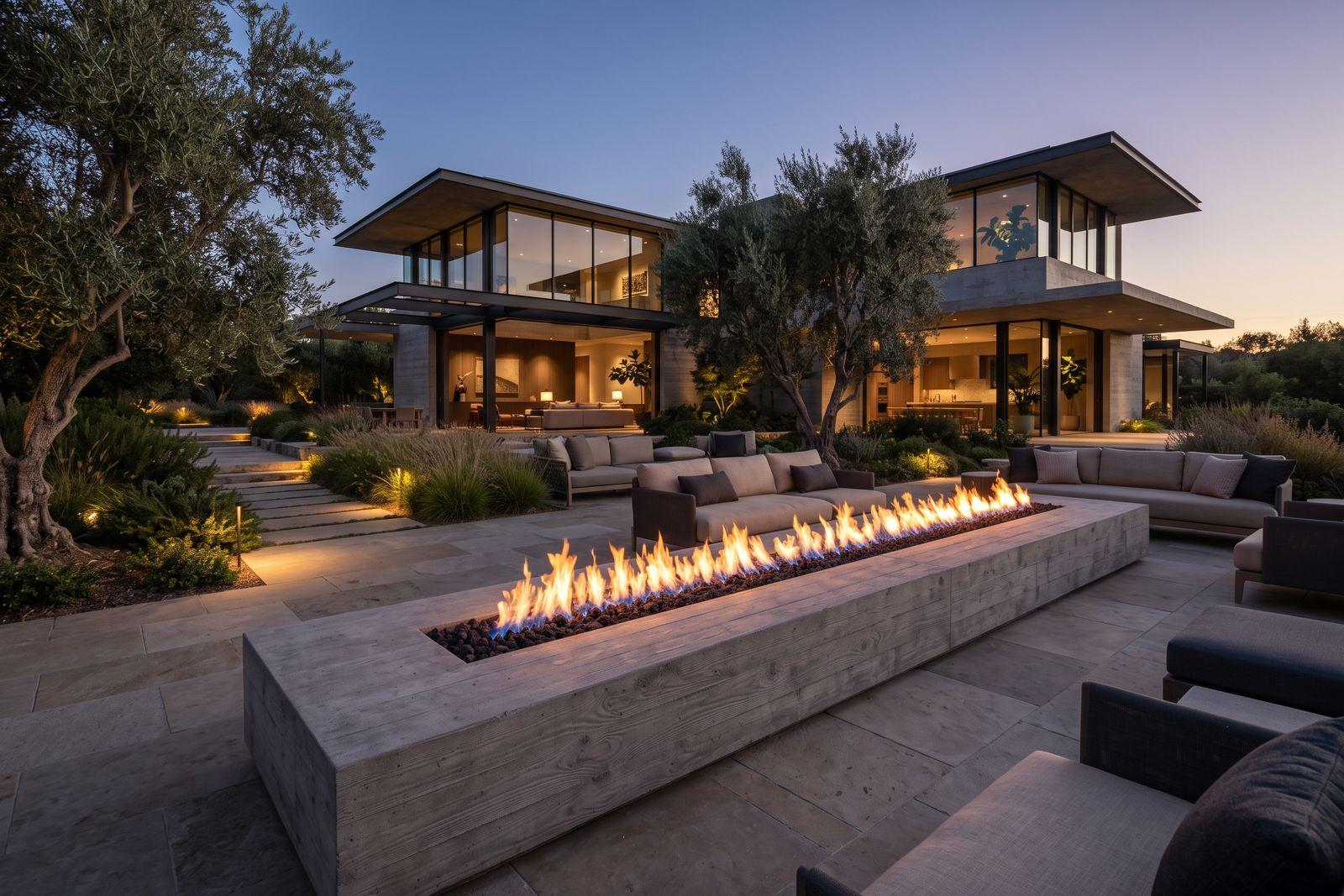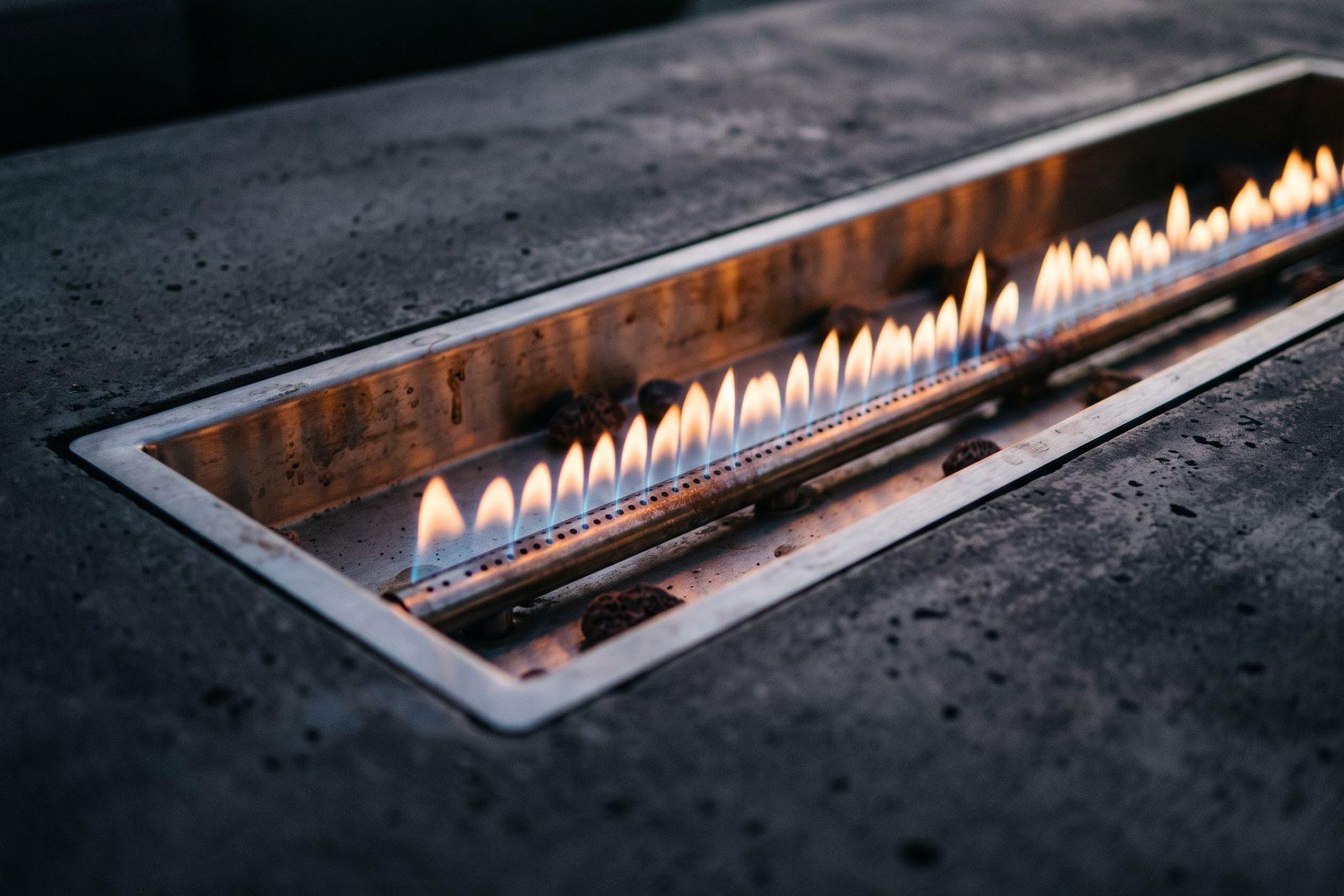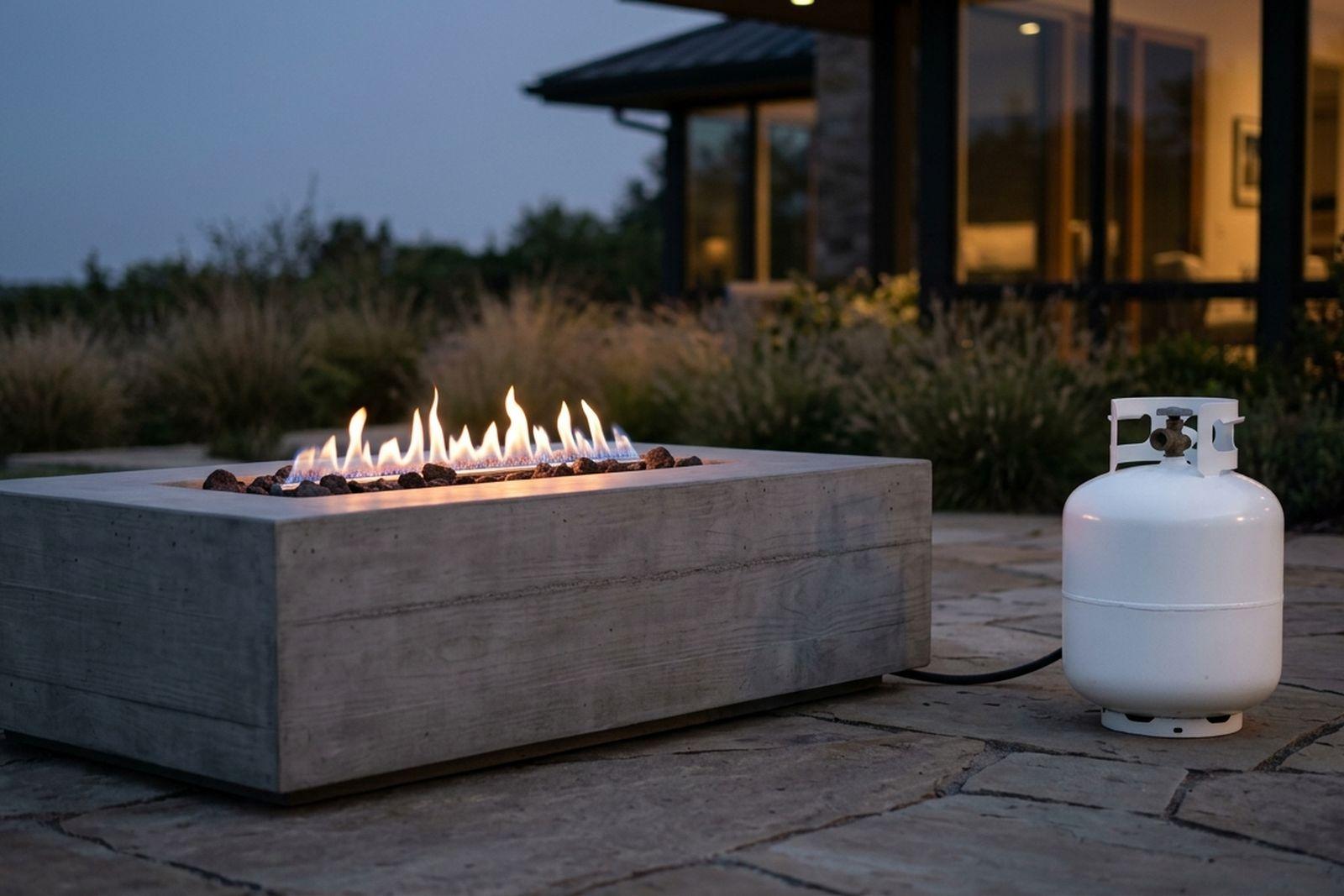

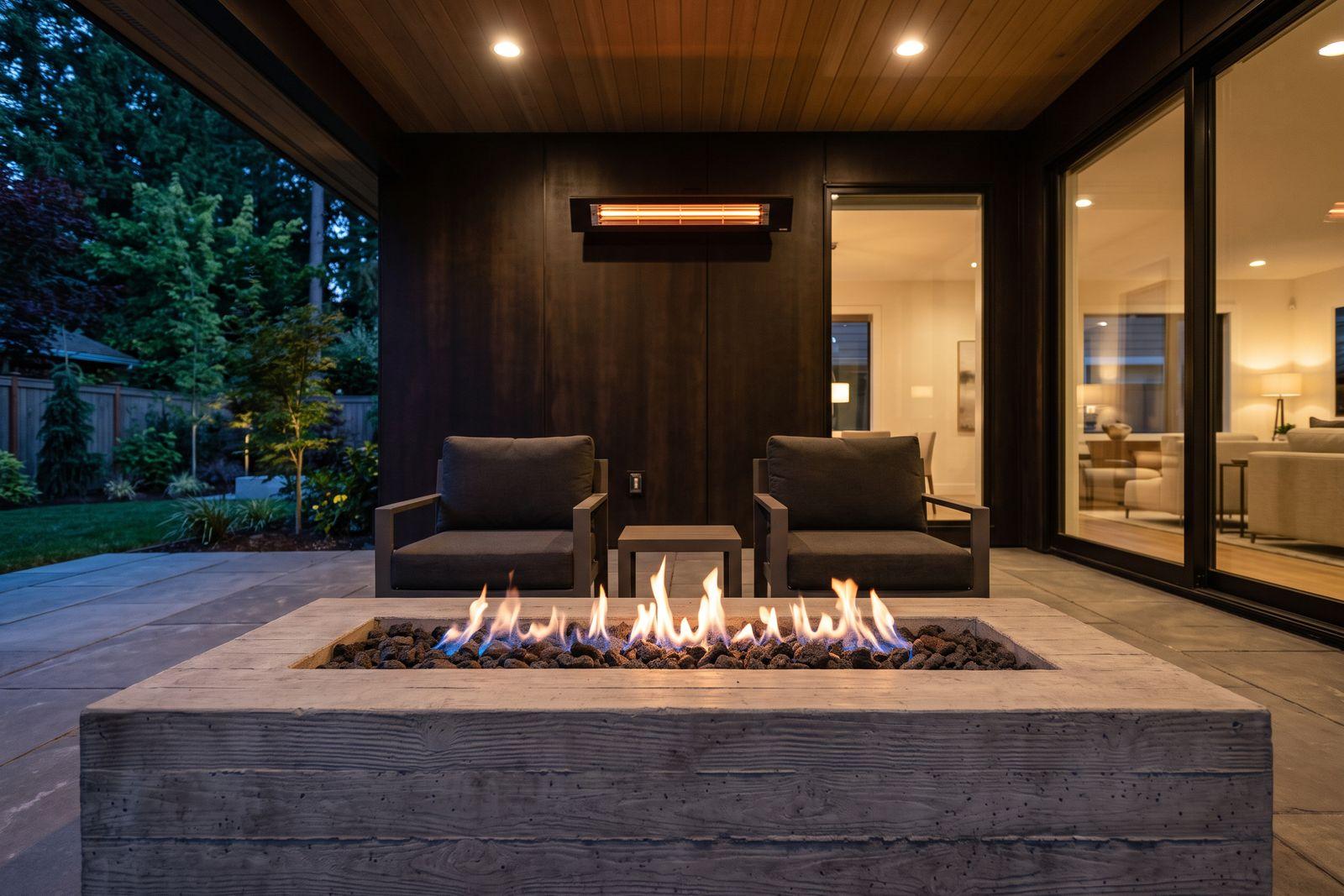
A patio heater heats a patio better than a fire pit does, and the published documents show why. Heater makers state how many square feet a heater covers, most with a mounting height or condition attached, and they build it to be aimed at the seats. Fire pit makers state an input rating and clearances, and none of the ones I read states an area their fire heats. Buy the heater for warmth across a seating area and the fire pit for the flame.
This guide compares published specs, manuals and a NIST fire model. Firepit HQ has not tested any heater or fire pit, and every figure comes from a maker's document, a standards body or a government source in the sources list.
Which Heats a Patio Better, a Patio Heater or a Fire Pit?
The heater, on the evidence a buyer can check. This is what each maker puts in writing.
Appliance, Rated input, Area the maker states, Basis the maker states
Bromic Tungsten Gas 300
- Rated input
- 26,000 BTU/h
- Area the maker states
- 160 sq ft
- Basis the maker states
- Footnote "In ideal conditions"
Bromic Tungsten Gas 500
- Rated input
- 43,000 BTU/h
- Area the maker states
- 215 sq ft
- Basis the maker states
- Same footnote
Bromic Tungsten Freestanding
- Rated input
- 38,500 BTU/h
- Area the maker states
- Up to 215 sq ft
- Basis the maker states
- None stated
Heatstrip gas heaters, wall-mounted and portable
- Rated input
- 32,225 BTU/h
- Area the maker states
- 172 sq ft
- Basis the maker states
- None stated
Schwank supremeSchwank 35K
- Rated input
- 35,000 BTU/h
- Area the maker states
- Up to about 250 sq ft
- Basis the maker states
- 10 ft mounting height
Infratech C-15
- Rated input
- 1,500 W
- Area the maker states
- 25 sq ft (5 by 5 ft)
- Basis the maker states
- 6 to 7 ft mounting height
Infratech CD-60
- Rated input
- 6,000 W
- Area the maker states
- 121 sq ft (11 by 11 ft)
- Basis the maker states
- 8 to 12 ft mounting height
Prism Moderno fire bowl
- Rated input
- 65,000 BTU/h
- Area the maker states
- None
- Basis the maker states
- None
Bull Slim High Profile fire pit
- Rated input
- 35,000 BTU/h
- Area the maker states
- None
- Basis the maker states
- None
Read the basis before the number. Bromic's Tungsten Gas cut sheet puts an asterisked "In ideal conditions" footnote under the table that lists the heat area. Infratech and Schwank tie each area to a mounting height. Bromic's freestanding sheet and Heatstrip's brochure state no basis. Each is a claim you can check against your own patio. The fire pits in the last two rows give you no claim to check.
One fire feature maker comes closer. HPC's design page matches 65,000 to 125,000 BTU/h to a small outdoor space, 125,000 to 250,000 to a medium one and 250,000 to 400,000 to a large one, and says exact sizing should follow the manufacturer's specifications and fuel supply. It gives no square feet and no conditions, so it cannot be turned into a heated area. Do gas fire pits give off heat covers that question in full.
How the Heat Reaches You: Overhead Heater or Low Flame
Radiant heaters warm people and objects instead of the air. Heatstrip's manual says its heater heats objects rather than the air, so the people have to sit inside its radiant footprint. Its diagram puts the warmest spot directly under the heater, with the temperature falling as you move away. The manual calls a ceiling mount directly above the area to be heated the ideal position and recommends spot heating a table for most outdoor layouts. Infratech says its heat is absorbed by solid objects instead of heating the air, and does not simply blow away in windy or drafty conditions. Bromic builds aim into its gas heaters: the Tungsten Gas cut sheet lists a pivot arm bracket for directional control, and the freestanding manual describes a pivoting head.
The makers disagree on geometry. Infratech's manual says to angle its fixtures down 30 to 60 degrees, best at about 45, to heat from the cold side, and to move a heater beside a table, since one directly over a table blocks the energy and mainly heats the object. Heatstrip says to mount directly above. Follow the manual for your model.
A fire pit has no aim. The flame sits low and radiates in every direction. NIST's point source model, the method it uses for burning gases, spreads the radiated energy over the surface of a sphere, so the heat flux at a target falls with the square of its distance (Equation 7 in NISTIR 6546). Double the distance and, in the far field, the flux drops to a quarter. NIST calls the model accurate in the far field and overly conservative within a few fire diameters, and it takes 0.20 as a conservative radiated fraction for gaseous fuels. That is a hazard model for large fires, and I found no measured heat data for a residential fire pit.
The layout advice from fire pit makers follows the same logic. HPC puts seating typically 36 to 42 inches from the flame edge for residential installs and says a strong breeze can direct the heat flow, leaving some guests hot and others chilly. Outdoor GreatRoom says the closer you sit to its table, the fewer BTUs it takes to keep you warm.
Reasoning from those documents, a heater delivers heat to a chosen spot from above and a fire pit delivers it to whoever sits closest. A fire pit warms a ring of seats. A heater can warm a table.
Fuel Per Hour: What Each One Burns
A rated input is the most gas a burner can burn in an hour at full flame. It is a fuel figure and says nothing about heat at your chair. This math uses PERC's 91,500 Btu per gallon of propane and Manchester Tank's 4.7 gallons for a 20 lb cylinder, about 430,050 Btu.
Appliance, Rated input (BTU/h), Propane, gallons per hour, Hours from one 20 lb cylinder at full output
Bull Slim High Profile fire pit
- Rated input (BTU/h)
- 35,000
- Propane, gallons per hour
- 0.38
- Hours from one 20 lb cylinder at full output
- 12.3
Prism Moderno fire bowl
- Rated input (BTU/h)
- 65,000
- Propane, gallons per hour
- 0.71
- Hours from one 20 lb cylinder at full output
- 6.6
Bromic Tungsten Gas 300
- Rated input (BTU/h)
- 26,000
- Propane, gallons per hour
- 0.28
- Hours from one 20 lb cylinder at full output
- 16.5
Bromic Tungsten Gas 500
- Rated input (BTU/h)
- 43,000
- Propane, gallons per hour
- 0.47
- Hours from one 20 lb cylinder at full output
- 10.0
Bromic Tungsten Freestanding
- Rated input (BTU/h)
- 38,500
- Propane, gallons per hour
- 0.42
- Hours from one 20 lb cylinder at full output
- 11.2
Heatstrip gas heaters
- Rated input (BTU/h)
- 32,225
- Propane, gallons per hour
- 0.35
- Hours from one 20 lb cylinder at full output
- 13.3
Divide any rating the same way. The 65,000 BTU/h bowl burns about half again as much propane per hour as Bromic's 43,000 BTU/h heater, and only the heater states an area. A cylinder may not deliver full rate on a cold night: PERC says a container vaporizes more slowly when the air is colder or the liquid level is lower. The propane tank runtime calculator runs your own burner.
Natural gas has no cylinder to run dry. EIA's sample factor is 1,036 Btu per cubic foot, so 65,000 BTU/h is about 63 cubic feet an hour and 43,000 is about 42. Your utility bill gives the local heating value. Electric heaters draw their watts, which is 1.5 kWh an hour at 1,500 W and 6 kWh at 6,000 W. EIA puts 1 kWh at 3,412 Btu, so Infratech's 6,000 W CD-60 is about 20,500 BTU/h of electrical input for the 121 sq ft it states. Multiply kWh by your rate for the cost.
Wind and Cold
Both lose ground in wind, and the makers say so in different words. Prism's Moderno guide says never to use the fire feature in windy conditions, and The Outdoor Plus fire bowl manual lists a wind guard or an adjusted flame height as the fix for a flame that keeps going out in high wind. On the heater side, Infratech says infrared heat does not simply blow away, yet its chart adds that heaters may cover less in extremely cold or windy conditions, and Schwank's page says the same. Bromic gives wind limits. Its Tungsten Gas manual says the heater is designed for winds up to 10 mph and is subject to reduced performance or failure in high wind, and the Platinum Gas cut sheet says up to 12 mph. The guide to choosing a patio heater goes through the cold and exposure figures makers publish.
Can Either One Go Under a Roof?
Both can, with limits, and the limits differ.
| Appliance | Distances the document prints | Open-air or wall rule |
|---|---|---|
| Infratech electric, C and CD series | At least 6 ft from the floor if labeled UL Listed, 8 ft if UL/CUL. 12 in. from the ceiling on a wall mount, 6 in. on a ceiling mount | Hang under a protective roof whenever possible |
| Bromic Tungsten Electric | Minimum floor clearance 72 in. wall, 96 in. ceiling | Best built in under cover, no ventilation needed |
| Bromic Tungsten Gas | 8 ft from the ground, 3 ft above the heater, 14 in. with the heat shield | Open air only. A roof with two walls or fewer, or more walls with at least 25 percent of total wall area completely open and 30 percent of the rest open |
| Prism Moderno bowl, 65,000 BTU/h | 6 ft from the top, 4 ft to the sides | Outdoor use only. Never in an enclosed space |
| HPC EI insert, up to 200,000 BTU/h | 84 in. above the product, 36 in. to the sides (12 in. if noncombustible) | Outdoor use only. An overhead structure includes a pergola, roof, overhang or screen |
| The Outdoor Plus fire bowl | 96 in. overhead at every rating. No overhead structures above 200,000 BTU/h | Outdoor use only. Never in an enclosed space |
The electric makers recommend a roof. Bromic's gas heater also goes under a protective cover to keep rain off, but only inside its open-air rule. Fire pits get an overhead distance, 72 to 96 inches in the three manuals above, measured from points that differ by maker. Portable propane heaters, the type with a cylinder in the base, meet a further fire code limit. Charleston's fire marshal publishes Section 605.5 of the 2021 International Fire Code as adopted in South Carolina: such heaters stay 5 ft from buildings and out from beneath combustible overhangs. The bulletin is written for restaurants and venues, so ask your fire marshal whether your code applies it at a house.
On a covered patio with a standard ceiling, I read the documents as favoring an electric heater over a gas fire pit or a gas heater. Outdoor heaters for covered patios and gas fire pit under a covered patio take the rules in detail, and your manual and local code come first.
What the Documents Say About Looks and Warmth
Fire pit makers lead with the flame, and their documents claim little about warmth. The standard these appliances are listed to, ANSI Z21.97 / CSA 2.41, is titled Outdoor decorative gas appliances in the National Research Council of Canada's listing. The standard's text is paid, so only the title was checked. Prism's Moderno pages call the 65,000 BTU burner a source of consistent warmth, on the same pages that state no area. HPC's design page says heat output, flame height and burner design affect comfort zones. Firegear's 2022 blog describes a fire pit as extra warmth and a look, good for colder evenings, and then lists outdoor heaters separately as a way to extend a patio into fall and winter.
Heater makers describe it the other way around. Bromic's 2024 blog post says a fire pit's heat output may leave you wanting more, that its radiant heaters ensure guests' warmth and comfort while fire features provide a focal point, and that the two work together. Bromic sells heaters, so read that as a maker's view. The same post calls a gas fire feature a dependable source of heat and light. Heaters carry some light of their own. Infratech says its medium-wave elements give a barely discernible glow, and Bromic's Eclipse pendant pairs a 2,900 W heater with a dimmable LED.
None of these documents measures what a flame adds to a seating area, and I found no independent test that does.
Which One Should You Buy?
This is my reading of the documents, not a maker's recommendation.
- A heater first if the goal is warmth across a seating area on a cool night. It is the one with a stated area, and it is built to aim. Under a roof with a 240 V circuit available, a hardwired electric heater, wired by a licensed electrician. In open air, a propane or natural gas heater, with a licensed gas fitter on any fixed gas line.
- A fire pit first if the goal is a flame to sit around. Expect warmth on the people within a few feet, plan seats 36 to 42 inches from the flame edge, and expect wind to push it around. A bigger input buys a taller flame and brings a bigger gas line, more clearance and a shorter cylinder runtime, which the fire pit BTU ratings guide explains.
- Both if you want warmth across the patio and a fire to look at. Bromic recommends using the two together, and Firegear's blog lists heaters as an add-on to a fire pit patio. Put the heater over the seats and the fire pit at the center, and keep each manual's clearances.
- A low covered patio: an electric heater. Add a fire pit only if the overhead distance in its manual fits the ceiling with the height of the piece included.
- An open yard with no power or gas line: a portable propane heater on a 20 lb cylinder, about 11 hours at full output for Bromic's freestanding model, kept out from beneath combustible overhangs.
Don't count on a fire pit to warm a cold, exposed patio, and don't plan a gas heater for a porch closed in on all sides, because Bromic's manual limits its gas heater to open-air situations.
What to Check Before You Buy
- Ask the maker for the heated area at your mounting height and exposure. If none exists, treat the appliance as a flame.
- Measure the seating zone and size a heater with the BTU calculator.
- Compare fuel per hour at full output, and run the cylinder or gas line numbers.
- Read the overhead and wall rules in the manual for the exact model, and ask the maker in writing about screens, louvers and closable panels.
- Hire a licensed electrician for a hardwired heater and a licensed gas fitter for any gas line.
- Check your local code and the installation manual for the exact model, ask your building department about permits and the fire code edition, and start with the state fire code library.
Common Questions
Does a patio heater or a fire pit heat a patio better?
A patio heater, by what makers publish. Bromic states 215 square feet for its 43,000 Btu/h Tungsten Gas 500 with a footnote reading "In ideal conditions", and Infratech and Schwank tie their areas to a mounting height. None of the fire pit makers I read states an area. HPC matches Btu/h ranges to small, medium and large spaces without square feet. A fire pit warms the people nearest the flame.
Do fire tables give off enough heat?
It depends on how close you sit and how much wind there is. Fire table makers publish an input rating and clearances, not a heated area. HPC puts seating 36 to 42 inches from the flame edge for residential installs, NIST's far-field model for gas fires has radiant heat falling with the square of the distance, and HPC says a strong breeze can direct the heat flow. A table suits a few seats close to the flame.
Do I need a patio heater if I already have a fire pit?
If warmth across a seating area is the goal, the documents point to yes. Bromic's blog says a fire pit's heat output may leave you wanting more and recommends using heaters and fire features together, though Bromic sells heaters. Firegear's blog lists outdoor heaters as a way to extend a patio into fall and winter. A heater also states a heated area, which a fire pit does not.
Which uses more propane, a patio heater or a fire pit?
It depends on the rating. A gallon of propane holds 91,500 Btu, so a 65,000 Btu/h fire pit burner uses about 0.71 gallons an hour at full flame, and Bromic's 43,000 Btu/h Tungsten Gas 500 uses about 0.47. A 20 lb cylinder holds 4.7 gallons, which is about 6.6 hours for the burner and 10 for the heater at full output. Colder air slows vaporization.
Can you use a patio heater or a fire pit on a covered patio?
Both, with limits. Infratech says to hang its electric heaters under a protective roof whenever possible. Bromic's gas heater manual allows a roof over no more than two walls, or more walls with enough open wall area. The three fire pit manuals compared here print 72 to 96 inches of overhead clearance. Check the manual for your model and your local code.
Sources
- Bromic Heating, Product Cut Sheet, Tungsten Smart-Heat Gas: 26,000 and 43,000 BTU, heat area 160 and 215 sq ft with the footnote 'In ideal conditions' under the specifications table, pivot arm bracket for directional control, minimum floor clearance 96 in.Checked
- Bromic Heating, Tungsten Smart-Heat Gas Installation, Instruction and Service Manual (V2.3, USA and Canada): protect from rain and install under a protective cover (PDF p. 5), wind up to 10 mph and reduced performance in high wind, open-air rule, roof and wall rules (PDF p. 6), 8 ft mounting height and 3 ft overhead, 14 in. with the heat shield (PDF p. 7)Checked
- Bromic Heating, Tungsten Smart-Heat Freestanding product cut sheet: 38,500 BTU, heat area up to 215 sq ft, minimum floor clearance 121 in.Checked
- Bromic Heating, Tungsten Smart-Heat Portable (Freestanding) Instruction Manual (US, V1.8): gas consumption 38,500 BTU/HR, pivoting head and adjustable heat output, 20 lb propane cylinder or natural gasChecked
- Bromic Heating, Product Cut Sheet, Tungsten Smart-Heat Electric: minimum floor clearance, wall 72 in. and ceiling 96 in.Checked
- Bromic Heating, Tungsten Smart-Heat Electric product page, FAQ: best built in under cover, no ventilation required because no gases are releasedChecked
- Bromic Heating, Product Cut Sheet, Eclipse Smart-Heat Electric: 2,900 W pendant heater with a dimmable LED and three heat settingsChecked
- Bromic Heating, Product Cut Sheet, Platinum Smart-Heat Gas: wind speeds up to 12 mphChecked
- Bromic Heating, blog post Radiant Outdoor Heaters vs. Fire Pits (June 24, 2024): fire pit heat output may leave you yearning for more, heaters and fire features used together, gas fire features as a dependable source of heat and lightChecked
- Infratech, All Weather C-Series and CD-Series Installation, Use & Care Manual (IN038, July 2024): mounting heights and clearances (p. 2), recommended positioning, angle and the cold side, hang under a protective roof (p. 7)Checked
- Infratech, Choosing your Infratech system chart (IN999, 2025): C-15 at 1,500 W and 5 by 5 ft, CD-60 at 6,000 W and 11 by 11 ft, mounting heights, note on cold and windChecked
- Infratech, Infrared Basics page: infrared heat is absorbed by solid objects instead of heating the air and does not simply blow away in windy or drafty conditions; medium wave elements emit a barely discernible glowChecked
- Heatstrip, Classic (X-THHUS-A) Product Manual, Rev 6: radiant footprint (PDF p. 6), selection guide and coverage by exposure (PDF p. 7), table layout (PDF p. 8), installation requirements (PDF p. 9)Checked
- Heatstrip, 2025 US Brochure: wall-mounted and portable gas heaters, 32,225 BTU, heating area 16 m2 and 172 sq ft (PDF pp. 21 and 23)Checked
- Schwank, Compare Schwank Patio Heater Models: supremeSchwank 35K coverage of up to about 250 sq ft at a 10 ft mounting height, coverage qualifiersChecked
- HPC Fire Inspired, 5 Best Practices for Designing an HPC Outdoor Fire Feature: BTU output matched to small, medium and large spaces, seating distance of 36 to 42 inches from the flame edge, windChecked
- HPC Fire Inspired, Outdoor Fire Effects: Placement and Seating that make the Setting (newsletter, June 28, 2018): a strong breeze can direct the heat flowChecked
- HPC Fire Inspired, EI Series Electronic Ignition Fire Pit Insert, Installation and Operation Instructions (860-EI): outdoor use only and Table 3.1 clearances (PDF p. 9), overhead structures such as pergola, roof, overhang and screens (PDF p. 10)Checked
- The Outdoor Plus, Fire Bowl Installation Manual, Match Lit (FB-ML-M, 2026): outdoor use only and Clearance from Combustibles by input (PDF p. 5), high wind troubleshooting (PDF p. 13)Checked
- Prism Hardscapes, Moderno Series Installation Guide: outdoor use only (PDF p. 1), never use the fire feature in windy conditions and enclosed-space warning (PDF p. 9), clearance of 4 ft on the sides and 6 ft from the top, gas input 65,000 BTU/HR (PDF p. 10)Checked
- Prism Hardscapes, Moderno Series product page: 65,000 BTU burner described as providing consistent warmth, no heated area statedChecked
- Bull Outdoor Products, Slim High Profile Fire Pit product page: 35,000 BTU, liquid propane and natural gasChecked
- Outdoor GreatRoom Company, How Many BTUs Do I Need?: the closer you sit, the fewer BTUs it takes to keep you warmChecked
- Firegear Outdoors, Create Your Dream Backyard Around a Fire Pit with These Tips and Tricks (blog, April 20, 2022): fire pit for warmth and looks on colder evenings, outdoor heaters to extend the seasonChecked
- NIST, NISTIR 6546, Thermal Radiation from Large Pool Fires (McGrattan, Baum and Hamins, November 2000): point source model, Equation 7, accuracy in the far field, radiative fraction of 0.20 for gaseous fuelsChecked
- National Research Council Canada, standards listing for ANSI Z21.97-2017 (R2022) / CSA 2.41-2017 (R2022): title, Outdoor decorative gas appliances (title only; the standard's text was not read)Checked
- Propane Education & Research Council, The Propane Technical Pocket Guide, 4482-BR-21 v3: Table 1C (91,500 Btu per gallon of propane), Vaporization Rates (lower in colder air and at a lower liquid level)Checked
- Manchester Tank & Equipment Co., Portable DOT Steel LP Gas Cylinders 5 lb to 100 lb, Catalog 49500: LPG capacity of a 20 lb cylinder (4.7 gal)Checked
- U.S. Energy Information Administration, Units and calculators, sample Btu conversion factors: 1 kilowatthour is 3,412 Btu, 1 cubic foot of natural gas is 1,036 BtuChecked
- Charleston Fire Department, Fire Marshal Division, Information Bulletin IB-2020-11-16-01 (revised 12/28/2022), Portable Outdoor Gas-Fired Heating Appliances (Patio Heaters): Section 605.5 of the 2021 International Fire Code as adopted in South Carolina, 5 ft from buildings (605.5.2.1.2), not beneath combustible overhangs (605.5.2.1.3)Checked
About the Author
James Darren Writes the Firepit HQ guides on fire features, fuel and fire codes. Every figure in them is cited to its source with the date it was checked.