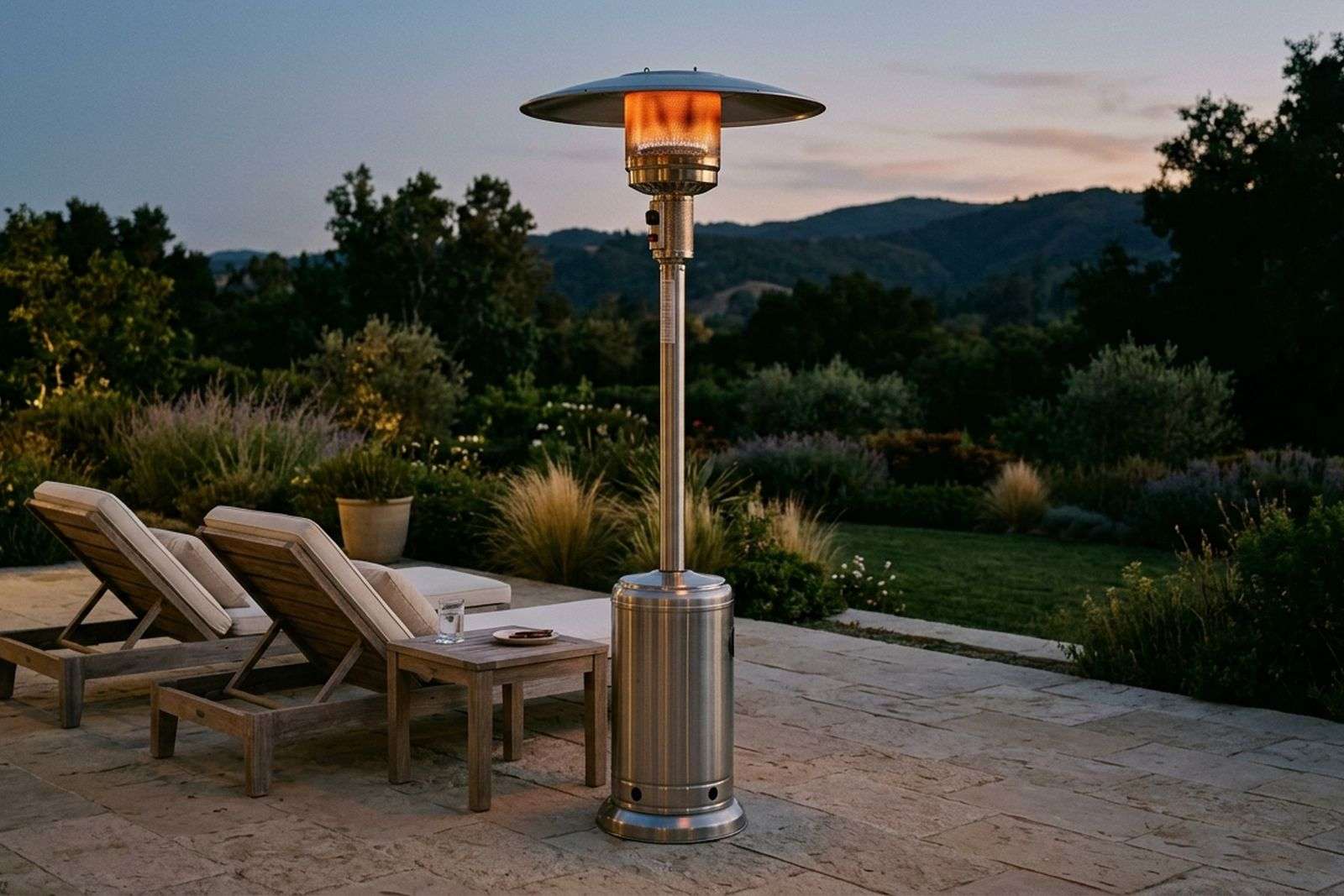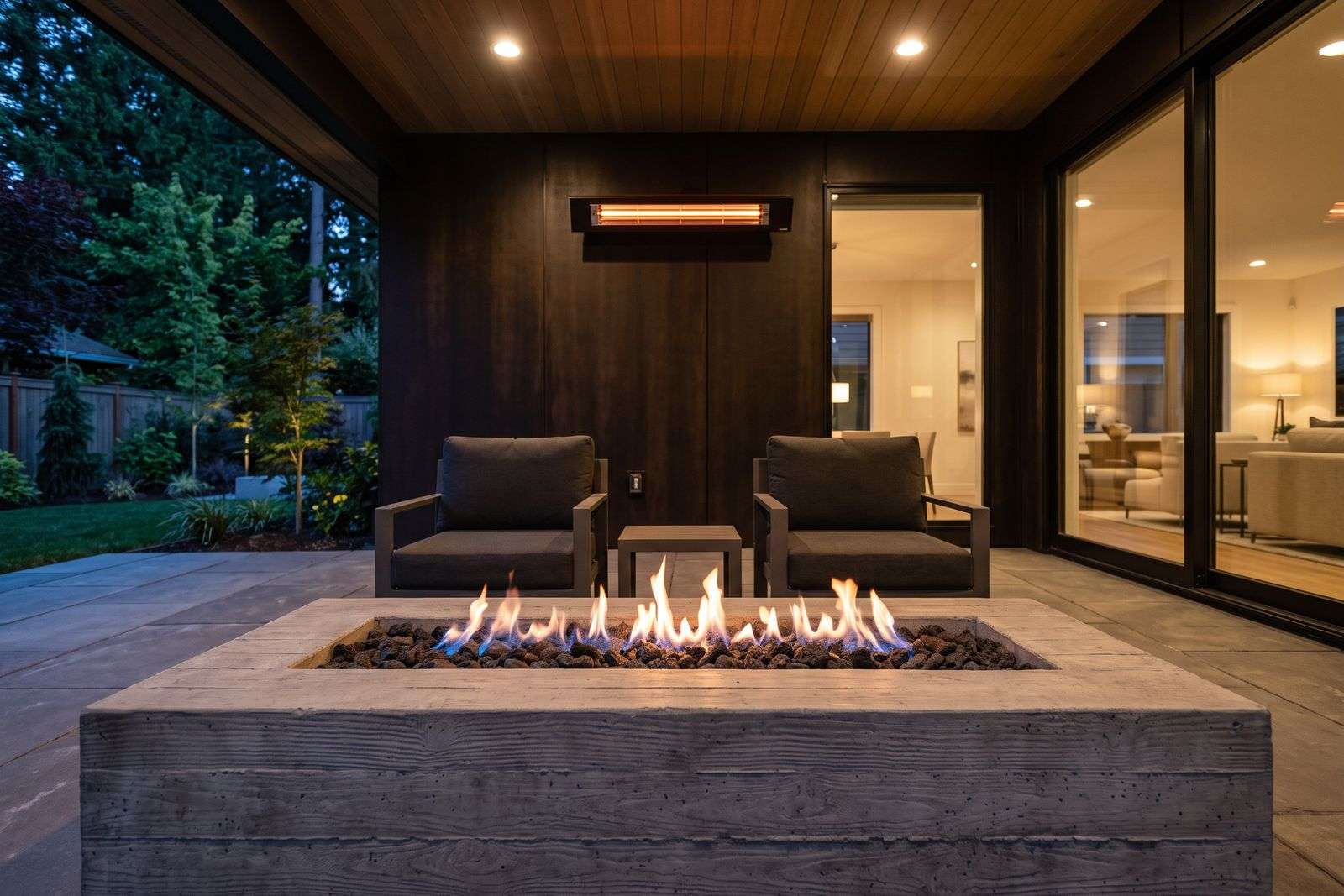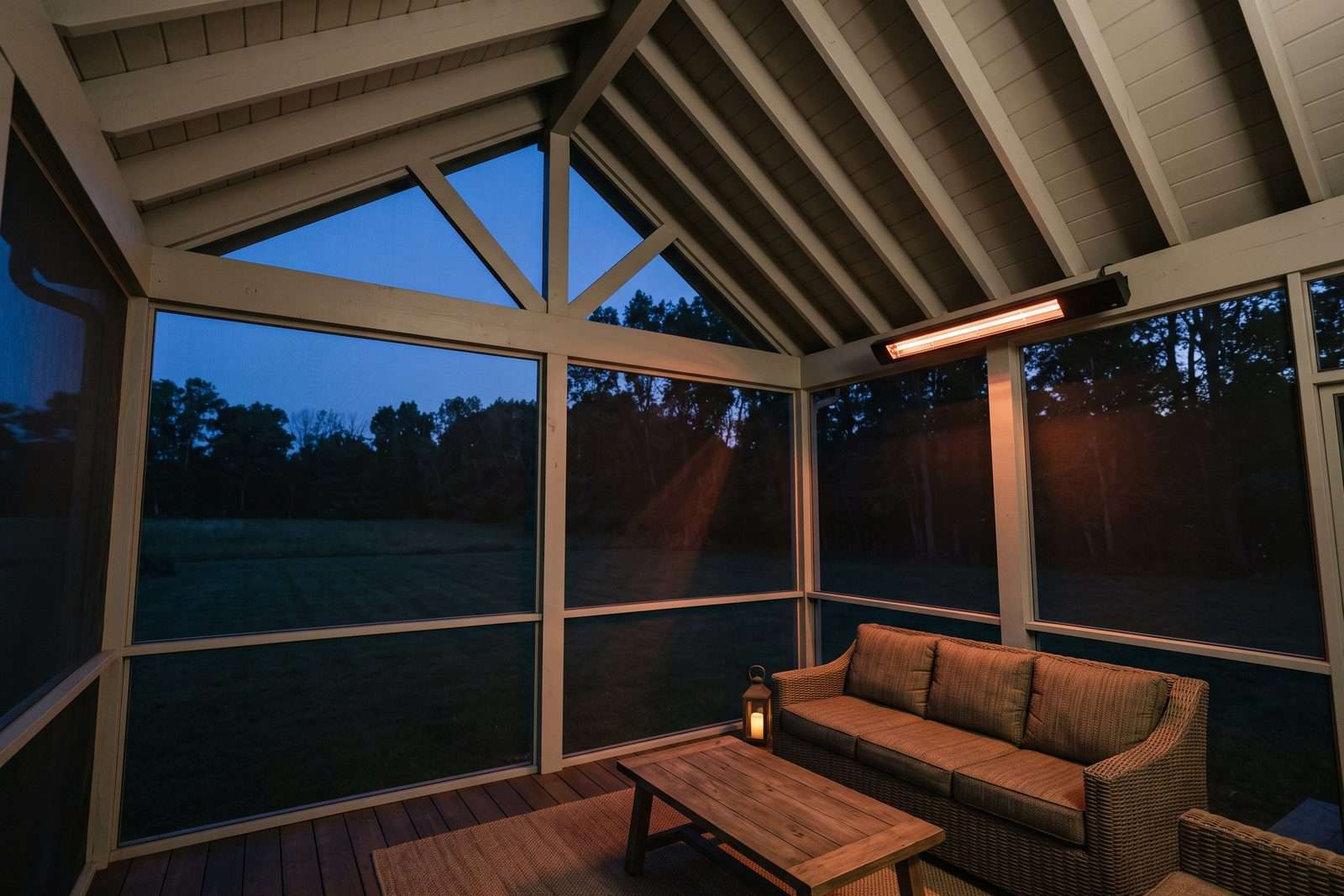

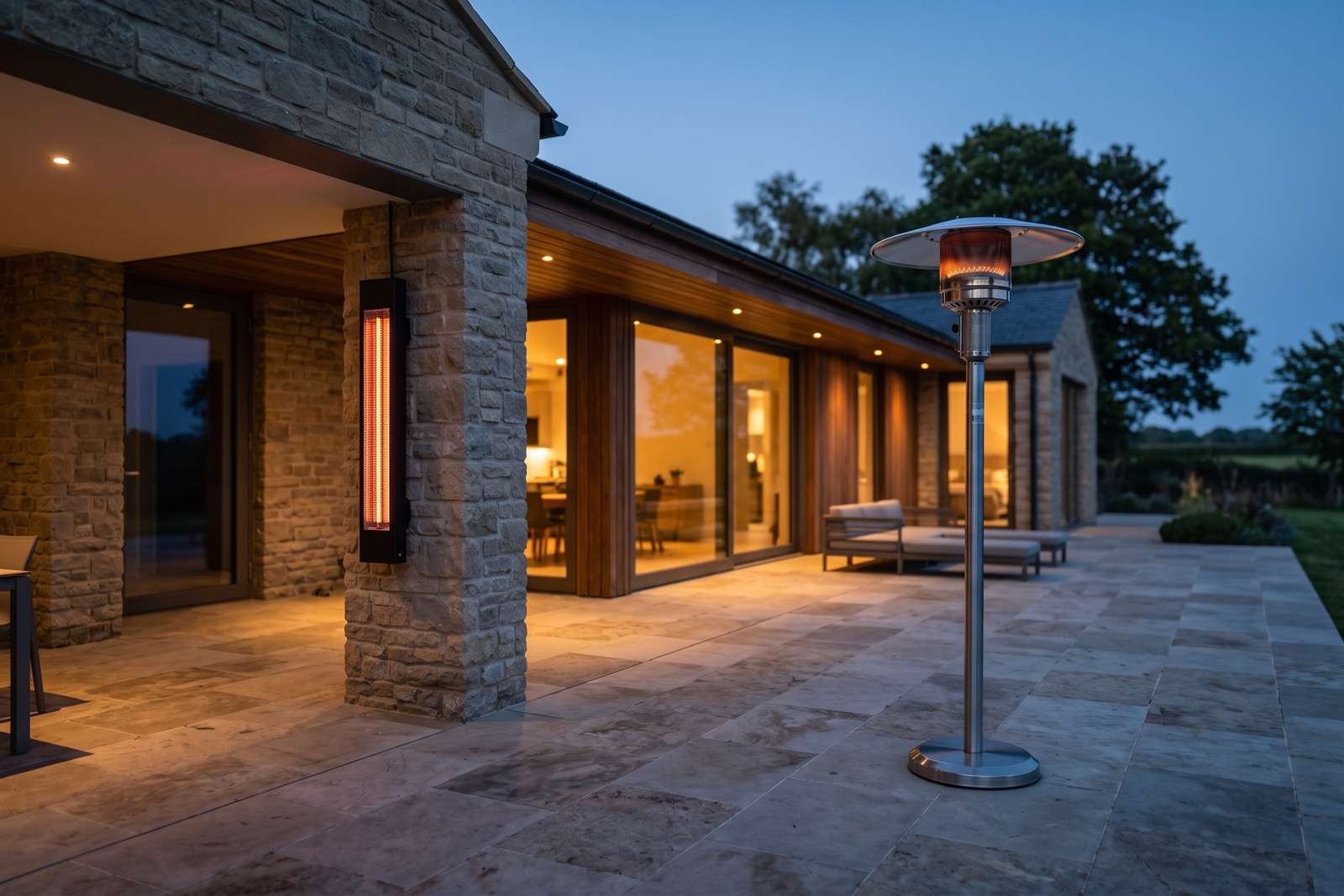
Electric patio heaters suit covered patios with a 240 V circuit available, and propane heaters suit open air where nothing is wired. That is the split the makers' manuals draw: Bromic says its electric heaters need no ventilation and are best built in under cover, while its gas and propane heaters need open-air placement. Neither type has a published edge in warmth, so the rest is wind, install, fire code and running cost.
Firepit HQ has not tested any heater. This guide compares published manuals, cut sheets and the model fire code, and every figure traces to a document in the sources.
Electric vs Propane Patio Heater at a Glance
| Electric infrared (hardwired) | Portable propane (20 lb cylinder) | |
|---|---|---|
| Where the makers put it | Under cover where possible. Bromic and Infratech both say so | Open air with rain protection (Bromic). Heatstrip bars open locations subject to rain |
| Ventilation | None required, per Bromic and Infratech | Well ventilated area, with open-wall percentages in the manual |
| What it connects to | A 240 V circuit, wired by a licensed electrician | A 20 lb cylinder, regulator and hose |
| Published input | 2,000 to 6,000 W (Bromic Tungsten) | 32,225 to 38,500 BTU/h (Heatstrip, Bromic) |
| Fire code touchpoint | IFC 4102.1 addresses portable plug-in heaters. Ask your official about fixed ones | 5 ft from buildings, exits and combustible overhangs (IFC 4103.1.2) |
| What you manage | Amps at the panel | Cylinders to swap |
Bromic, Infratech and Heatstrip are the makers whose documents are used here. Wall and ceiling gas heaters, which run on a gas line instead of a cylinder, get one section below.
Which Gives More Heat, Electric or Propane?
The documents do not say. Makers publish an input and an area, and each states its own basis. Electric input converts to BTU/h at 3,413 Btu per kWh, the factor in PERC's energy table.
Heater, Input, Input in BTU/h, Area the maker states, Basis the maker states
Bromic Tungsten Electric
- Input
- 4,000 W
- Input in BTU/h
- 13,652
- Area the maker states
- 130 sq ft (cut sheet), up to 120 (manual)
- Basis the maker states
- None
Bromic Tungsten Electric
- Input
- 6,000 W
- Input in BTU/h
- 20,478
- Area the maker states
- 160 sq ft (cut sheet), up to 144 (manual)
- Basis the maker states
- None
Infratech C-40
- Input
- 4,000 W
- Input in BTU/h
- 13,652
- Area the maker states
- 10 by 10 ft
- Basis the maker states
- 8 to 10 ft mounting height
Heatstrip Classic 3,200 W
- Input
- 3,200 W
- Input in BTU/h
- 10,922
- Area the maker states
- 86, 69 or 57 sq ft
- Basis the maker states
- Indoor protected, outdoor enclosed or outdoor exposed, mounted directly overhead
Bromic Tungsten Gas 300
- Input
- 26,000 BTU/h
- Input in BTU/h
- 26,000
- Area the maker states
- 160 sq ft
- Basis the maker states
- "In ideal conditions"
Bromic Tungsten Freestanding
- Input
- 38,500 BTU/h
- Input in BTU/h
- 38,500
- Area the maker states
- 215 sq ft
- Basis the maker states
- None
The propane heater takes in about 2.8 times the energy of the 4,000 W Bromic electric and states about 1.7 times the area. That gap proves nothing by itself, because the two companies measure coverage their own ways and Bromic's own electric documents disagree by 10 square feet at 4,000 W. Read the basis before you compare a number. The BTU calculator lists the stated areas with sources, and how many BTUs or watts a patio heater needs works the per square foot figures.
What Is the Most Efficient Type of Patio Heater?
No independent source ranks them. What exists is two maker claims that point in opposite directions and one test method.
- Infratech: says traditional gas burners are often less than 50 percent efficient and that its fixtures convert over 90 percent of input energy to radiant heat. The page gives no test or standard behind either figure.
- Bromic: its freestanding propane cut sheet says up to 3 times more efficient than traditional portable heaters, with no basis stated.
- ASTM F2644: a test method covering commercial gas and electric radiant patio heaters. It measures energy input rate, preheat, temperature distribution and effective heated area. Only the store summary was read.
Each claim comes from a company that sells that type, and a conversion figure measured at the appliance says nothing about warmth where you sit. The sourced answer is to compare coverage at your mounting height and exposure, since that is the figure you will use, and to compare running cost with the method below.
Wind and Cold: Which Type Copes Better?
Both lose ground, and each maker says so in its own words.
- Infratech (electric): says infrared heat is absorbed by solid objects and will not simply blow away in windy or drafty conditions. Its coverage chart adds that indoor or well-protected environments generally exceed average coverage and that heaters may provide less in extremely cold or windy conditions.
- Heatstrip Classic (electric): the 3,200 W model covers 86 sq ft indoor protected, 69 outdoor enclosed and 57 outdoor exposed. Exposed is about two thirds of protected.
- Bromic Tungsten Gas: the installation manual (V2.3) says the heater is designed to function in winds up to 10 mph and is subject to reduced performance or failure in high wind or extreme saturation. That is the figure printed here, because the manual is the document the installation follows. Bromic's product page gives a lower "wind resistance of up to 8 mph", so 8 mph is the cautious number to plan a site around.
- Mi-T-M propane: the operation checklist asks for wind below 10 mph and notes reduced efficiency below 40°F. Its troubleshooting table lists a low flame when the air is under 40°F and the cylinder is under a quarter full.
The cold has a propane-specific cause. PERC says a container vaporizes more slowly when the air is colder or the liquid level is lower, so a cylinder can fall behind the burner on a cold night before it is empty. An electric heater has no cylinder, and the Infratech and Heatstrip figures show it still gives up area in the cold and wind.
On an exposed patio, size from the exposed or cold figure whichever you choose, and shelter the seats before adding output. That is reasoning from the published numbers, not a maker's rule.
Under a Roof, on a Deck or in Open Air
Placement decides this more than anything else. The rules differ by type.
| Where | Electric | Propane |
|---|---|---|
| Covered patio | The natural fit. Bromic's manual says to mount under cover whenever possible, for product life and appearance, and Infratech says under a protective roof whenever possible | Limited by open-wall rules, below |
| Screened or three-season porch | The electric manuals above carry no open-wall tests. Ask your inspector about location and listing | The open-wall tests below apply, and Mi-T-M's manual bars use in enclosed areas |
| Open deck | Possible with a wired circuit and a mounting point | Possible, but the 5 ft from the house can rule out a shallow deck |
| Open yard | Needs power run to the spot | The portable choice |
| Exterior balcony | Ask your official | Prohibited for portable gas heaters in IFC 4103.1.2.1.1, with an exception as permitted in Chapter 61 |
The open-wall tests for gas are close across makers. Bromic's and Heatstrip's manuals allow a roof with no more than two walls, or more than two walls if at least 25 percent of the total wall area is completely open and at least 30 percent of the remaining wall area is open and unrestricted. Mi-T-M allows three walls only if 30 percent or more of the horizontal periphery is permanently open. Heatstrip adds 20 percent for a balcony. Mi-T-M also asks for 3 sq ft of opening to outside air for every 100,000 BTU/hr of heater rating.
Outdoor heaters for covered patios works through roofs, gazebos and ceiling clearance, and patio heater on a deck works the deck arithmetic.
What the Fire Code Says About Each
The 2024 International Fire Code covers both types in Chapter 41, with a limit that matters here. Section 4101.1 applies the chapter to mobile and portable equipment used for temporary heating and cooking. Section 4102.1 permits portable electric space heaters only if listed and labeled, plugged directly into an approved receptacle and kept off extension cords. They stay 3 feet from combustible materials and run only in locations they are listed for. A hardwired fixture is not a plug-in portable heater, so the section may not reach it. That is a question for your fire official.
For propane, Section 4103.1.2.1.2 says portable outdoor gas-fired heating appliances "shall be located not less than 5 feet (1524 mm) from buildings." The sections around it keep them from beneath, or within 5 ft of, combustible overhangs and awnings (4103.1.2.1.3), and from within 5 ft of exits (4103.1.2.1.4). The same group limits containers to 20 pounds (4103.1.2.3.3), requires a listing to ANSI Z83.26/CSA 2.37 (4103.1.2.2.1), and requires a tip-over switch that shuts off gas past 15 degrees from vertical (4103.1.2.2.3). The Mi-T-M manual states it conforms to CSA/ANSI Z83.26-2020 / CSA 2.37-2020, and the Bromic portable manual lists a flame failure device and an anti-tilt switch.
This is the model code. Your jurisdiction adopts an edition and may amend it, and your fire official decides how the chapter applies at a house. Check your local code and the installation manual, and start at the fire code library.
What Each Install Involves
Electric. Infratech's manual says the heater must be permanently installed and hard wired by a licensed electrician, and Bromic's says the same of an authorised or licensed person. The current is printed on the cut sheet. Bromic's Tungsten runs from 8.3 A at 2,000 W to 25 A at 6,000 W on 220 to 240 V, and the current is higher on 208 V. Voltage, amps and circuit sizing are covered in the infrared patio heater guide.
Portable propane. Heatstrip's manual calls for a standard 20 lb tank, not included, with a listed overfill prevention device, and says to use only the regulator and hose supplied with the heater. Mi-T-M's ignitor takes an AAA battery, and its manual requires a complete leak test whenever gas connections are loosened or removed. Nothing is wired. The work is cylinder swaps, hose checks and keeping the tank outdoors. Propane patio heater won't light covers the owner side of that.
Wall and ceiling gas. These run on a line instead of a cylinder and still need power. Bromic's Tungsten Gas lists 110 V at under 2 A, says it must be installed by authorized persons under local code or NFPA 54, and says electrical connections go to trained authorized electrical technicians. A licensed gas fitter and a licensed electrician both come into it.
Running Cost: A Method, Not a Number
Fuel prices go stale and vary by county, so use your own rates.
- Electric: kilowatts times your rate per kWh, for each hour at full output. A 4,000 W heater is 4 kWh an hour.
- Propane: BTU/h divided by 91,500 Btu per gallon (PERC) gives gallons an hour, times your price per gallon. Bromic's 38,500 BTU/h freestanding is about 0.42 gallons an hour and Heatstrip's 32,225 is about 0.35.
- Break-even on input energy: a gallon of propane holds 91,500 Btu and a kWh 3,413, so a gallon is worth 26.8 kWh of input energy. If your gallon costs less than 26.8 times your kWh rate, propane is the cheaper fuel per Btu bought. The U.S. Energy Information Administration's table gives slightly different factors, 91,452 Btu per gallon and 3,412 Btu per kWh, and they give the same 26.8.
That break-even compares energy purchased and not warmth delivered. It ignores coverage, wind and how each heater aims its heat. For the cylinder, Manchester Tank lists 4.7 gallons for a 20 lb cylinder, which is 430,050 Btu. That is about 11.2 hours at full output on the Bromic freestanding and 13.3 on the Heatstrip, and less on a cold night when the cylinder falls behind. The propane tank runtime calculator runs your burner.
Which Should You Choose?
This reads the documents. It is not a maker's recommendation.
- Covered patio, 240 V available: electric. It has no open-wall tests, no cylinder and no ventilation requirement.
- Open deck or yard with no power at the seats: portable propane, in the open, 5 ft off the house and clear of overhangs.
- A seating zone you use all season: a fixed heater, either wired electric or a gas line with a licensed fitter. A cylinder lasting 11 to 13 hours at full output suits occasional use.
- Windy, exposed site: neither wins on paper. Shelter the seats and size from the cold or exposed figures.
How to choose a patio heater covers sizing and mounting across fuels, and patio heater vs fire pit compares a heater with a flame.
What to Check Before You Buy
- The roof and the walls: which rule your space meets, covered for electric, open-wall percentages for propane.
- The supply: a 240 V circuit and an electrician, or a place to store and swap a 20 lb cylinder outdoors.
- The coverage basis: the mounting height or exposure behind each stated area.
- The listing: ETL or UL on electric, ANSI Z83.26/CSA 2.37 on portable propane.
- Your rates: kWh and propane price, run through the method above.
- Local rules: your fire official, building department and the manual for your exact model.
Common Questions
What is the most efficient type of patio heater?
No independent comparison is published. Infratech says its electric fixtures convert over 90 percent of input energy to radiant heat, and Bromic says its freestanding propane heater is up to 3 times more efficient than traditional portable heaters, and neither states a test basis. ASTM F2644 is a test method for commercial gas and electric radiant patio heaters. Compare each maker's stated coverage at your mounting height and exposure.
Do infrared patio heaters use a lot of electricity?
They draw their rated watts for every hour at full output. A 2,000 W Bromic Tungsten draws 2 kWh an hour and a 6,000 W model draws 6 kWh. Multiply the kilowatts by your rate per kWh to get the hourly cost. A 6,000 W heater is about 20,478 BTU/h of electrical input at 3,413 BTU per kWh.
Is an electric or propane patio heater better in wind?
No maker publishes a head-to-head test. Infratech says infrared heat will not simply blow away, yet its own chart says coverage may be less in extremely cold or windy conditions. Bromic's gas installation manual says its wall heater is designed to function in winds up to 10 mph, with reduced performance or failure in high wind, and its product page gives a lower 8 mph. Mi-T-M's propane checklist asks for wind below 10 mph.
Can I use an electric patio heater under a covered patio?
Electric is the type the makers point to for covered spaces. Bromic says its electric heaters need no ventilation and are best built in under cover, and Infratech says to hang its heaters under a protective roof when possible. Portable propane heaters face the open-air rules in their manuals and, in the model fire code, a 5 ft distance from buildings and combustible overhangs.
How do I compare the running cost of electric and propane patio heaters?
Electric costs the kilowatts times your rate per kWh each hour. Propane costs the heater's BTU/h divided by 91,500, which gives gallons an hour, times your price per gallon. On input energy alone, propane is cheaper per Btu when a gallon costs less than 26.8 times a kWh, since a gallon holds 91,500 Btu and a kWh 3,413. That ignores how each heater delivers warmth.
Sources
- Bromic Heating, Tungsten Smart-Heat Electric Installation, Instruction and Service Manual (US): wattage, voltage and amps table (PDF p. 4), outdoor installation under cover and protected from rain whenever possible (PDF pp. 5 and 15), permanently installed and hard wired by an authorised or licensed person (PDF p. 10)Checked
- Bromic Heating, Product Cut Sheet, Tungsten Smart-Heat Electric: 2,000 to 6,000 W, heat area, rated current at 220 to 240 V, minimum floor clearance wall 72 in and ceiling 96 in, IPX4Checked
- Bromic Heating, Tungsten Smart-Heat Electric product page, FAQ: electric Tungsten heaters need no ventilation, gas and freestanding Tungsten heaters do, best built in under cover and not directly exposed to rainChecked
- Bromic Heating, Tungsten Smart-Heat Gas Installation, Instruction and Service Manual (V2.3, USA and Canadian): specifications with 110 V and under 2 A (PDF p. 5), installation by authorized persons under NFPA 54, protect from rain (PDF p. 5), wind up to 10 mph and reduced performance in high wind, open-air situations and the wall rules (PDF p. 6), electrical connections by trained and authorized electrical technicians (PDF p. 10)Checked
- Bromic Heating, Tungsten Smart-Heat Gas product page: wind resistance of up to 8 mph, 26,000 and 43,000 BTUChecked
- Bromic Heating, Product Cut Sheet, Tungsten Smart-Heat Gas: 26,000 and 43,000 BTU models, heat area 160 and 215 sq ft with the footnote 'In ideal conditions', rated current 110 V and 2 AChecked
- Bromic Heating, Product Cut Sheet, Tungsten Smart-Heat Freestanding: 38,500 BTU, heat area 215 sq ft, the claim of up to 3 times more efficient than traditional portable heaters, no rated currentChecked
- Bromic Heating, Tungsten Smart-Heat Portable (Freestanding) Instruction Manual (US; the URL reads V1.8): 38,500 BTU/HR and 20 lb propane cylinder (PDF p. 5), protect from rain and open-air situations (PDF pp. 5 and 7), flame failure device and anti-tilt switch (PDF p. 5)Checked
- Heatstrip, X-DGR32PLP Head and Stand US Manual (portable propane): 20 lb tank with overfill prevention device (PDF p. 3), outdoor-use-only wall rules (PDF p. 4, scanned page read as an image), 32,225 BTU/HR, well ventilated area, not in open locations subject to rain (PDF p. 6)Checked
- Heatstrip, Classic (X-THHUS-A) Product Manual, Rev 6: coverage of the 3,200 W model by exposure, indoor protected, outdoor enclosed and outdoor exposed, with direct overhead mounting (PDF p. 7)Checked
- Mi-T-M, Propane Patio Heaters Operator's Manual MH-0042-PM11: conforms to CSA/ANSI Z83.26-2020 / CSA 2.37-2020 (PDF p. 1), 3 sq ft of outside air opening per 100,000 BTU/hr (PDF p. 5), AAA battery ignitor, 30 percent open horizontal periphery with three walls (PDF p. 19), complete leak test whenever gas connections are loosened or removed (PDF p. 19), checklist of wind below 10 mph and reduced efficiency below 40°F (PDF p. 20), low flame below 40°F with a cylinder under 1/4 full (PDF p. 23)Checked
- Infratech, All Weather C-Series and CD-Series Installation, Use & Care Manual (IN038, July 2024): permanently installed and hard wired by a licensed electrician (PDF p. 3), hang under a protective roof or weather cover whenever possible (PDF p. 7)Checked
- Infratech, Choosing your Infratech system chart (IN999, 2025): C-40 heat coverage area of 10 by 10 ft at an 8 to 10 ft mounting height, note on cold and windy conditionsChecked
- Infratech, Infrared Basics page: heat absorbed by solid objects and not simply blown away, the claims that traditional gas burners are often less than 50 percent efficient and its fixtures convert over 90 percent of input energy to radiant heat, no ventilation requiredChecked
- ASTM International, F2644-07(2019), Standard Test Method for Performance of Commercial Patio Heaters, store page (scope only: applicable to commercial gas and electric radiant patio heaters, measures energy input rate, preheat, temperature distribution and effective heated area; standard text not read)Checked
- Propane Education & Research Council, The Propane Technical Pocket Guide, 4482-BR-21 v3: Table 1C, propane 91,500 Btu per gallon and electricity 3,413 Btu per kWh (PDF p. 7), vaporization rate lower in colder air and at a lower liquid level (PDF p. 11)Checked
- U.S. Energy Information Administration, Energy Explained, Units and calculators, Sample Btu conversion factors: 1 kilowatthour = 3,412 Btu, propane 1 gallon = 91,452 Btu, factors recalculated each yearChecked
- Manchester Tank & Equipment Co., Portable DOT Steel LP Gas Cylinders 5 lb to 100 lb, Catalog 49500: LPG capacity of a 20 lb cylinder (4.7 gal)Checked
- International Code Council, 2024 International Fire Code (Version 2.1), Chapter 41: Section 4101.1 (scope, mobile and portable equipment used for temporary heating and cooking), Sections 4102.1 to 4102.1.4 (portable electric space heaters) and Sections 4103.1.2 to 4103.1.2.3.3 (portable outdoor gas-fired heating appliances: location, 5 ft clearances, listing, tip-over switch, 20 lb container limit). Model code text: adoption and edition vary by jurisdictionChecked
About the Author
James Darren Writes the Firepit HQ guides on fire features, fuel and fire codes. Every figure in them is cited to its source with the date it was checked.