
The best patio heater is the one whose published coverage matches the spot where people sit, on a fuel and mounting your site allows. Start with three facts: the square feet you want warm, the ceiling height and how open the sides are. Under a roof with a 240 V circuit available, a hardwired electric heater fits. In open air, a propane or natural gas heater does. This guide helps you select a heater and does not rank them. Firepit HQ has not tested any heater, and every figure comes from a maker's document listed in the sources.
Electric, Propane or Natural Gas?
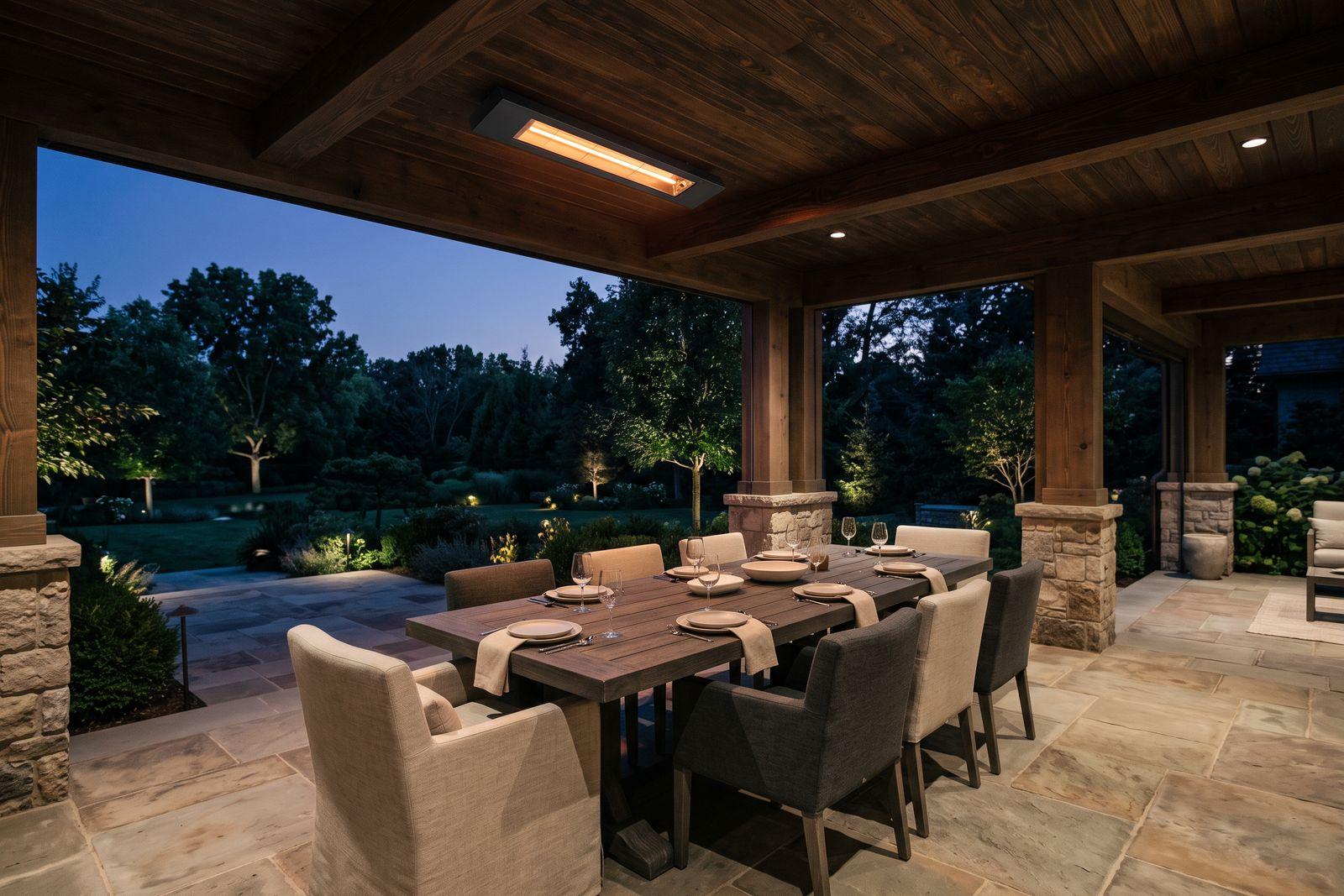
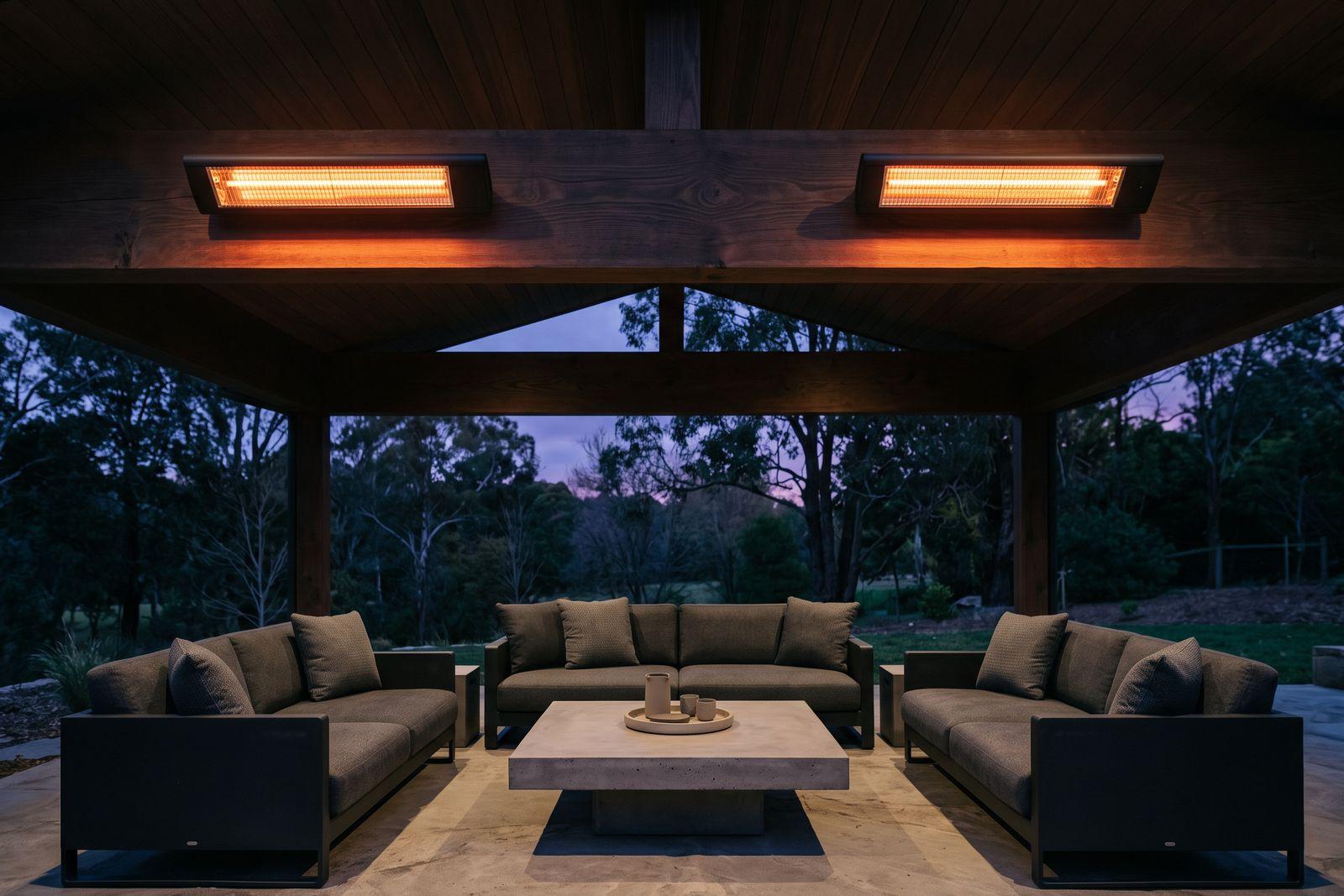
- Electric: a hardwired fixture, mostly on a 240 V circuit, listed at 6.3 to 25 A at that voltage. A licensed electrician runs it. There is no flame and no tank. Inputs run from 1,500 to 6,000 W for the makers covered in the infrared patio heater guide. Bromic says to mount its electric heaters under cover where possible. Heatstrip's Intense manual says that model does not need full protection.
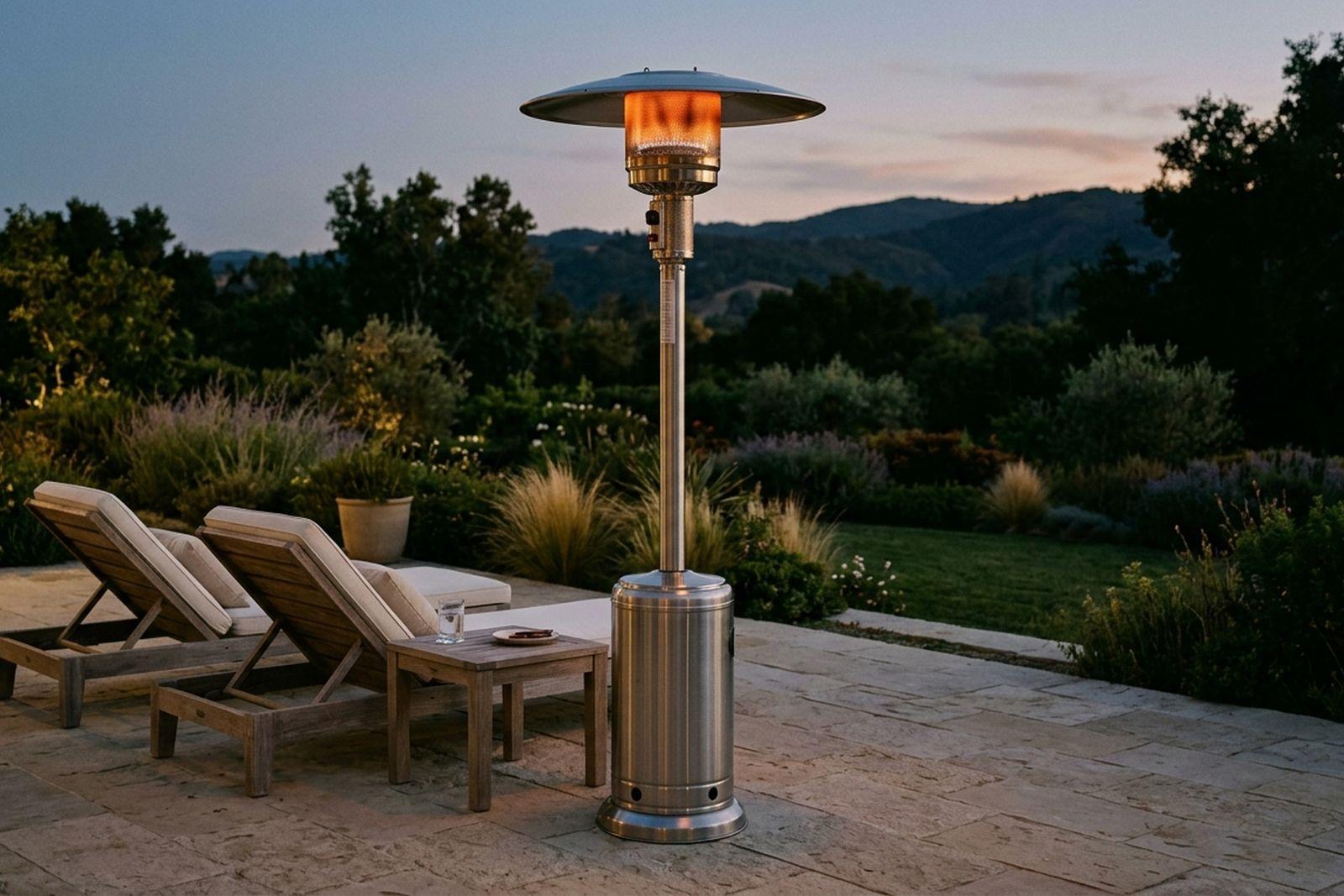
- Propane: the portable route. Heatstrip's portable heater runs 32,225 BTU/h and Bromic's freestanding tower 38,500, each from a 20 lb cylinder. You refill or swap cylinders. Bromic requires open-air placement, and Heatstrip says to use its heater only in a well ventilated area.
- Natural gas: the fixed route. Bromic's Tungsten Gas comes in 26,000 and 43,000 BTU/h, Heatstrip's wall-mounted heater is 32,225 BTU/h, and Lava Heat Italia towers come in natural gas versions. Bromic's manual says a gas heater must be installed by authorized persons under local code or NFPA 54. A licensed gas fitter sizes the line, and the gas line sizing calculator shows the math to expect.
A gas heater can still need power. Bromic's wall and ceiling Tungsten Gas lists a rated current of 110 V and 2 A on its cut sheet.
Freestanding, Wall or Ceiling Mounting
Freestanding needs floor space and headroom. Bromic's freestanding heater is 2,160 mm (7.1 ft) tall and weighs 123.5 lb. Its cut sheet lists a minimum floor clearance of 121 in and draws it from floor to ceiling, with 36 in above the heater and to the side. Lava Heat Italia states a minimum ceiling height for each tower. The Positano Capri is 72.5 in tall and needs 8 ft 0.5 in, and the 2G and Lava Lite at 92.5 in need 9 ft 8.5 in, which is the tower height plus the 24 in the page requires overhead and on all sides. The page adds that a standard 8-foot covered patio will not take any of them. Bromic's freestanding manual lists a flame failure device and an anti-tilt switch, and Lava Heat Italia lists tilt shut-off and flame-failure protection on its towers, so check for both on any freestanding unit.
Wall mounting frees the floor. Bromic's Tungsten, Platinum and Cobalt electric heaters sit at least 72 in above the floor, and so do Infratech's when labeled UL Listed (8 ft when labeled UL/CUL). Bromic's Tungsten Gas wants 96 in and recommends a heat deflector if the space overhead is under 42 in. Heatstrip's manual says coverage drops by up to 40 percent when its electric Classic is wall mounted at an angle.
Ceiling mounting puts the heater over the seating. Bromic publishes a 96 in ceiling minimum for its electric heaters, Heatstrip's strips need 2.1 m, and Infratech's flush-mount frames need a drywall pocket built into a flat ceiling. For gas, Heatstrip's brochure says its wall-mounted heater needs only 500 mm overhead because of its reflector, but that heater's manual says not to use it under any overhead, so get Heatstrip's answer in writing.
Quick Picks by Situation
| Your situation | What the published documents point to |
|---|---|
| Covered patio, 240 V available, ceiling of 8 ft or more | Electric. On an 8 ft ceiling, Bromic's 96 in ceiling minimum rules out its ceiling mounts but its 72 in wall minimum fits, and Infratech's chart pairs 2,000 to 2,600 W with 7 to 8 ft |
| Open deck, no power or gas near the seating | Propane freestanding from a 20 lb cylinder, placed in open air |
| Permanent seating zone with a gas line | Natural gas on a wall or ceiling mount, installed by a licensed gas fitter |
| Exposed and breezy | Size from the exposed figure. Heatstrip says its Intense suits permanent exposure, and Bromic's gas manual gives a 10 mph design wind |
| High ceiling or fully open terrace | A tower such as Lava Heat Italia's, which needs ceiling height equal to its own plus 24 in |
How Big a Heater Do You Need?
No published standard says how much heat a patio needs. ASTM F2644 is a test method that rates a commercial heater's effective heated area, for gas and electric models. It rates the heater and says nothing about your patio, and I did not read its text. What you can use is each maker's published coverage.
- Measure the zone where people sit, not the whole patio.
- Note the mounting height you can actually reach.
- Choose the exposure that matches your space, covered and walled or open.
- Find the maker's published area for that height and exposure. When there is only one number, read how it is qualified: Bromic marks its gas figures "in ideal conditions," and Infratech calls its chart figures average coverage.
- Cover a large zone with more than one heater. Bromic wants at least 20 in between its electric heaters.
Heater, Input, Published coverage, Basis the maker states, BTU/h per sq ft
Infratech C-15
- Input
- 1,500 W
- Published coverage
- 25 sq ft
- Basis the maker states
- 5 by 5 ft, mounted 6 to 7 ft
- BTU/h per sq ft
- 205
Infratech C-40
- Input
- 4,000 W
- Published coverage
- 100 sq ft
- Basis the maker states
- 10 by 10 ft, mounted 8 to 10 ft
- BTU/h per sq ft
- 136
Infratech CD-60
- Input
- 6,000 W
- Published coverage
- 121 sq ft
- Basis the maker states
- 11 by 11 ft, mounted 8 to 12 ft
- BTU/h per sq ft
- 169
Heatstrip Classic 3,200 W
- Input
- 3,200 W
- Published coverage
- 57, 69 or 86 sq ft
- Basis the maker states
- Exposed, enclosed or indoor protected
- BTU/h per sq ft
- 192, 158 or 127
Bromic Tungsten Electric
- Input
- 4,000 W
- Published coverage
- 130 sq ft
- Basis the maker states
- Not stated
- BTU/h per sq ft
- 105
Bromic Tungsten Gas 300
- Input
- 26,000 BTU/h
- Published coverage
- 160 sq ft
- Basis the maker states
- In ideal conditions
- BTU/h per sq ft
- 163
Bromic Tungsten Gas 500
- Input
- 43,000 BTU/h
- Published coverage
- 215 sq ft
- Basis the maker states
- In ideal conditions
- BTU/h per sq ft
- 200
Bromic Tungsten Freestanding
- Input
- 38,500 BTU/h
- Published coverage
- 215 sq ft
- Basis the maker states
- Not stated
- BTU/h per sq ft
- 179
Schwank phantomSchwank
- Input
- 50,000 to 115,000 BTU/h
- Published coverage
- Up to about 200 to 500 sq ft
- Basis the maker states
- At a 10 ft mounting height
- BTU/h per sq ft
- Not computed
Schwank eSchwank ES/ESD
- Input
- 2,000 to 6,000 W
- Published coverage
- Up to about 100 to 160 sq ft
- Basis the maker states
- At a 10 ft mounting height
- BTU/h per sq ft
- Not computed
The last column is calculated here. In watts, Infratech's chart works out to 40 to 64 W per sq ft, Heatstrip's Classic to 46 to 56 outdoors, and Bromic's electric cut sheets to 24 to 37.5. Heatstrip's Classic manual sets a minimum of 46 W per sq ft for a protected outdoor area; its Classic rows come from the manual's selection guide, since its spec table gives the 3,200 W a narrower 54 to 65 sq ft. Watts convert at 3.412 BTU/h each, the ratio in Infratech's own table, where 4,000 W is 13,648 BTU and 6,000 W is 20,472. Electric input and gas input are not the same thing, so read the column as each maker's own claim and nothing more. Lava Heat Italia's coverage figures are left out because its pages do not line up. The Positano page lists 400 sq ft for the 42,000 BTU Capri and 350 for the 56,000 BTU Lava Lite.
The BTU calculator lists these models and their sources and returns a range for your area.
Do Patio Heaters Work in Wind and Cold?
They work less well, and makers say so. Infratech's chart notes that well-protected spaces generally exceed its average coverage and that heaters may cover less in extremely cold or windy conditions. Its FAQ says colder or draftier areas may need more heat. It also cites Pacific Gas & Electric testing that puts a good installation at 3 to 7 degrees of perceived warmth at 60°F. Infratech says infrared heat does not simply blow away in a breeze, and its own chart still carries the caution.
Heatstrip's Classic figures show the effect in numbers. The 3,200 W model covers 86 sq ft indoor protected, 69 outdoor enclosed and 57 outdoor exposed, a drop of about a third. Schwank's tip for colder locations is to choose its 80,000 or 115,000 BTU/h models.
Gas heaters publish wind speeds. Bromic's Tungsten Gas manual says the heater is designed to work in winds up to 10 mph and can perform worse or fail in high wind or extreme saturation, though the product page says 8 mph. Heatstrip's brochure gives its wall-mounted gas heater a wind rating of 16 km/h, about 10 mph. Bromic's Platinum electric manual calls that heater wind resistant and gives no speed.
Reasoning from those numbers, I would size an open patio from the exposed figure and shelter the seating zone before adding output.
Covered or Open: Which Heaters Fit?
Electric heaters are the natural fit under a roof. Gas heaters carry location rules. Bromic's Tungsten Gas manual allows use only in an above-ground open-air situation with natural ventilation, and says it is not approved for indoor use. Among the layouts it permits are a roof over no more than two walls, and a roof over more than two walls only if at least 25 percent of the total wall area is completely open and at least 30 percent of the remaining wall area is open and unrestricted. It also says to protect the heater from rain.
Those are one maker's rules, and your manual governs. Fire codes can add limits of their own for portable propane heaters, and outdoor heaters for covered patios goes through the model code and the makers' roof rules. For the electric makers side by side, see Bromic vs Infratech vs Heatstrip.
How Long Does a 20 lb Propane Tank Last on a Patio Heater?
A 20 lb cylinder holds 4.7 gallons of propane (Manchester Tank), and a gallon holds 91,500 Btu (PERC). Multiply, then divide by the heater's BTU/h.
- Bromic's freestanding heater at 38,500 BTU/h: 430,050 Btu, or about 11.2 hours at full output.
- Heatstrip's portable heater at 32,225 BTU/h: about 13.3 hours.
To cost an hour of heat without a price printed here, divide the BTU/h by 91,500 for gallons of propane per hour, about 0.42 for the Bromic freestanding, and multiply by what you pay. For electric, multiply kilowatts by your rate per kWh. A lower setting stretches the hours. Bromic's manual describes adjustable heat output. PERC says vaporization slows when the air is colder and the tank holds less liquid, so on a cold night a 20 lb cylinder can fall behind the burner before it is empty. Heatstrip's manual says to use a 20 lb tank with an overfill prevention device and never fill it past 80 percent. The propane tank runtime calculator runs your burner.
What to Check Before You Buy
- The zone: measure the seating area and the mounting height before you read a coverage number.
- The supply: a 240 V circuit and an electrician, a licensed gas fitter for natural gas, or a 20 lb cylinder and a place to swap it.
- The headroom: ceiling height against the heater's published minimum, plus the 24 in Lava Heat Italia adds around its towers.
- Open-air limits: the manual's rules for roofs and walls, if the heater is gas.
- The coverage basis: mounting height and exposure behind each published area.
- The listing: the safety mark on the label and the manual for your exact model, with the warranty terms.
- Local rules: your building department, your installer and, for fire code questions on the patio, the state fire code library.
Common Questions
How many BTU do I need for a patio heater?
No standard sets it, so use each maker's published coverage. Bromic lists 43,000 BTU/h for up to 215 sq ft in ideal conditions, and Schwank lists 50,000 to 115,000 BTU/h for up to about 200 to 500 sq ft at a 10 ft mounting height. Divided out, the figures in this guide run from 105 to 205 BTU/h per square foot. Measure the seating zone and the mounting height, then check the BTU calculator.
How many watts do I need for a patio heater?
Infratech lists 1,500 W for 25 sq ft, 4,000 W for 100 sq ft and 6,000 W for 121 sq ft, each tied to a mounting height. Heatstrip's Classic manual calls for at least 46 W per square foot in a protected outdoor area. Bromic's electric cut sheets work out to 24 to 37.5 W per square foot. Pick the figure that matches your exposure.
How long will a 20 lb propane tank last in a patio heater?
A 20 lb cylinder holds 4.7 gallons, and a gallon of propane holds 91,500 Btu. At full output a 38,500 BTU/h Bromic freestanding heater runs about 11.2 hours and a 32,225 BTU/h Heatstrip portable about 13.3 hours. A lower setting lasts longer, and cold air slows vaporization.
Can you use a patio heater on a covered patio?
Electric heaters are made for it, and Bromic says to mount its electric heaters under cover where possible. Gas heaters carry limits. Bromic's Tungsten Gas manual allows a roof over no more than two walls, or over more than two walls only if enough wall area is open. Lava Heat Italia's towers add 24 in of overhead clearance, so a standard 8-foot ceiling will not take them.
What is the most efficient type of patio heater?
No published comparison ranks them. ASTM F2644 is the test method that rates a commercial heater's effective heated area, for gas and electric models alike, but I did not read its text, and makers publish their areas on their own bases. Infratech ties each area to a mounting height. Compare coverage at your own mounting height and exposure, and read the basis before the number.
Which patio heater gives off the most heat?
By published input, the largest in this guide are Schwank's 115,000 BTU/h gas heater and the 6,000 W electric models, which is 20,472 BTU/h. Input is not warmth on your skin. Coverage depends on mounting height, exposure and wind, which is why makers publish different areas for similar input. Size from the published area for your conditions.
Sources
- Infratech, Choosing your Infratech system chart (IN999, 2025): heat coverage area, mounting height, note that indoor or well-protected spaces exceed average coverage and cold or wind reduces itChecked
- Infratech, Reference Manual (IN_refmanual_022625_dj): watt to BTU table (4,000 W is 13,648 BTU, 6,000 W is 20,472 BTU), Mounting Options (UL Listed as low as 6 ft, CUL Listed as low as 8 ft), flush mount pocket, FAQ on perceived heat and colder or draftier areasChecked
- Infratech, Infrared Basics page: heat does not blow away in windy or drafty airChecked
- Infratech, C-Series and CD-Series page: model wattage and amps at 240 VChecked
- Bromic Heating, Tungsten Smart-Heat Gas Installation, Instruction and Service Manual (V2.3): open-air and enclosure rules, wind up to 10 mph, authorized installer and NFPA 54, protect from rainChecked
- Bromic Heating, Tungsten Smart-Heat Gas product page: 26,000 and 43,000 BTU, 160 and 215 sq ft, 96 in floor clearance, heat deflector under 42 in, natural gas and propane, wind resistance up to 8 mphChecked
- Bromic Heating, Product Cut Sheet, Tungsten Smart-Heat Gas: heat area footnote in ideal conditions, rated current 110 V and 2 A, minimum floor clearanceChecked
- Bromic Heating, Tungsten Smart-Heat Freestanding product page: 38,500 BTU, 215 sq ft, 20 lb cylinder or natural gas lineChecked
- Bromic Heating, Product Cut Sheet, Tungsten Smart-Heat Freestanding: heat area, weight, minimum floor clearance of 121 in, clearance diagram (36 in above and to the side)Checked
- Bromic Heating, Tungsten Smart-Heat Portable (Freestanding) Instruction Manual (US, V1.8): 38,500 BTU/h, 20 lb cylinder, 2,160 mm height, open-air rule, anti-tilt switch and flame failure device, adjustable heat outputChecked
- Bromic Heating, Tungsten Smart-Heat Electric Installation, Instruction and Service Manual (US): electric mounting height, outdoor installation under coverChecked
- Bromic Heating, Product Cut Sheet, Tungsten Smart-Heat Electric: 4,000 W at 130 sq ft, floor clearanceChecked
- Bromic Heating, Platinum Smart-Heat Electric Installation, Instruction and Service Manual (US, v4): wind resistant claimChecked
- Heatstrip, Classic (X-THHUS-A) Product Manual, Rev 6: specification table heating area, selection guide coverage by exposure, 46 W per sq ft rule, angled wall mounting coverage loss, mounting heightChecked
- Heatstrip, Intense with Remote and App Control (X-THBBA) Product Manual, Rev 6: suitable for permanently exposed installationsChecked
- Heatstrip, X-DGR32PLP Head and Stand US Manual (portable propane): 32,225 BTU/hr, 20 lb tank, overfill prevention device, well ventilated area, not in open locations subject to rain, 80 percent fillChecked
- Heatstrip, X-DGR32WNG US Manual (wall-mounted natural gas): 32,225 BTU/hr; For Your Safety warning (PDF p. 5): do not use under any overheadChecked
- Heatstrip, 2025 US Brochure: wall-mounted gas wind protection rating of 16 km/h, 500 mm overhead clearance, mounting heightsChecked
- Lava Heat Italia, Positano Flame Tower Collection page: BTU, tower height, minimum ceiling height, 24 in clearance, coverage, anti-tilt and flame-failure protection, LP or natural gas, standard 8-foot covered patio statementChecked
- Schwank, Compare Schwank Patio Heater Models: BTU and kW ranges, coverage area stated at a 10 ft mounting height, tip for colder locationsChecked
- Propane Education & Research Council, The Propane Technical Pocket Guide, 4482-BR-21 v3: Table 1C (91,500 Btu per gallon), Vaporization Rates (lower in colder air and at a lower liquid level)Checked
- Manchester Tank & Equipment Co., Portable DOT Steel LP Gas Cylinders 5 lb to 100 lb, Catalog 49500: LPG capacity of a 20 lb cylinder (4.7 gal)Checked
- ASTM International, F2644, Standard Test Method for Performance of Commercial Patio Heaters, store page (scope only: energy input rate, preheat, temperature distribution, effective heated area; standard text not read)Checked
About the Author
James Darren Writes the Firepit HQ guides on fire features, fuel and fire codes. Every figure in them is cited to its source with the date it was checked.