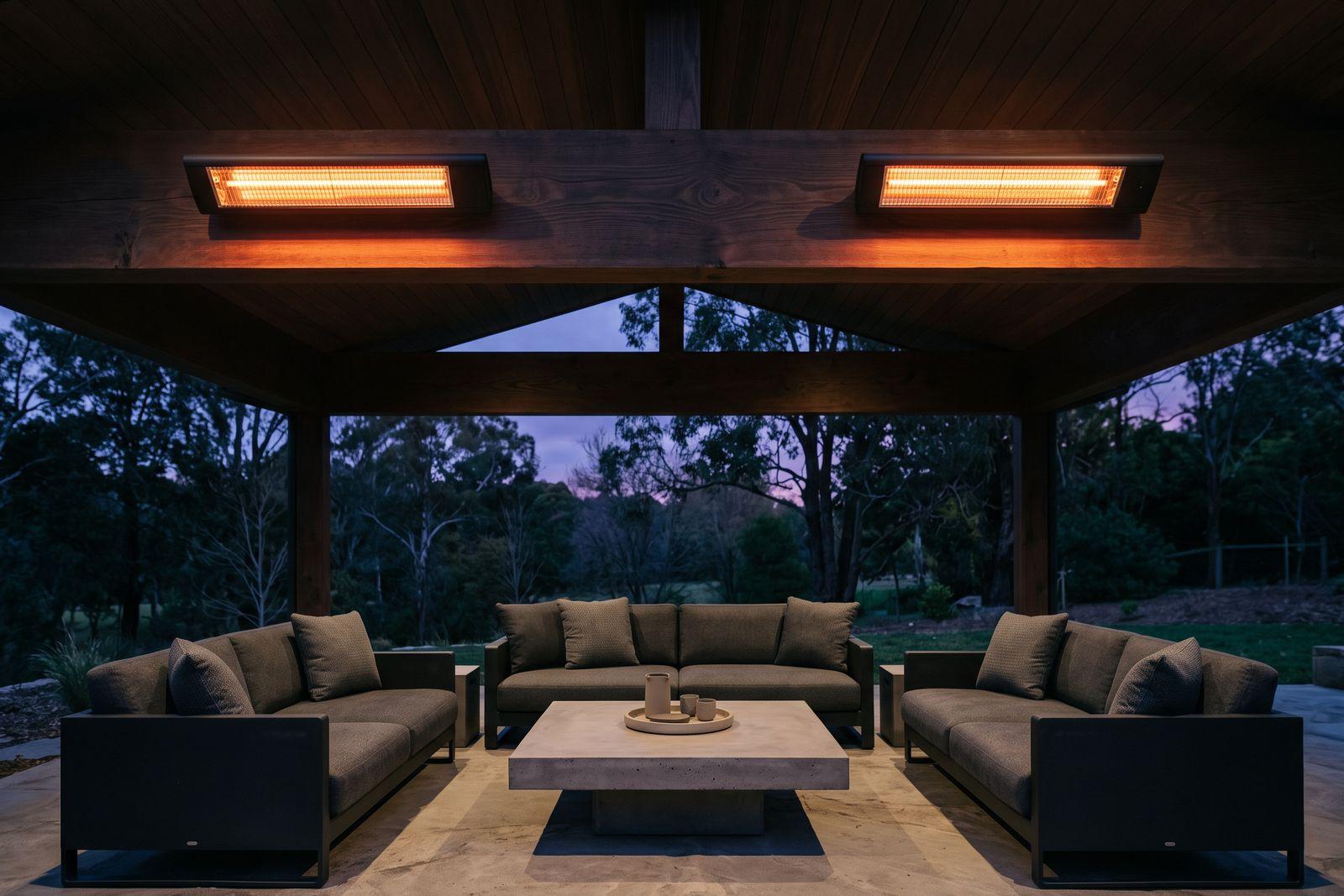

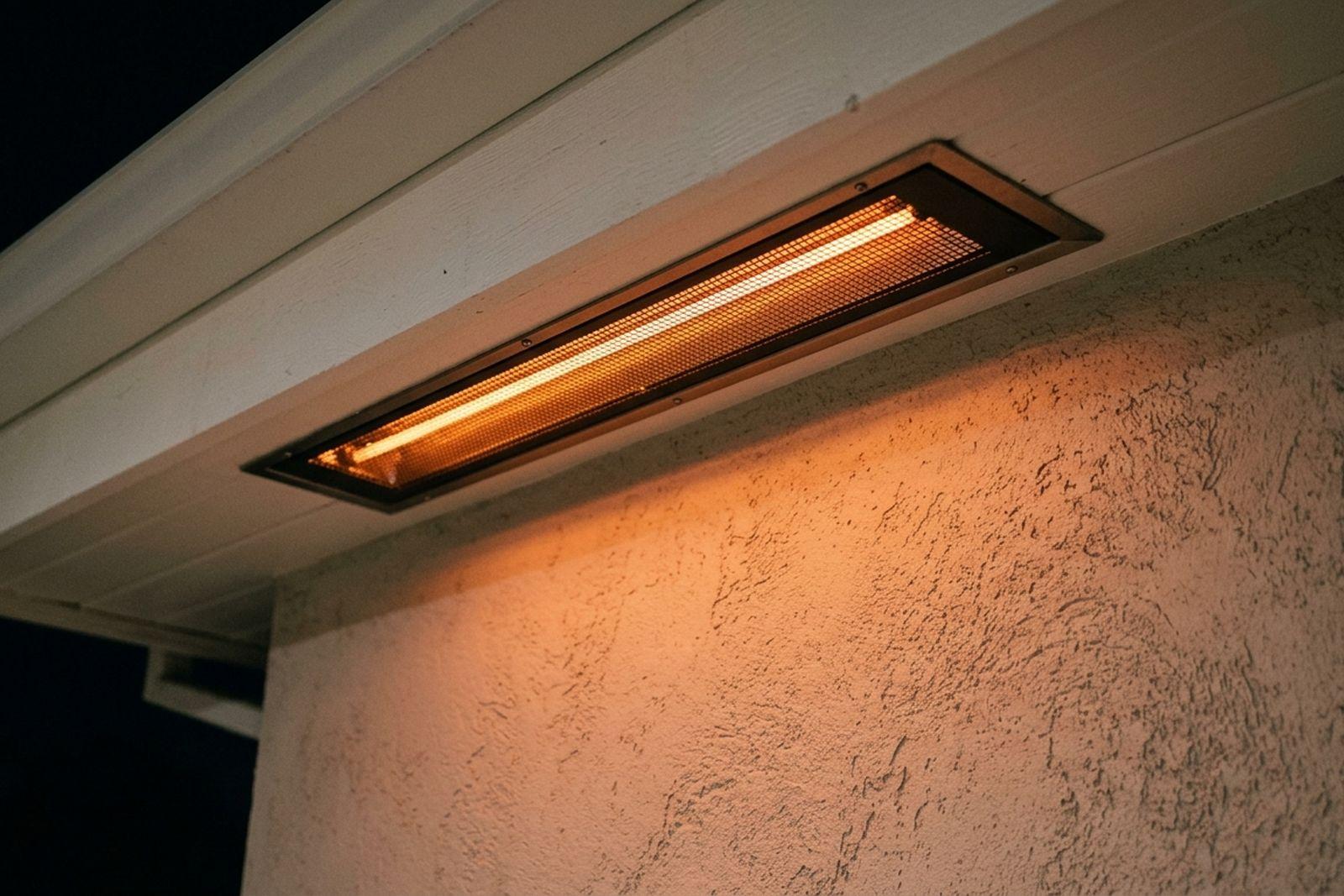
An infrared patio heater warms the people and surfaces under it instead of the air. The electric models from Bromic, Infratech and Heatstrip are hardwired fixtures that run mostly on 240 V, draw 6.3 to 25 A at that voltage, and mount about 6 to 12 feet up. The one plug version in their documents, a 2,400 W Heatstrip Enhance, still calls for fixed wiring by a licensed electrician. Settle the voltage, the amps and the mounting height before you pick a model.
Every figure below is cited in the sources. I have not tested any of these heaters. For the three makers side by side, see Bromic vs Infratech vs Heatstrip.
What Makes a Heater Infrared?
Infrared heat travels as radiation and warms whatever absorbs it: skin, a tabletop, the floor. Infratech says its quartz elements heat solid objects rather than the air, so the heat does not simply blow away in a breeze. The catch is the footprint. Heatstrip's manuals show the warmest spot directly under the heater and the temperature falling as you move away, so people have to sit inside that pattern.
Infrared is split into bands by wavelength. Ceramicx, an infrared element maker, gives short-wave as 0.78 to 1.4 micrometers, medium-wave as 1.4 to 3.0 and long-wave as 3 to 1,000. Its white paper on comfort heating says the longer bands are better absorbed by human skin.
On a patio, the difference you notice is light. Infratech says short-wave halogen heaters throw very bright, harsh-colored light, and that its medium-wave quartz elements give a soft glow that is practically unnoticeable. Bromic calls its Tungsten and Cobalt elements a soft glow with no harsh glare.
Maker and line, Element as published, Band stated, What the maker says about light
Infratech C, CD, W, WD, SL
- Element as published
- Quartz
- Band stated
- Medium-wave
- What the maker says about light
- Soft, warm glow, practically unnoticeable
Bromic Tungsten and Cobalt
- Element as published
- Quartz
- Band stated
- None
- What the maker says about light
- Soft glow, no harsh glare
Bromic Platinum and Eclipse
- Element as published
- Not stated
- Band stated
- None
- What the maker says about light
- Platinum has a tinted ceramic-glass face. Eclipse adds a dimmable 3000 K LED
Heatstrip Classic
- Element as published
- Not stated; a profiled alloy strip, ceramic coated
- Band stated
- None
- What the maker says about light
- Nothing stated
Heatstrip Intense and Enhance
- Element as published
- Carbon filament
- Band stated
- None
- What the maker says about light
- Nothing stated. Enhance has a Schott glass face
Only Infratech names its band in the documents I read. If glare matters on your patio, ask the maker which band the element is.
Are Electric Patio Heaters Hardwired or Plug-In?
Hardwired, nearly always. Bromic's Tungsten Electric manual says the heater must be permanently installed and hard wired by an authorized person, and Infratech's manuals say the same with a licensed electrician. Heatstrip's manuals call for a fixed installation by a licensed electrical professional, and its Max DC Commercial must be hard-wired.
The one exception is Heatstrip's Enhance manual, which describes a 2,400 W plug version and a 3,200 W hardwired version, then says the fixed wiring must be installed by a licensed electrician in both cases. Ask Heatstrip which applies to the US model you are buying.
The other variation is voltage. Infratech's FAQ says a 120 V heater tops out at 1,500 W and suits garages, indoor work areas or an outdoor space no larger than 5 by 5 feet, though its reference manual lists a 1,600 W SL-1612 at 120 V and 13.3 A. For anything larger it points to a 240 V circuit, which it says takes the same amount of wiring and two spaces in the breaker panel.
The wiring is code work. Heatstrip's manual says US installs follow the National Electrical Code (NEC). Bromic's says the installer must meet the local electrical code, use supply wire rated at least 90°C, and build a disconnect into the fixed wiring. Article 424 of the NEC covers fixed electric space-heating equipment. EC&M's summary of 424.3(B) says it counts as a continuous load, which puts the branch circuit at 125 percent of the heater's current, and Infratech specs its relay panels the same way, fed at 125 percent of the heaters' full amperage. Your inspector decides which NEC edition applies, and a licensed electrician sizes the circuit.
What Voltage Does an Electric Patio Heater Need?
Most of the lines here are 240 V single phase. Infratech also lists 208, 277 and 480 V models, and Bromic's Tungsten comes in 208, 220 to 240 and 277 V. Heatstrip's US models are listed at 240 V.
Check your actual voltage before you order. Infratech says many new homes and businesses are supplied with 208 V, and that a 240 V heater on 208 V power produces only about 60 percent of the desired infrared energy. Models built for 208 V draw more current for the same watts. Bromic's 6,000 W Tungsten lists 21.66 A at 277 V, 25 A at 240 V and 28.85 A at 208 V.
Patio Heater Amps and Circuit Sizing
The makers print the current. The last column is 125 percent of it, which is where an electrician starts.
Heater, Watts, Listed current at 240 V, 125 percent of listed current
Infratech C-1524
- Watts
- 1,500
- Listed current at 240 V
- 6.3 A
- 125 percent of listed current
- 7.9 A
Infratech C-2024, Bromic Tungsten 2,000 W
- Watts
- 2,000
- Listed current at 240 V
- 8.3 A
- 125 percent of listed current
- 10.4 A
Bromic Tungsten 3,000 W
- Watts
- 3,000
- Listed current at 240 V
- 12.5 A
- 125 percent of listed current
- 15.6 A
Heatstrip Classic X-THH3200US-A
- Watts
- 3,200
- Listed current at 240 V
- 13.3 A
- 125 percent of listed current
- 16.6 A
Infratech C-4024
- Watts
- 4,000
- Listed current at 240 V
- 16.7 A
- 125 percent of listed current
- 20.9 A
Bromic Platinum 4,500 W
- Watts
- 4,500
- Listed current at 240 V
- 18.8 A
- 125 percent of listed current
- 23.5 A
Infratech CD-5224
- Watts
- 5,200
- Listed current at 240 V
- 21.6 A
- 125 percent of listed current
- 27.0 A
Infratech CD-6024, Bromic Tungsten and Cobalt 6,000 W
- Watts
- 6,000
- Listed current at 240 V
- 25 A
- 125 percent of listed current
- 31.25 A
Sources: Infratech C-Series and CD-Series page; Bromic cut sheets and Tungsten manual; Heatstrip Classic manual.
The last row shows why the big heaters are a panel question. At 125 percent, one 6,000 W heater does not fit a 30 A breaker. Heatstrip's manual sets its own rule, an overcurrent device rated at 150 percent of the heater's rating, which works out to about 20 A for the 13.3 A Classic. Bromic says to use only one branch circuit for its 2,000 and 3,000 W models. Follow the manual for your model and your electrician's calculation.
How Many Watts Does a Patio Heater Need Per Square Foot?
Makers publish the area each heater covers, which is the closest thing to a sizing rule. Divide watts by that area and they do not agree.
Heater, Watts, Published area, sq ft, Basis the maker states, Watts per sq ft
Infratech C-15
- Watts
- 1,500
- Published area, sq ft
- 25
- Basis the maker states
- 5 by 5 ft, mounted 6 to 7 ft
- Watts per sq ft
- 60.0
Infratech C-30
- Watts
- 3,000
- Published area, sq ft
- 64
- Basis the maker states
- 8 by 8 ft, mounted 7 to 9 ft
- Watts per sq ft
- 46.9
Infratech C-40
- Watts
- 4,000
- Published area, sq ft
- 100
- Basis the maker states
- 10 by 10 ft, mounted 8 to 10 ft
- Watts per sq ft
- 40.0
Infratech CD-60
- Watts
- 6,000
- Published area, sq ft
- 121
- Basis the maker states
- 11 by 11 ft, mounted 8 to 12 ft
- Watts per sq ft
- 49.6
Heatstrip Classic 2,400 W
- Watts
- 2,400
- Published area, sq ft
- 43
- Basis the maker states
- Outdoor exposed, overhead mount
- Watts per sq ft
- 55.8
Heatstrip Classic 2,400 W
- Watts
- 2,400
- Published area, sq ft
- 52
- Basis the maker states
- Outdoor enclosed
- Watts per sq ft
- 46.2
Heatstrip Classic 2,400 W
- Watts
- 2,400
- Published area, sq ft
- 65
- Basis the maker states
- Indoor protected
- Watts per sq ft
- 36.9
Bromic Tungsten Electric
- Watts
- 2,000
- Published area, sq ft
- 65
- Basis the maker states
- Not stated
- Watts per sq ft
- 30.8
Bromic Tungsten Electric
- Watts
- 6,000
- Published area, sq ft
- 160
- Basis the maker states
- Not stated
- Watts per sq ft
- 37.5
Bromic Platinum Electric
- Watts
- 3,400
- Published area, sq ft
- 108
- Basis the maker states
- Not stated
- Watts per sq ft
- 31.5
Bromic Eclipse
- Watts
- 2,900
- Published area, sq ft
- 121
- Basis the maker states
- Not stated
- Watts per sq ft
- 24.0
Three things explain the spread. Infratech ties each area to a mounting height. Heatstrip's selection guide gives a figure for each exposure, falling about a fifth from indoor protected to outdoor enclosed and a third to outdoor exposed, though the same manual's spec table gives the 2,400 W only 43 to 54 sq ft. Bromic's own documents disagree: its cut sheets give up to 130 and 160 square feet for the 4,000 and 6,000 W Tungsten and Cobalt, and its manuals give up to 120 and 144.
Infratech's chart notes that well-protected spaces generally exceed its average coverage, and that heaters may cover less in extremely cold or windy conditions. Heatstrip says coverage drops by up to 40 percent when its Classic is wall mounted at an angle. Reasoning from those numbers, I would size from the cautious rows. A patio open on two sides sits closer to Heatstrip's exposed row than its enclosed one. The BTU calculator shows the full range for your area.
Heatstrip also advises spot heating the high-use zone, such as the dining table, instead of the whole patio. Infratech cites Pacific Gas & Electric testing that puts a good installation at 3 to 7 degrees of perceived warmth at 60°F, and says more than 7 is too warm to sit in for long.
Mounting Height and Clearances
Each maker publishes a minimum mounting height.
| Maker and line | Published mounting height |
|---|---|
| Infratech, by model | 6 to 7 ft (1,500 and 1,600 W), 7 to 8 ft (2,000 to 2,600 W and the dual-element 3,000 W), 7 to 9 ft (single-element 3,000 W), 8 to 10 ft (4,000 to 5,200 W), 8 to 12 ft (6,000 W). UL listed as low as 6 ft with 7 ft suggested, cUL listed as low as 8 ft |
| Bromic Tungsten Electric, Platinum | Wall 72 in minimum, ceiling 96 in minimum |
| Bromic Cobalt | Wall 6 ft minimum, ceiling 8 ft minimum |
| Bromic Eclipse | 96 in minimum for wall and ceiling |
| Heatstrip Classic | 6 ft 10¾ in (2.1 m) minimum, 2.3 to 2.5 m recommended, 2.7 m maximum (the 2025 brochure's product pages say 3.0 m). The manual's US install note also says at least 6 ft above ground |
| Heatstrip Intense and Enhance | 2.1 m minimum, 2.3 to 2.5 m recommended, 2.8 m maximum outdoors |
Clearances come from each manual and are not interchangeable.
- Infratech: keep combustibles at least 6 in behind the heater, 18 in from the sides and ends, and 36 in in front. Wall and ceiling mounts sit at least 6 ft above the floor if the label says UL Listed and 8 ft if it says UL/CUL Listed.
- Bromic: leave 3 ft in front, and at least 20 in between heaters. The Tungsten manual says its stated clearances reflect a surface 117°F above room temperature and that the installer must protect nearby materials.
- Heatstrip: keep 100 mm (3 15/16 in) from the ceiling or wall behind the heater and 2.1 m above the surface below. Lights, fans and sprinklers must not sit below it, and it must not go directly below or in front of a socket outlet.
Orientation matters too. Bromic says the elements must be horizontal and that mounting vertically voids the warranty. Infratech's flush-mount frames go only on a flat, level ceiling. Heatstrip says the heating surface must never face the ceiling.
Can an Infrared Patio Heater Get Rained On?
The makers publish ingress protection (IP) ratings. IPX4 means protection against splashing water from any direction, and IPX5 means protection against water jets, per the IEC 60529 summary in the sources. A 5 in the first digit, as in Heatstrip's IP55 rating for the Classic, adds dust protection.
| Maker and line | Water rating | Electrical listing |
|---|---|---|
| Infratech, all fixtures | IP X4 | UL and cUL, file E 29825 |
| Bromic Tungsten Electric and Cobalt | IPX4 | Intertek ETL and cETL |
| Bromic Platinum Electric | IP54 on the cut sheet, IPX4 in the manual | Intertek ETL and cETL |
| Bromic Eclipse | IP54 | SGS |
| Heatstrip Classic | IP55 | ETL |
| Heatstrip Intense, Enhance, Max DC | IPX5 | ETL on Intense and Enhance |
An IP rating is not the same as a damp or wet location listing. OSHA's definitions put a roofed open porch in the damp category and an unprotected, weather-exposed spot in the wet category. The manuals I read for these heaters do not use the terms "damp location" or "wet location", so ask your inspector which listing your location calls for.
The makers' advice differs. Bromic's Tungsten and Cobalt manuals say to mount outdoors with the face angled down, under cover where possible, and Platinum's says the unit must not be directly exposed to rain. Heatstrip's Intense manual calls that model suitable for permanently exposed courtyards and patios. The rating also depends on the wiring parts: Bromic says to use IPX4 rated conduit fittings to keep a Tungsten at IPX4.
Controls: Switches, Dimmers and Timers
- Infratech: on/off and duplex switches (20 A maximum per switch), an INF regulator that cycles single-element heaters up to 3,000 W (15 A) and is not a dimmer, solid-state zone controllers with digital timers from 15 minutes to 4 hours, and a Universal Control that works with a 0 to 120 V dimmer. Infratech says its controls adjust a heater from zero to 100 percent of power, and that competitor controls may void its warranty.
- Bromic: Affinity on/off and dimmer controllers, with the dimmer adjusting heat in 1 percent steps. A single channel handles 6 kW, and the app adds Wi-Fi and Bluetooth control, timers and schedules. Eclipse has its own controller and three heat settings.
- Heatstrip: the Classic comes with or without remote and app control, and Intense and Enhance include them. The brochure gives every remote and app model three heat levels and a timer from 0 to 24 hours.
Heaters draw their rated watts at full power: 1.5 kWh an hour at 1,500 W, 6 kWh at 6,000 W. Multiply by your utility rate. Infratech's installation manual says not to leave powered heaters unattended, and the Bromic and Heatstrip manuals call for extreme caution whenever a heater is left operating unattended.
What to Check Before You Buy
- Voltage at your panel: 208 or 240 V, confirmed by an electrician.
- Amps and breaker space: use the listed current and the manual's overcurrent rule for your model.
- Ceiling height: compare it to the mounting range for the wattage you want.
- Clearances: combustibles, fans, lights, sprinklers and outlets near the heater's spot.
- Rating and listing: IP rating, ETL or UL mark, and the damp or wet location your inspector requires.
- Coverage figure: read the basis, whether height or exposure, before you trust the area.
- Permits and codes: ask your building department about an electrical permit. For the fire code side of the patio, see the state fire code library.
If part of the space is covered, outdoor heaters for covered patios covers what suits it. For the fuel and mounting choice across electric, propane and natural gas, read how to choose a patio heater. The makers are profiled at Bromic, Infratech and Heatstrip.
Common Questions
Are infrared heaters good for patios?
They work where people sit inside the heater's footprint and the space has some shelter. Infratech's chart says well-protected spaces generally exceed its average coverage and that extreme cold or wind can reduce it. Heatstrip's published area for one heater drops by about a third between an indoor protected space and an exposed outdoor one. Size from the maker's figure for your exposure.
Do infrared patio heaters use a lot of electricity?
A heater draws its wattage every hour it runs at full power, so a 1,500 W model uses 1.5 kWh an hour and a 6,000 W model uses 6 kWh. Multiply by your utility rate for the cost. Controls cut that: Infratech says its controls adjust output from zero to 100 percent, and Bromic's dimmers adjust heat in 1 percent steps.
How many amps does an electric patio heater draw?
At 240 V the heaters in this guide list 6.3 A for Infratech's 1,500 W C-1524 up to 25 A for the 6,000 W models. Bromic's 6,000 W Tungsten lists 28.85 A on 208 V. The NEC method summarized here sizes the circuit at 125 percent of that current, so a 6,000 W heater needs 31.25 A of capacity. A licensed electrician sizes the wire and breaker.
Can an electric patio heater run on 208 volts?
Only a model built for 208 V should. Infratech says a 240 V heater on 208 V power produces about 60 percent of the desired infrared energy, and that many new homes and businesses are supplied with 208 V. Bromic and Infratech both list 208 V versions, which draw more current for the same watts. Have an electrician confirm the voltage at your panel.
What are the downsides of infrared patio heaters?
Coverage is local, so people have to sit inside the footprint, and makers say it shrinks in extreme cold, in wind or when a heater is wall mounted at an angle (up to 40 percent, per Heatstrip). The install is fixed wiring by a licensed electrician on a circuit sized for the load, with the heater mounted roughly 6 to 12 feet up and clear of combustibles.
Can I leave an infrared heater on all night?
Infratech's installation manual says not to leave powered heaters unattended, and the Bromic and Heatstrip manuals call for extreme caution whenever a heater is left operating and unattended. All three makers sell timers. Infratech's analog controller timers run from 15 minutes to 4 hours, Heatstrip's remote and app models have a 0 to 24 hour timer, and Bromic's app has timers and schedules. Read your manual and use a timer.
Sources
- Infratech, Reference Manual (IN_refmanual_022625_dj): What is Infrared Heat, SL-Series spec table (SL-1612, 1,600 W at 120 V, 13.3 A), mounting options and UL and cUL listing heights, flush mount and licensed electrician warnings, Control Options, Solid State Relay Panel fed at 125 percent of the heaters' full amperage, Frequently Asked Questions (120 V limit, 208 V against 240 V, UL file E 29825, IP X4)Checked
- Infratech, All Weather C-Series and CD-Series Installation, Use & Care Manual (IN038, July 2024), p. 2 and p. 3: clearances from combustibles, minimum mounting height by UL or UL/CUL label, do not leave powered heaters unattended, permanently installed and hard wired by a licensed electricianChecked
- Infratech, Choosing your Infratech system chart (IN999, 2025): heat coverage area, mounting height and length by model, coverage note on cold and windChecked
- Infratech, C-Series and CD-Series page: model wattage, length and amps at 240 VChecked
- Infratech, FAQs: 208 V against 240 V, IP X4, quartz against short-wave halogen elements, intensity adjustable from zero to 100 percent of power with Infratech controls, perceived heat of 3 to 7 degrees at 60 degrees F (attributed to Pacific Gas & Electric)Checked
- Infratech, Limited Product Warranty (PDF): three years, registration, competitor controls and accessories may void the warrantyChecked
- Infratech, Controls page: control packages and what each doesChecked
- Bromic Heating, Tungsten Smart-Heat Electric Installation, Instruction and Service Manual (US): hard wiring, IPX4 conduit fittings, clearances, mounting heights, outdoor installation, branch circuit and wire notes, Affinity control capacityChecked
- Bromic Heating, Product Cut Sheet, Tungsten Smart-Heat Electric: wattage, rated current, heat area, minimum floor clearance, IPX4 and certificationChecked
- Bromic Heating, Product Cut Sheet, Platinum Smart-Heat Electric and Marine: wattage, rated current, heat area, minimum floor clearance, IP rating and certificationChecked
- Bromic Heating, Platinum Smart-Heat Electric Installation, Instruction and Service Manual (US, v4): IPX4 rating for non-Marine variants, wall and ceiling mounting heights, not to be directly exposed to rainChecked
- Bromic Heating, Product Cut Sheet, Cobalt Smart-Heat Electric: wattage, rated current, heat area, minimum floor clearance, IPX4Checked
- Bromic Heating, Product Cut Sheet, Eclipse Smart-Heat Electric: wattage, rated current, heat area, minimum floor clearance, IP rating, LED and heat settingsChecked
- Bromic Heating, Affinity Smart-Heat controllers (Controls page): on/off and dimmer series, 1 percent increments, Wi-Fi and Bluetooth app, timers and schedulesChecked
- Heatstrip, Classic (X-THHUS-A) Product Manual, Rev 6: installation requirements, overcurrent device rating, specifications, selection guide and coverage table, installation clearances, IP55Checked
- Heatstrip, Classic product page and range menu: Classic sold with and without Remote and App controlChecked
- Heatstrip, Intense with Remote and App Control (X-THBBA) Product Manual, Rev 6: carbon filament element, mounting heights, IPX5, permanent outdoor exposureChecked
- Heatstrip, Enhance with Remote and App Control (X-THGBA) Product Manual, Rev 6: carbon filament element, Schott glass face, mounting heights, IPX5, plug (2,400 W) and hardwired (3,200 W) versions with fixed wiring by a licensed electricianChecked
- Heatstrip, 2025 US Brochure: Classic in ceramic coated extruded alloy with a 3.0 m maximum mounting height on its product pages; three heat levels and a 0 to 24 hour timer on the remote and app models; Max DC Commercial hard-wired, element and mounting heightsChecked
- Ceramicx, Infrared FAQ, What are the infrared wavelength standards (short-wave 0.78 to 1.4 micrometers, medium-wave 1.4 to 3.0, long-wave 3 to 1,000)Checked
- Ceramicx, white paper, Preferred IR Wavelengths for Comfort Heating (longer bands are better absorbed by human skin)Checked
- U.S. Occupational Safety and Health Administration, 29 CFR 1910.399, Definitions applicable to this subpart (damp location, wet location)Checked
- Oriental Motor, IP Ratings chart, a summary of EN 60529 (IEC 60529): IPX4 splashing water, IPX5 water jets, IP5X dust protectionChecked
- EC&M, Article 424: Fixed Electric Space Heating (2008), summary of NEC 424.3(B), fixed electric space heating treated as continuous load at 125 percent. The NEC text itself sits behind an NFPA login and was not openedChecked
About the Author
James Darren Writes the Firepit HQ guides on fire features, fuel and fire codes. Every figure in them is cited to its source with the date it was checked.