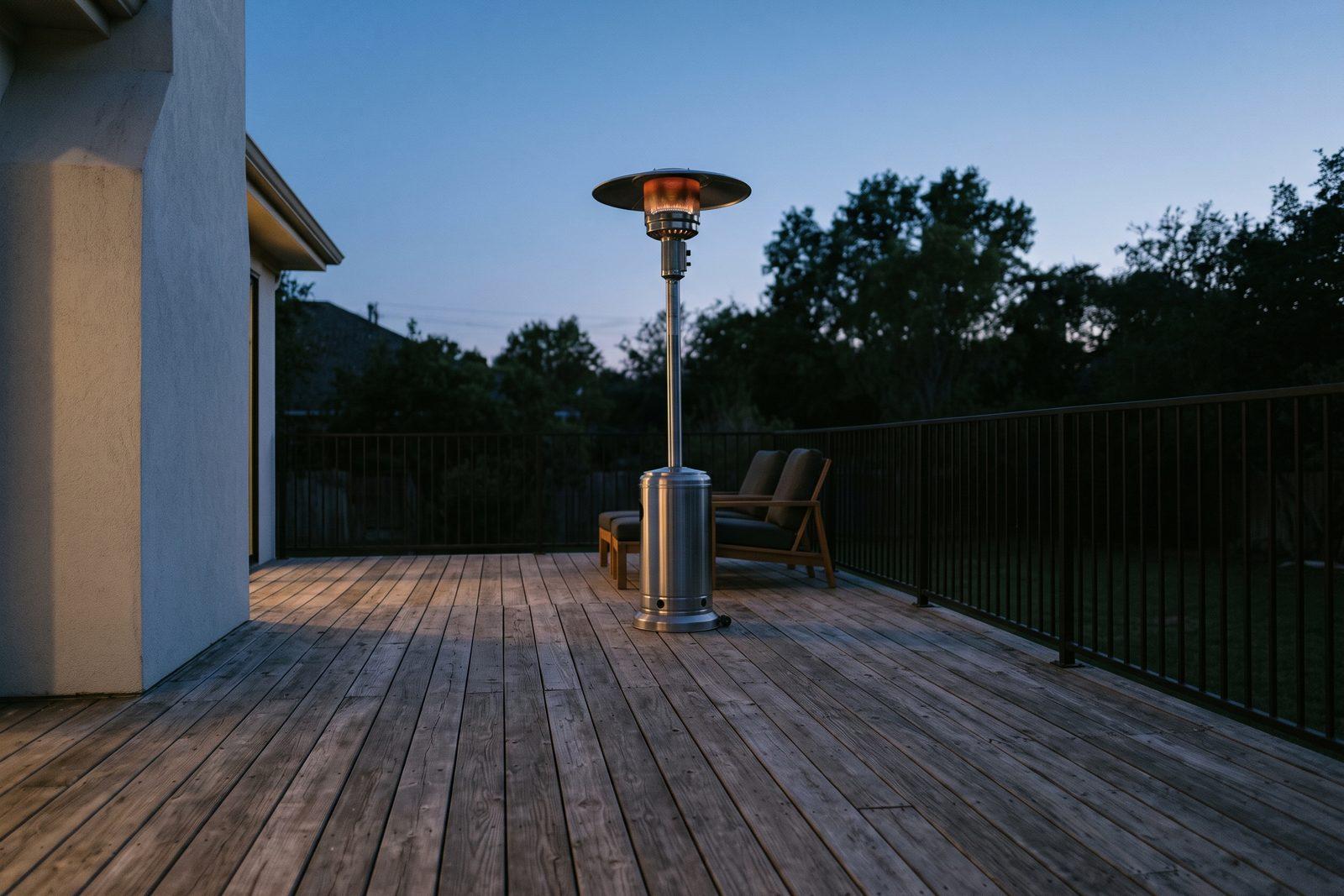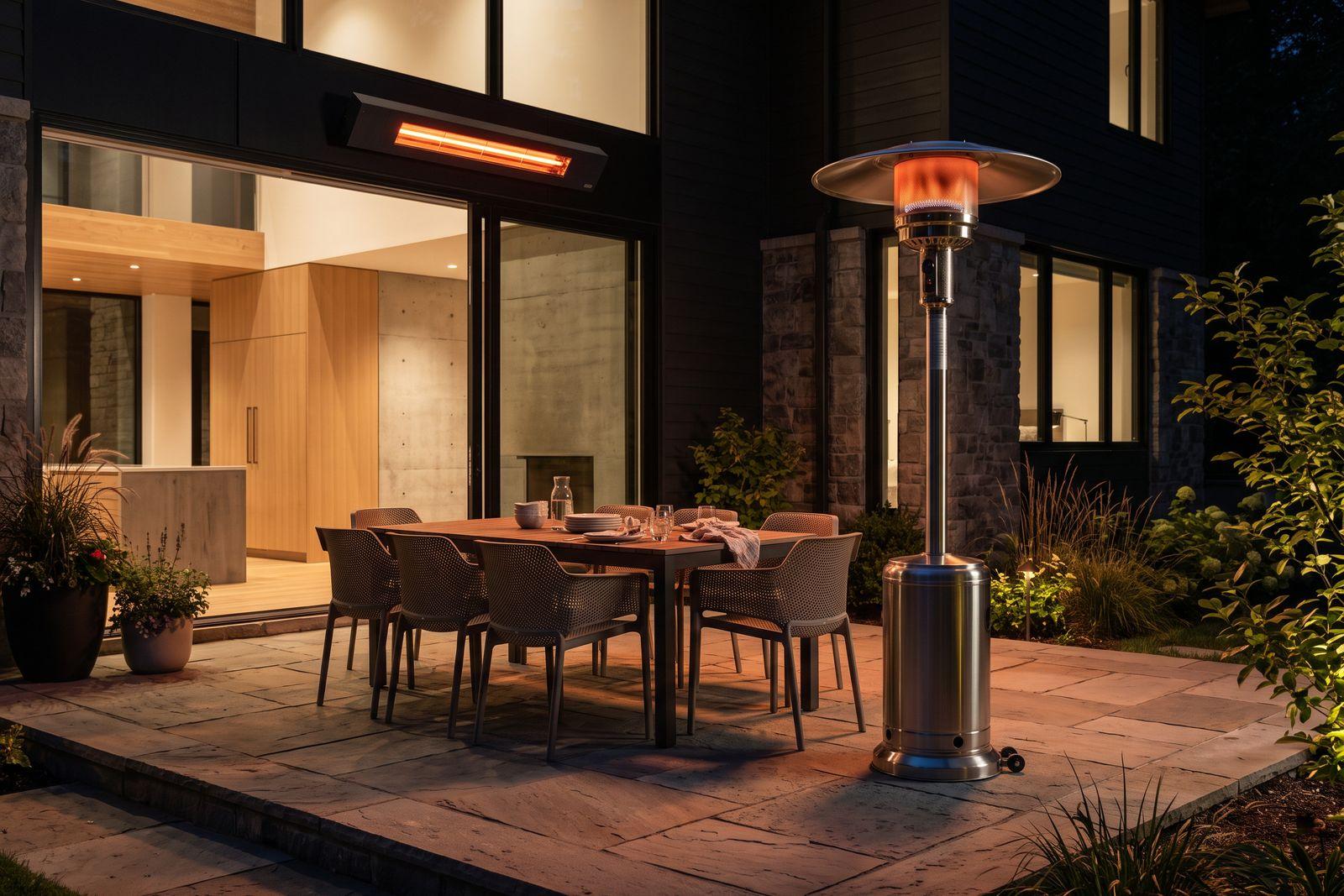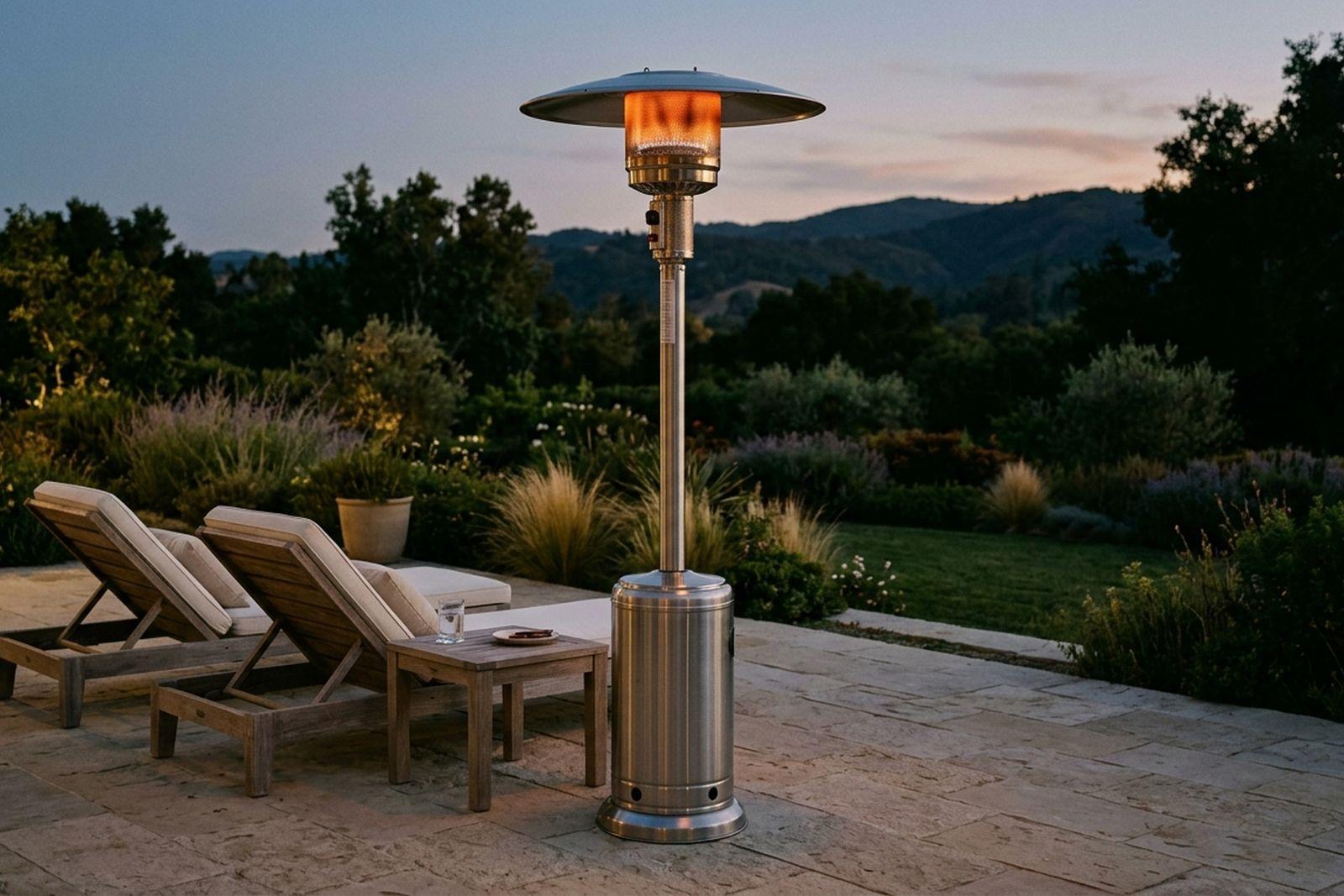

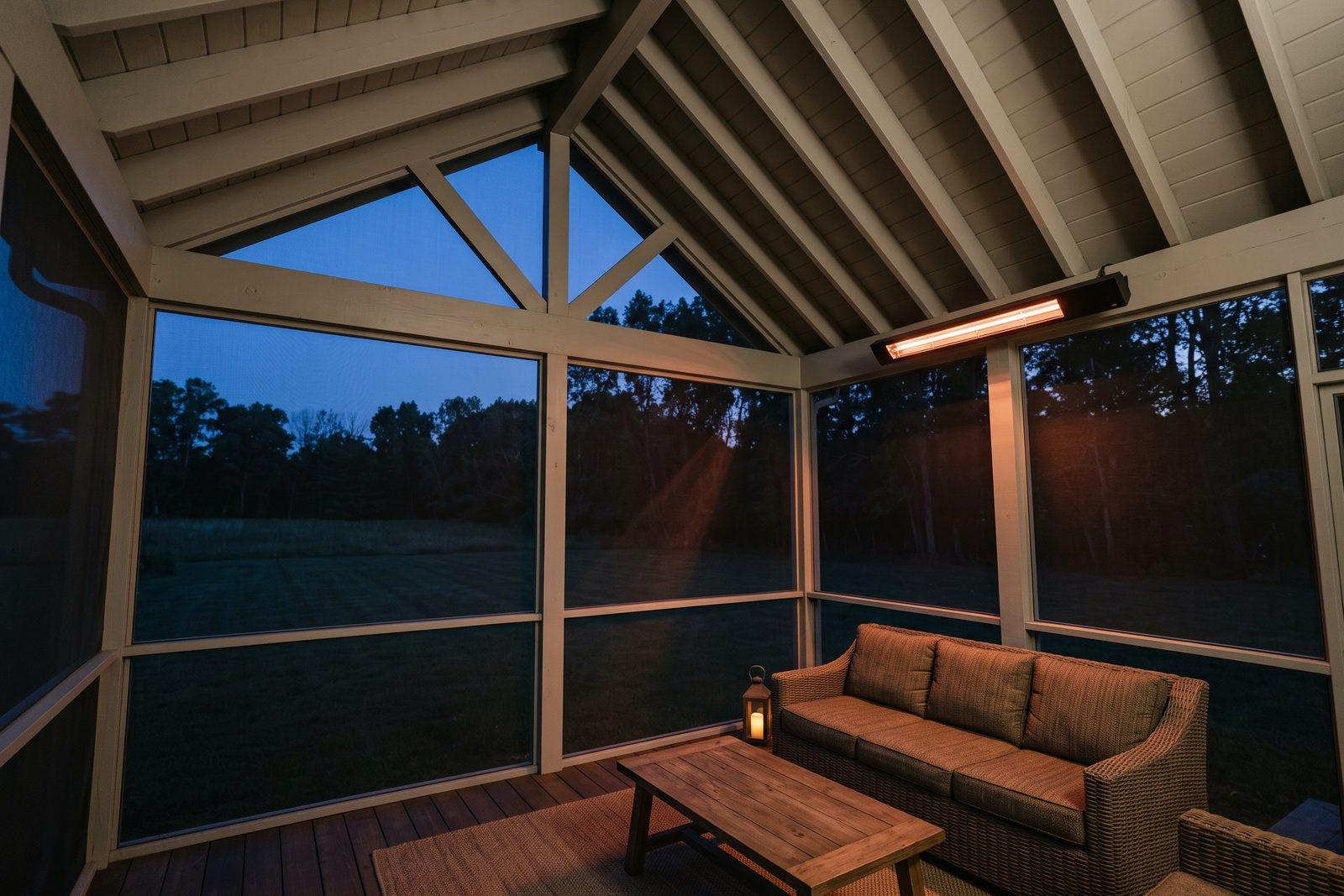
An electric infrared heater is the one that fits a screened porch or a three-season room. For a gas heater, none of the manuals I read says a screen counts as open wall, and the 2024 International Fire Code (IFC) bars a portable propane heater from inside any occupancy while it is connected to its cylinder. A porch closed in with glass or vinyl panels fails the open-air rules in every gas heater manual I read, so the answer there is no.
This guide reads the makers' manuals and the model codes. It adds to outdoor heaters for covered patios by working out what "open" means in the manuals, what the fire code says about portable heaters indoors, and which electric heaters state indoor use. Firepit HQ has not tested any heater, and your manual and your fire official decide.
Can You Use a Patio Heater in a Screened Porch?
It depends on the heater. This table is my reading of the documents, and the sections after it give the text behind each row.
Heater type, Screened porch, Porch closed in with glass or vinyl panels, What the documents say
Portable propane, cylinder in the base
- Screened porch
- Unlikely
- Porch closed in with glass or vinyl panels
- No
- What the documents say
- The IFC bars it inside any occupancy while connected to its cylinder. Mi-T-M's manual bars it from a building, garage or other enclosed area
Gas radiant, wall or ceiling mount
- Screened porch
- Only if the opening rules are met, and no manual says a screen counts
- Porch closed in with glass or vinyl panels
- No
- What the documents say
- Bromic's Tungsten Gas manual says not approved for indoor use and not for indoor residential locations
Freestanding gas tower
- Screened porch
- Same as above
- Porch closed in with glass or vinyl panels
- No
- What the documents say
- Lava Heat Italia says never to operate its heater in an enclosed space
Hardwired electric infrared
- Screened porch
- Yes, under the roof
- Porch closed in with glass or vinyl panels
- Yes, if the label states indoor use
- What the documents say
- Infratech lists UL for indoor and outdoor use, and Heatstrip's Classic is made for indoor or outdoor areas
Plug-in portable electric
- Screened porch
- Only where listed for the location
- Porch closed in with glass or vinyl panels
- Only where listed
- What the documents say
- IFC Section 4102.1
What Counts as Open in the Manuals?
The gas makers answer with percentages of wall area. Bromic's Tungsten Gas manual allows a roof over more than two walls only if at least 25 percent of the total wall area is completely open and at least 30 percent of the remaining wall area is open and unrestricted. Heatstrip's portable propane manual prints the same two figures and adds that on a balcony at least 20 percent of the total wall area must be and stay open and unrestricted. Its warnings page also lists a porch among the places never to use the heater. Mi-T-M uses a different test: a roof over three walls, with 30 percent or more of the horizontal periphery permanently open.
None of those documents defines a screen as open. Bromic and Heatstrip both say "completely open" for the first figure and "open and unrestricted" for the second, and a screened side is neither on its face. Here is the arithmetic on an invented porch, a roofed 12 by 16 ft space with 8 ft walls, attached along one 16 ft side to the house. I counted the house wall as solid and the screened sides as zero open area, because no manual says a screen is open.
| Test | What it asks | What the example porch needs |
|---|---|---|
| Bromic and Heatstrip, first test | 25 percent of total wall area completely open | The walls total 56 ft by 8 ft, or 448 sq ft, so 112 sq ft. One whole 16 ft side open is 128 sq ft (28.6 percent) and passes. One open 12 ft end is 96 sq ft (21.4 percent) and does not |
| Bromic and Heatstrip, second test | 30 percent of the remaining wall area open and unrestricted | With a 16 ft side open, 320 sq ft remain, so 96 sq ft must be open and unrestricted. That is half of the two 12 ft end walls |
| Mi-T-M | 30 percent of the horizontal periphery permanently open | 30 percent of 56 ft is 16.8 ft. One open 16 ft side is 28.6 percent, which is 0.8 ft short |
A porch with a screened far side and screened ends fails every row. A porch with the far side fully open still fails Mi-T-M's test by 0.8 ft and fails the second Bromic and Heatstrip test unless the ends are half open. The percentages are the makers', the dimensions are invented, and your maker can tell you whether any of this changes for your model.
Bromic's manual also states what it means by outdoors: an above-ground open-air situation with natural ventilation, without stagnant areas, where gas leakage and products of combustion are rapidly dispersed by wind and natural convection. A porch where the air sits still on a calm night is the stagnant case that sentence describes. That is my reading, and the text is Bromic's.
What the Fire Code Says About Portable Heaters Indoors
The 2024 IFC puts these rules in Chapter 41. Section 4101.1 applies the chapter to mobile and portable equipment used for temporary heating, so whether it reaches a home porch is a local call.
- Gas heaters with a built-in cylinder. Section 4103.1.2.1.1 prohibits their use "inside of any occupancy where connected to the fuel gas container," inside tents, canopies and membrane structures, and on exterior balconies.
- Overhangs. Section 4103.1.2.1.3 keeps them out from beneath, and within 5 ft of, combustible overhangs, awnings, sunshades or similar combustible attachments to buildings. A wood-framed porch roof that is attached to the house may be one of those.
- Cylinder storage. Section 4103.1.2.3.4 says gas containers shall not be stored inside buildings, with one exception for small cylinders in Section 6109.9 that applies to buildings open to the public.
- Other portable unvented fuel-fired heaters. Section 4103.1 prohibits them in residential Groups R-1 through R-4 and several other occupancies. Its exceptions are heaters listed to UL 647 in one- and two-family homes, and portable outdoor gas-fired heating appliances that follow Section 4103.1.2. I did not check which listing any propane heater carries.
- Attendance. Section 4101.4.2 says portable heating equipment shall be constantly attended while in use and until cooled to a safe temperature.
The 2024 International Residential Code does not define a porch, a screened porch or a three-season room. Its definitions chapter does define a sunroom as a one-story structure attached to a dwelling with glazing over 40 percent of the gross area of its exterior walls and roof. Whether your porch is inside an occupancy, a sunroom or an outdoor space is for your building department and fire official. Your jurisdiction may also be on an older edition or amend this one, so start with the fire code library.
Ventilation and Carbon Monoxide
Mi-T-M asks for at least 3 sq ft of opening to outside air for every 100,000 BTU/hr of heater rating. For an example input of 40,000 BTU/hr, an invented figure and not a Mi-T-M rating, that is 1.2 sq ft. The number is small, and the same manual says the heater shall not be used in a building, garage or any other enclosed area. The opening rule is the easy one, and the shelter rule decides.
Bromic says its Tungsten Gas and Freestanding heaters need ventilation because potentially harmful by-products go into the air, while its electric Tungsten heaters need none because no gases are released. The Consumer Product Safety Commission (CPSC) calls carbon monoxide a colorless, odorless, poisonous gas made by the incomplete burning of fuels that include propane and natural gas. It reports 33 CO deaths in 2020 associated with portable heaters.
PERC, the Propane Education & Research Council, says using a space heater designed for outdoor use indoors can be deadly, and to never use portable heaters indoors unless they are designed and approved for indoor use. Mi-T-M adds that propane vapor is heavier than air and collects in low places, and walls give it more places to collect. That last point is my reading of the manual's statement.
Electric Heaters in a Screened Porch or Three-Season Room
Three electric makers state where their heaters can go.
- Infratech: its reference manual lists its heaters UL-listed for indoor and outdoor use. Its installation manual says to hang them under a protective roof whenever possible, and that they must be hard wired by a licensed electrician. Combustibles stay 6 in. behind, 18 in. at the sides and ends and 36 in. in front, and its caution says to keep electrical cords, drapery and furnishings at least 3 ft from the front. Wall and ceiling mounts sit at least 6 ft up if the label says UL Listed and 8 ft if it says UL/CUL Listed.
- Heatstrip: the Classic manual says the heater is designed for domestic and commercial heating within an indoor or outdoor area. It carries an ETL approval and an IP55 rating, and calls for a fixed installation by a licensed electrical professional. Its installation steps say at least 6 ft above ground level in the USA, while its specification table lists a minimum mounting height of 6 ft 10 3/4 in. (2.1 m). Plan around the higher figure unless Heatstrip tells you otherwise.
- Bromic: the product page for its electric Tungsten says it needs no ventilation and is best built in under cover.
Many porches have outdoor curtains or vinyl weather panels, and those are the materials to watch. Infratech's caution names drapery. Bromic's gas manual lists plastic, vinyl siding and canvas as low heat tolerance materials that may degrade below the temperature its clearance assumes. I found no maker document that names porch screening or vinyl window panels, so ask the panel maker for a heat limit.
A portable plug-in electric heater has its own rules in Section 4102.1. It must be listed and labeled and plugged directly into an approved receptacle, not an extension cord, and kept 3 ft from combustibles. The section says such heaters "shall be operated only in locations for which they are listed." For hardwired models, the infrared patio heater guide covers voltage, amps and mounting, and the BTU calculator turns a porch area into a wattage range.
Three-Season Rooms, Sunrooms and Closed-In Porches
A porch closed in with glass or vinyl panels is an enclosed space under every gas heater manual I read. Heatstrip's list of places never to use its gas heater names a porch, a shed, a breezeway and any other enclosed area. Mi-T-M bars its heater from a building and any enclosed area, and Lava Heat Italia says never in an enclosed space. Bromic does not approve its gas heaters for indoor residential locations.
If you want gas heat in a room that is closed in, that is a heating system question for a licensed gas fitter or mechanical contractor and your building department, with an appliance listed for that use. A patio heater is an outdoor appliance and is not that. A hardwired electric heater with an indoor listing is the simpler route, wired by a licensed electrician.
Which Heater Fits Which Porch
These pairings are my reading of the documents above, and none of them is a maker's statement.
- A screened porch with a solid roof and screens all around: a hardwired electric infrared heater overhead, at the mounting height on its label.
- A screened porch with one or more sides truly open: run the arithmetic above, ask the gas maker in writing whether your layout counts, and ask your fire official about the cylinder and overhang rules before you consider a gas heater.
- A three-season room with glass or vinyl panels: an electric heater that states indoor use, or a heating system installed by the licensed trades.
- A gas fire table on the same porch: that is a different appliance with its own manuals, covered in the gas fire pit under a covered patio guide.
- An open deck beside the porch: the floor and the 5 ft rules come into play, and the patio heater on a deck guide goes through them.
Checklist Before You Buy
- Read the exact model's manual, and ask the maker in writing whether a screened side counts as open.
- Measure the porch, count the walls and work out the open share of wall area the way the table above does.
- Ask your fire official whether the porch counts as inside an occupancy and whether the roof is a combustible attachment to the house.
- For electric, check the label for the voltage, the listing and whether it states indoor use.
- Check the mounting height against the ceiling, and keep curtains, panels and furnishings clear of the heater's front.
- Hire a licensed electrician for any hardwired heater, and a licensed gas fitter for any gas line.
- Keep a propane cylinder outdoors, since PERC says never to use or store a small cylinder in an enclosed area.
Common Questions
Can you use a patio heater in a screened porch?
An electric infrared heater can go under the porch roof. A gas heater is the hard case, because none of the manuals reviewed says a screen counts as open wall, and the 2024 International Fire Code bars a portable propane heater inside any occupancy while it is connected to its cylinder. Ask the maker in writing, and ask your fire official how your porch is classified.
Can you use a propane heater on a screened porch?
Probably not. Bromic and Heatstrip ask for wall area that is completely open or open and unrestricted, and Mi-T-M asks for 30 percent of the perimeter permanently open. A screened side is not described as open in any of them. The 2024 fire code also keeps a portable propane heater from beneath combustible overhangs attached to a building, which a wood-framed porch roof may be.
Can you use an outdoor patio heater in a three-season room?
Not a gas one. Heatstrip's manual lists a porch and any other enclosed area as places never to use its gas heater, Mi-T-M bars its heater from any building or enclosed area, and Lava Heat Italia says never in an enclosed space. Electric infrared heaters that state indoor use, such as Infratech's UL-listed models, are the alternative. A licensed electrician wires them.
Do propane patio heaters need ventilation?
Yes. Mi-T-M asks for at least 3 square feet of opening to outside air for every 100,000 BTU/hr of heater rating, and Bromic says its gas heaters need ventilation because harmful by-products go into the air. Its electric heaters need none. That ventilation rule sits beside shelter rules and the fire code, so meeting one does not clear the others.
What kind of heater works on a screened porch?
A hardwired electric infrared heater under the roof is the easiest fit by the documents. Infratech says to hang its heaters under a protective roof when possible, Heatstrip's Classic is made for indoor or outdoor areas, and Bromic's electric Tungsten needs no ventilation. Check the label for the listing, the voltage and the mounting height, and keep curtains and furnishings 3 feet from the front.
Is it safe to use an outdoor propane heater indoors?
No. PERC says a space heater designed for outdoor use can be deadly indoors, because heaters not designed for indoor use can make high levels of carbon monoxide. It says never to use portable heaters indoors unless they are designed and approved for indoor use. Mi-T-M's manual says never to use its heater inside a house or in an unventilated or enclosed area.
Sources
- International Code Council, 2024 International Fire Code (Version 2.1, Feb 2026), Chapter 41, Temporary Heating and Cooking Operation: Section 4101.1 (scope), 4101.4.2 (attendance), 4102.1 (portable electric space heaters), 4103.1 (portable unvented fuel-fired heaters in residential occupancies and the two exceptions), 4103.1.2.1.1 (prohibited locations), 4103.1.2.1.3 (combustible overhangs and attachments to buildings) and 4103.1.2.3.4 (indoor storage of gas containers)Checked
- International Code Council, 2024 International Residential Code, Chapter 2 Definitions: Sunroom (a one-story structure attached to a dwelling with glazing over 40 percent of the gross area of its exterior walls and roof). The chapter has no definition of porch, screened porch or three-season roomChecked
- Bromic, Tungsten Smart-Heat Gas Installation, instruction and service manual, Version 2.3 USA - Canadian: not approved for indoor use and protect from rain (PDF p. 5), open-air rule, enclosure options and definition of outdoors (p. 6), not for indoor residential locations and low heat tolerance materials (p. 7), troubleshooting table (p. 25), Appendix A outdoor area examples (p. 27)Checked
- Bromic, Tungsten Smart-Heat Portable Heater Installation, Instruction and Service Manual (cover: Version 2.2 USA / CAN; the file name says V1.8): outdoor use only (PDF p. 1) and the same enclosure options (p. 7)Checked
- Heatstrip, X-DGR32PLP Head and Stand US Manual (portable propane): Outdoor Areas Safety Appliance Locations, shelter rules including the 25, 30 and balcony 20 percent figures (PDF p. 4) and For Your Safety warnings, never in a garage, porch, shed, breezeway or other enclosed area (p. 5)Checked
- Mi-T-M Corporation, Propane Patio Heaters Operator's Manual MH-0042-PM11 (37-1494-E-071322): ventilation opening of 3 sq ft per 100,000 BTU/hr (PDF p. 5), never use inside a house or enclosed area (p. 9), propane vapors heavier than air (p. 18), shelter rules and no use in a building, garage or other enclosed area (p. 19)Checked
- Lava Heat Italia, Troubleshooting & Diagnostics (owner support page): for outdoor use only, never operate in an enclosed spaceChecked
- Infratech, Reference Manual (IN_refmanual_022625_dj): UL-listed for indoor and outdoor use (PDF p. 3) and low profile heaters suitable for indoor and outdoor installations (PDF p. 54)Checked
- Infratech, All Weather C-Series and CD-Series Installation, Use & Care Manual (IN038, July 2024): clearances, mounting heights, 3 ft caution for drapery and furnishings, hard wiring by a licensed electrician (pp. 2 and 3) and hanging under a protective roof (p. 7)Checked
- Heatstrip, Classic US product manual (X-THHUS-A, Rev 6): domestic and commercial heating within indoor or outdoor areas, fixed installation by a licensed electrical professional, at least 6 ft above ground level in the USA, 3 ft caution (PDF p. 3), ETL approval, IP55 rating and a minimum mounting height of 6 ft 10 3/4 in. (2.1 m) in the specification table (p. 4)Checked
- Bromic, Tungsten Smart-Heat Electric product page, FAQ: electric Tungsten heaters need no ventilation because no gases are released, the gas and freestanding Tungsten heaters do; best built in under coverChecked
- Propane Education & Research Council, Safety Guide for Propane Users (PRC-101063D, 2025): using a space heater designed for outdoor use indoors can be deadly (printed p. 10), never use portable heaters indoors unless designed and approved for indoor use (p. 15), never use or store a small cylinder in an enclosed area (p. 19)Checked
- U.S. Consumer Product Safety Commission, Carbon Monoxide Fact Sheet: CO is a colorless, odorless, poisonous gas made by the incomplete burning of fuels that include propane and natural gas; portable heaters were linked to 33 CO deaths in 2020Checked
About the Author
James Darren Writes the Firepit HQ guides on fire features, fuel and fire codes. Every figure in them is cited to its source with the date it was checked.