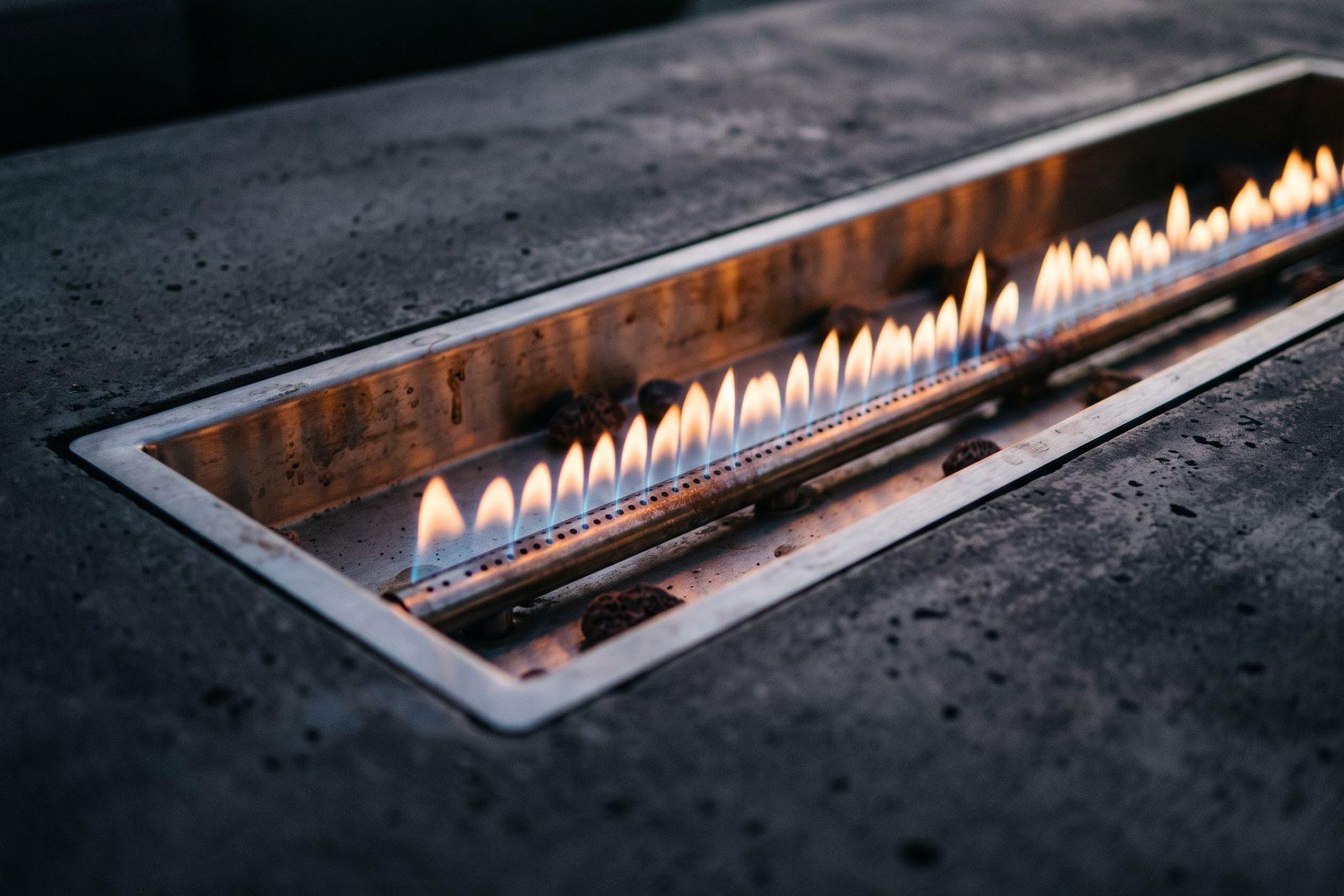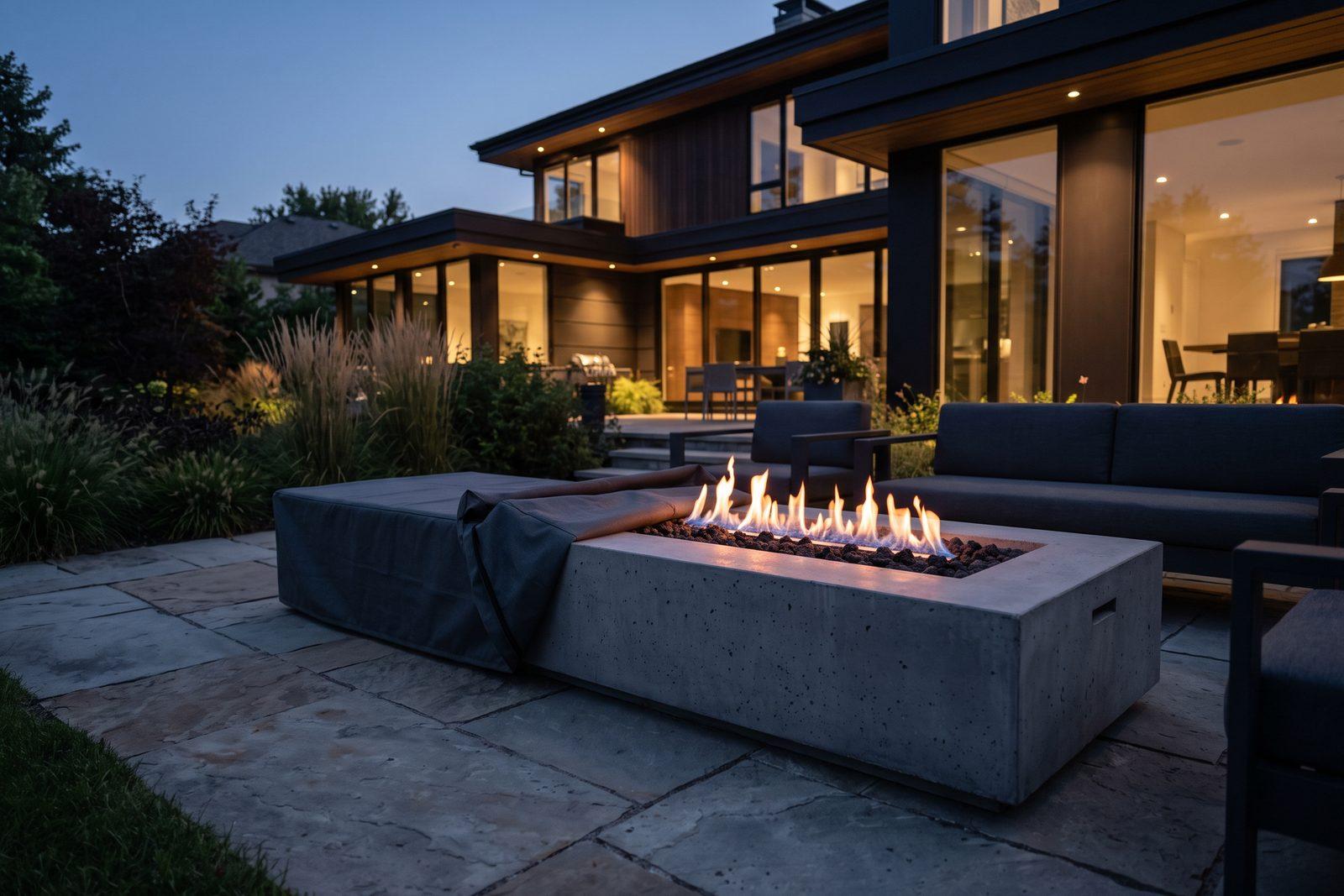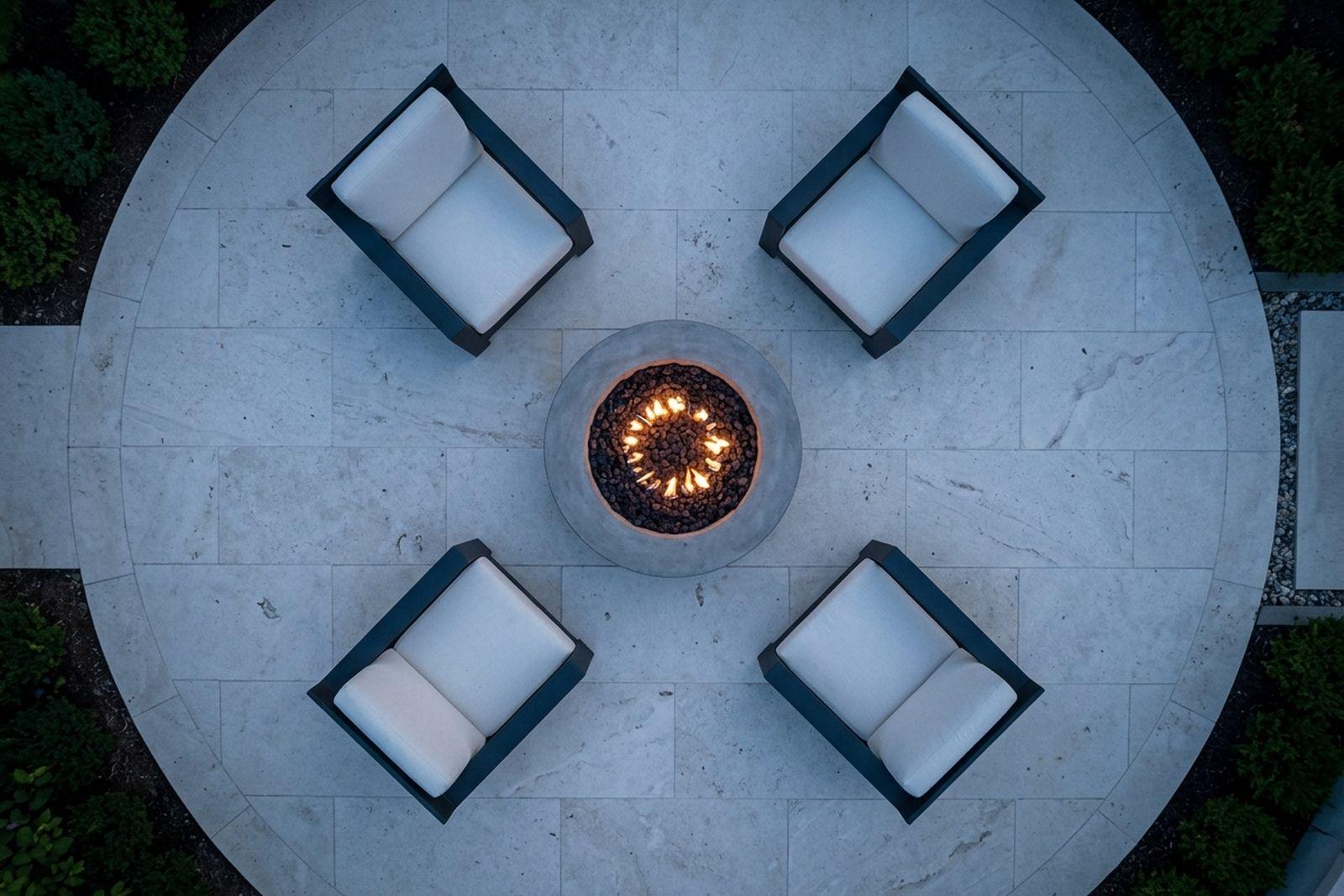

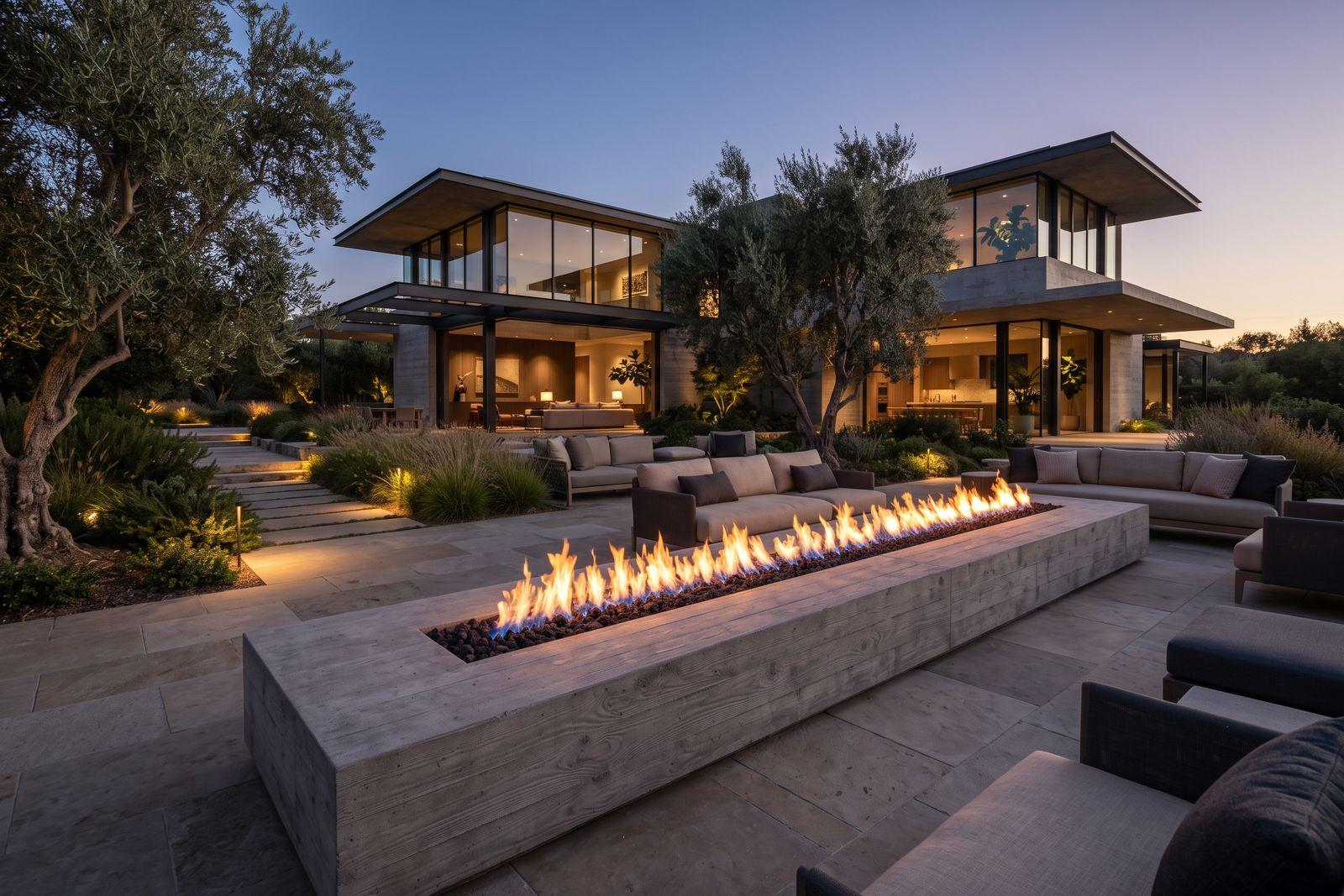
To choose a gas fire pit, settle eight things in order: where it goes, which fuel, how big it is, which burner and BTU rating, how it lights, what covers the burner, what it is made of and who makes it. The first two can rule out the rest, because your local code and your gas supply set limits no product can change.
Each step below gives the decision, the numbers makers and code bodies publish, and a link to the deeper guide or tool. Everything here is read from published documents, and we haven't tested any product.
| Step | Decision | What decides it |
|---|---|---|
| 1. Where it goes | Site, clearance, cover and surface | Local code, and the manual's clearance: 16 to 48 inches at the sides in the manuals I read |
| 2. Fuel | Natural gas or propane | Gas service at the house, and tank runtime: about 6.6 hours at 65,000 Btu/h on a 20 lb cylinder |
| 3. Size | Footprint and seating | Seats typically 36 to 42 inches from the flame edge, per HPC |
| 4. Burner and BTU | Finished piece, insert or burner kit | Input rating, gas line and clearance tier |
| 5. Ignition | Match-lit, flame-sensing or electronic | Whether there is power at the pit, and how you want to light it |
| 6. Media | Lava rock or fire glass | The depth limit in the manual: HPC allows no more than 1/2 inch of glass over a propane burner |
| 7. Material | GFRC, corten, copper, steel or stainless | Weight and weathering: Prism's GFRC tables weigh 205 to 650 pounds |
| 8. Maker | Whose documents fit your site | Published specs, clearances and listing for the exact unit |
Step 1: Where Will the Gas Fire Pit Go?
Start with the site, because it decides what you can buy. Four things matter: code, clearance, cover and surface.
- Code. The 2024 International Fuel Gas Code says a permanently fixed-in-place outdoor decorative appliance must be listed to ANSI Z21.97 and installed to the manufacturer's instructions (Section 635.1). States and cities adopt codes their own way, so look yours up, starting with the code library if your state is covered.
- Clearance. Manuals set a minimum distance to combustibles, and the figures differ by maker: 16 inches on a Firegear Sanctuary table, 36 inches on a Firegear Pro H-burner and on an Outdoor Plus bowl up to 65,000 Btu/h, 48 inches on a Prism. Overhead runs from 69 to 120 inches in those manuals. The clearance checker lists them by burner input.
- Cover. Under a roof, the manual rules. Outdoor GreatRoom allows a partial enclosure with two walls and an overhead cover, or three walls and a cover with at least 30% of the wall area permanently open, and says a fully enclosed space doesn't qualify. Firegear's manual carries a carbon monoxide danger label against use in an enclosed space. Read the covered patio guide first.
- Surface. HPC requires its deck insulation kit and pavers on a wood or composite deck. Firegear lists 18 inches of clearance to a combustible floor for its Pro H-burners, and Outdoor GreatRoom says its tables can go on a wood deck. Makers disagree, so ask yours, and see the deck guide.
Step 2: Natural Gas or Propane?
If gas service is already at the house and the fire pit will stay where you build it, natural gas avoids refills. Propane suits a site without service and a piece that has to move. A burner puts out the same heat on either fuel at the same rating, and Prism lists most of its Moderno bowls at 65,000 Btu/h on both.
The tank is the catch. A 20 lb cylinder holds 4.7 gallons, and a gallon holds 91,500 Btu. That is about 6.6 hours at 65,000 Btu/h and 2.2 hours at 200,000. PERC notes that a container vaporizes more slowly when the air is colder or the tank is lower, so a big burner can falter on a cold night before the tank is empty.
The natural gas vs propane guide compares pipe sizes, conversion kits and how to compare the two fuels by the therm. The propane tank runtime and gas line sizing calculators run the numbers for your burner.
Gas piping is licensed work. Firegear, The Outdoor Plus and HPC manuals say installation should be done by a qualified installer, service agency or gas supplier, and The Outdoor Plus and HPC suggest professionals licensed in gas piping by the local authority.
Step 3: How Big Should the Fire Pit Be?
Size it to the space, not the catalog. HPC puts seats typically 36 to 42 inches from the flame edge, and the manual's clearance sets the floor. The gas fire bowls I read run 29 to 70 inches across, tables run up to 110 inches long, and pits and tables stand from 12 to 30 inches high. A 12 foot square patio loses 72 to 84 inches to seating on two sides before a chair is counted, so a bigger pit isn't always a better one.
The sizing guide has the full tables of sizes, clearances, seating distances and table heights, and the maker-published figures behind them.
Step 4: Which Burner Type and BTU Rating?
First decide if you are buying a finished piece or building around a burner.
- Finished piece. A table or bowl with the burner inside. Prism's Tavola tables and Moderno bowls, Bull's two pits and Firegear's Sanctuary line are examples.
- Insert or pan. A burner in a pan that drops into your own enclosure. HPC lists nine certified insert styles: round bowl, round flat, square bowl, square flat, rectangle H-burner, linear trough, linear interlink, H flat and linear flat.
- Burner kit. Firegear's burner systems come as round, square, linear H and linear T. The Outdoor Plus sells bullet burners in double rectangle, H, linear, racetrack, rectangle, round, square, switchback and triple S shapes. The burner kits guide covers fit.
For input, most finished tables I read list 55,000 to 65,000 Btu/h, and Bull lists 35,000. A few go higher, such as Outdoor GreatRoom's 80,000 dining table and Prism's 125,000 Moderno 70 bowl. The big numbers bring requirements elsewhere: a larger gas line, a larger tank and more clearance. The BTU ratings guide explains the rating, and the heat guide explains why a high rating doesn't mean a warm patio.
Step 5: Match-Lit or Electronic Ignition?
Match-lit means a lit long handle lighter over the burner, then the key valve opened slowly, as The Outdoor Plus insert manual describes. Electronic ignition lights from a switch, remote or app, and it needs a powered circuit. HPC's EI manual calls for 120 VAC, or 24 or 12 VAC, a GFCI-protected circuit and a wall switch for safety shutoff, and in its sequence the main valve opens only after a pilot has heated a thermocouple.
For most backyard pits I'd choose match-lit, which needs no power, with a flame-sensing pilot if you want an automatic shutoff. Electronic is worth having when you want to light the fire from somewhere else. The ignition guide explains what a flame-sensing pilot adds, and covers the failure modes and the listing details.
Step 6: Lava Rock or Fire Glass?
Media covers the burner, and its depth is a safety setting as much as a style choice. HPC warns that glass over a propane burner shouldn't be deeper than 1/2 inch, because it can create back pressure and push gas out of the air mixer to pool under the fire pit. Some pieces ship with rock. Prism includes lava rock with its Tavola and Moderno models: 27 or 54 pounds on most, and six 27 pound bags with the Moderno 70.
Compare the two in the fire glass vs lava rock guide, and size the fill for your pan with the fire glass calculator.
Step 7: What Should a Gas Fire Pit Be Made Of?
The main choices are GFRC (glass fiber reinforced concrete), corten, copper, steel and stainless. Weight is the first practical difference. Prism's GFRC tables run from 205 pounds for the Tavola 1 to 650 pounds for the Tavola 5, and the Moderno 70 bowl is 650 pounds, so plan the route in and what it sits on. Finish is the second. The Outdoor Plus sells its Cazo bowl in GFRC, powder-coated steel and copper, and Ohio Flame's wood-burning steel pits come in a natural steel finish. The materials guide covers weathering, staining and care.
Step 8: Who Makes Gas Fire Pits?
This list compares published specs and documents. It isn't a ranking, and we don't sell any of these brands yet. Open a brand page for sourced facts, or the makers compared guide for a side-by-side.
| Maker | What the pages describe | Fuel or type |
|---|---|---|
| Prism Hardscapes | GFRC fire tables and bowls, plus copper bowls | Propane or natural gas on most models |
| The Outdoor Plus | Fire pits, bowls, pans, bullet burners and ignition systems | Propane or natural gas |
| HPC Fire Inspired | Certified inserts, Penta burner kits, electronic ignition systems and complete fire features | Natural gas or propane |
| Firegear Outdoors | Sanctuary GFRC tables and bowls, Pro Series burner systems and the LUME smokeless fire pit line | Natural gas or propane |
| Bull Outdoor Products | Two finished pits at 35,000 Btu/h | Propane, or propane and natural gas |
| Ohio Flame | Steel pits and rings, 24 to 48 inches for the pits | Wood |
| Lava Rock Direct | Wholesale lava rock | Media |
| Bromic Heating | Gas and electric infrared patio heaters | Gas or electric |
| Infratech | Electric infrared patio heaters, 1,500 to 6,000 W | Electric |
| Heatstrip | Electric radiant strips and two gas heaters | Electric or gas |
| Lava Heat Italia | Freestanding gas flame-tower heaters, 42,000 to 66,000 Btu/h | Gas |
The last four are heaters, not fire pits. If warmth is the goal, the guide to choosing a patio heater is the better starting point.
Gas Fire Pit Buying Checklist
- Look up your state and city rules, starting with the code library, and read the clearance in the manual for the exact unit.
- Choose the fuel the site supports, and have a licensed gas fitter size the line or tank.
- Measure the patio. It has to hold the pit plus 36 to 42 inches to the seats on each side you sit, with the manual's clearance kept to anything combustible.
- Check the input against your gas line or cylinder before you check the finish.
- Ask which ignition the unit ships with and which listing it carries.
- Match media depth to the manual, and weight to the surface.
If you have to choose between a bigger flame and the clearance, pick the clearance. The unit you buy ships with its own manual, and your local fire official has the final say. Every figure above comes from a maker's own document, a code body or the propane industry, linked where it appears.
Common Questions
How do I choose a gas fire pit?
Decide eight things in order: where it goes, which fuel, how big it is, which burner and BTU rating, how it lights, what media covers the burner, what it is made of and who makes it. The first two limit the rest, because local code and your gas supply decide what you can install. Check each maker's manual before you buy.
Is natural gas or propane better for a gas fire pit?
Natural gas is usually better when gas service already reaches the house and the fire pit will stay put, because nothing needs refilling. Propane suits sites without service and pieces that move. A burner puts out the same heat on either fuel at the same Btu/h rating, so the choice is about supply, not warmth.
How big should a gas fire pit be?
Size it to the patio, not the catalog. HPC puts seats typically 36 to 42 inches from the flame edge, and every manual sets a clearance to combustibles, from 16 to 48 inches in the ones I read. Gas fire bowls run 29 to 70 inches across and tables up to 110 inches long. The sizing guide has the tables.
Do gas fire pits need a licensed installer?
Manuals from Firegear, The Outdoor Plus and HPC say gas installation should be done by a qualified installer, service agency or gas supplier, and The Outdoor Plus and HPC suggest professionals licensed in gas piping by the local authority. Ask your building department who may do the work and whether a permit applies.
What are the downsides of using a propane fire pit?
The tank sets the limits. A 20 lb cylinder holds 4.7 gallons, which is about 6.6 hours at 65,000 Btu/h and 2.2 hours at 200,000. PERC notes a container vaporizes more slowly when the air is colder or the tank is lower, so a big burner can falter on a cold night before the tank is empty.
Sources
- International Code Council, 2024 International Fuel Gas Code, Chapter 6, Section 635.1 (permanently fixed-in-place outdoor decorative appliances listed to ANSI Z21.97 and installed per the manufacturer's instructions)Checked
- The Outdoor Plus, Fire Bowl Installation Manual, Match Lit (FB-ML-M, 2026): installation by a qualified installer, service agency or gas supplier and by professionals locally licensed in gas piping (PDF pp. 3 and 4), Clearance from Combustibles (PDF p. 5)Checked
- The Outdoor Plus, Match Lit Fire Pit Insert Manual (2024): outdoor use only (PDF p. 3), start-up procedure with a lit long handle lighter and key valve (PDF p. 6)Checked
- HPC Fire Inspired, EI Series Electronic Ignition Fire Pit Insert, Installation and Operation Instructions (860-EI): control options and wall switch (PDF p. 6), electrical supply and GFCI (PDF p. 7), Table 3.1 clearances and deck insulation kit requirement (PDF p. 9)Checked
- HPC Fire Inspired, Match Lit Fire Pit Insert, Installation and Operation Instructions (870): qualified installer, service agency or gas supplier (PDF p. 2), installers licensed in gas piping (PDF p. 5), glass over a propane burner not over 1/2 in. (PDF p. 20)Checked
- HPC Fire Inspired, 5 Best Practices for Designing an HPC Outdoor Fire Feature: seating typically 36 to 42 in. from the flame edgeChecked
- HPC Fire Inspired, CSA Certified Fire Pit Inserts category page (nine insert styles) and Complete Fire FeaturesChecked
- Firegear Outdoors, Pro H-Burners and Kits, Installation and Operating Instructions, REV. D: outdoor use only and carbon monoxide danger label (PDF p. 2), Table 1 clearances including combustible floor (PDF p. 4), qualified installer for natural or LP gas (PDF p. 5)Checked
- Firegear Outdoors, Sanctuary 1 installation manual, REV. C: Table 1 and Fig. 2 clearance to combustibles (PDF p. 4)Checked
- Firegear Outdoors, Sanctuary 3 product page (29 in. diameter GFRC bowl)Checked
- The Outdoor Plus, Florence GFRC Fire Pit 12 in. product page (12 in. tall by 42 in. diameter)Checked
- HPC Fire Inspired, Penta Burner Kits product page and Product References page (electronic ignition systems)Checked
- Firegear Outdoors, Products and Firepit Burner Systems pages (Sanctuary Series, The LUME, round, square, linear H and linear T burner systems)Checked
- Prism Hardscapes, Moderno Series Installation Guide, Section 3.1: 4 ft side and 6 ft top clearance to a combustible surface (PDF p. 10) and 65,000 BTU/HR inputChecked
- Prism Hardscapes, Copper Collection product page (hand hammered 99.9% copper Moderno bowls)Checked
- Prism Hardscapes, Tavola Series product page: weights (Tavola 1 at 205 lb, Tavola 5 at 650 lb), 27 and 54 lb of lava rock included, 65,000 BTU, propane or natural gasChecked
- Prism Hardscapes, Moderno Series product page: 30 to 70 in. bowls, 65,000 BTU (Moderno 70 at 125,000 BTU and 650 lb), lava rock included (27 or 54 lb; six 27 lb bags on the Moderno 70)Checked
- Outdoor GreatRoom Company, Frequently Asked Questions, Q1 to Q4 and wood deck answer: partial enclosure criteria, clearances, use on a wood deckChecked
- Outdoor GreatRoom Company, Kenwood and Brooks Linear Dining Height Gas Fire Pit Table product page (80.69 x 49 x 30 in., 80,000 BTU)Checked
- American Fyre Designs, 2026 Product Catalog: firetable dimensions and inputs, most at 60,000 to 65,000 BTU and up to 100,000 with Bluetooth control (pp. 7 to 10)Checked
- Bull Outdoor Products, Small Square Fire Pit and Slim High Profile Fire Pit product pages (35,000 BTU)Checked
- The Outdoor Plus, Fire Pits & Tables, Bullet Burners and Cazo Fire Bowl product pages (burner shapes, GFRC, powder-coated steel and copper Cazo bowls)Checked
- Ohio Flame, Patriot Collection product page (wood-burning steel fire pits, 24 to 48 in.) and Gas Burners collection page (coming soon)Checked
- Lava Rock Direct, Products page (wholesale lava rock for fire features and landscaping)Checked
- Bromic Heating, Tungsten Smart-Heat Gas product page (26,000 and 43,000 BTU) and Tungsten Smart-Heat Electric Product Cut Sheet (2,000 to 6,000 W)Checked
- Infratech, Choosing your Infratech system chart (IN999, 2025): electric heaters from 1,500 to 6,000 WChecked
- Heatstrip, product pages (Classic, Intense, Enhance, Max DC Commercial, Wall Mounted Gas and Portable Gas)Checked
- Lava Heat Italia, Positano Flame Tower Collection page (66,000, 56,000 and 42,000 BTU towers)Checked
- Propane Education & Research Council, The Propane Technical Pocket Guide, 4482-BR-21 v3: Table 1C (91,500 Btu per gallon) and Vaporization Rates (printed p. 9)Checked
- Manchester Tank & Equipment Co., Portable DOT Steel LP Gas Cylinders 5 lb to 100 lb, Catalog 49500 (09/2022), LPG capacity row (20 lb cylinder, 4.7 gal)Checked
About the Author
James Darren Writes the Firepit HQ guides on fire features, fuel and fire codes. Every figure in them is cited to its source with the date it was checked.