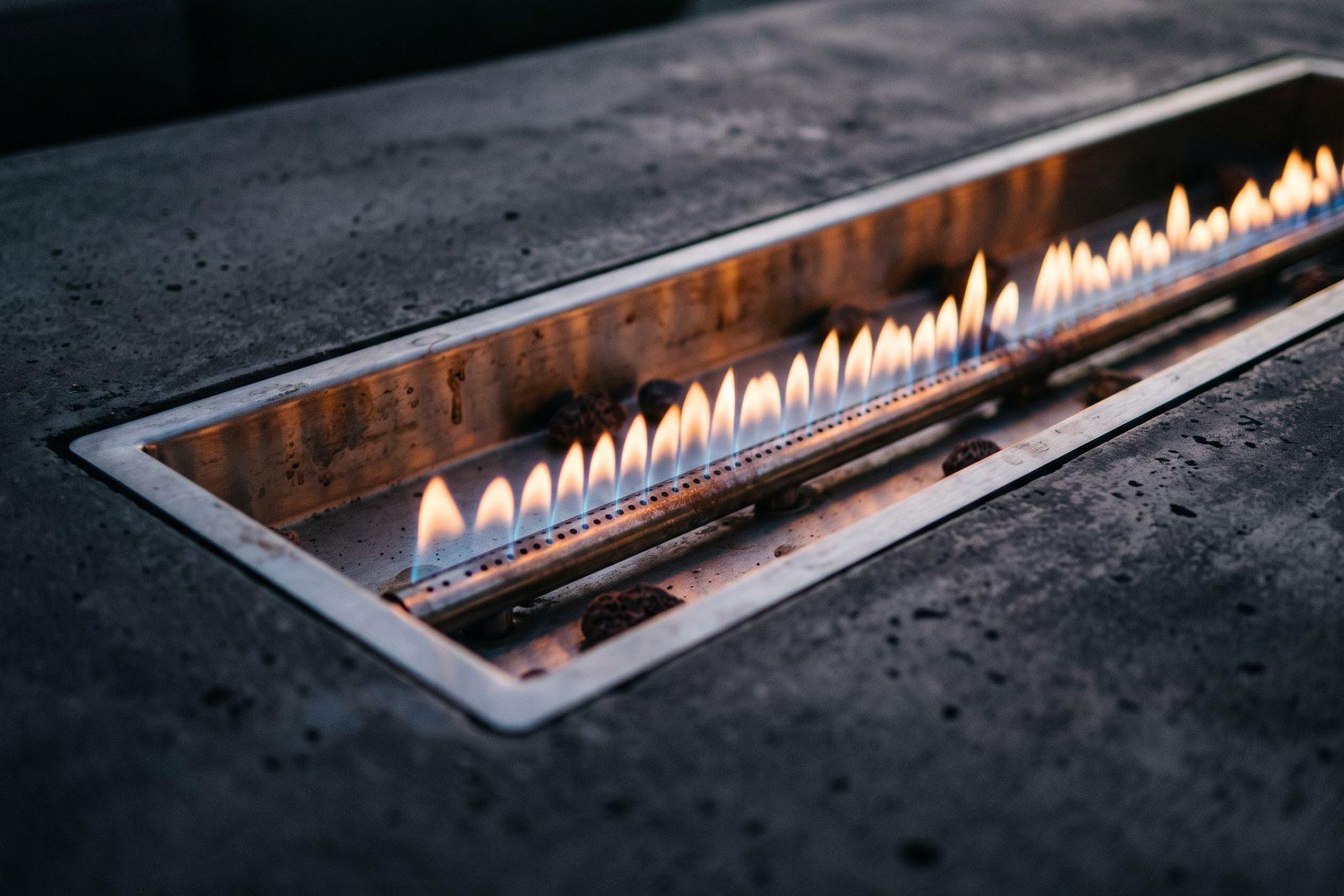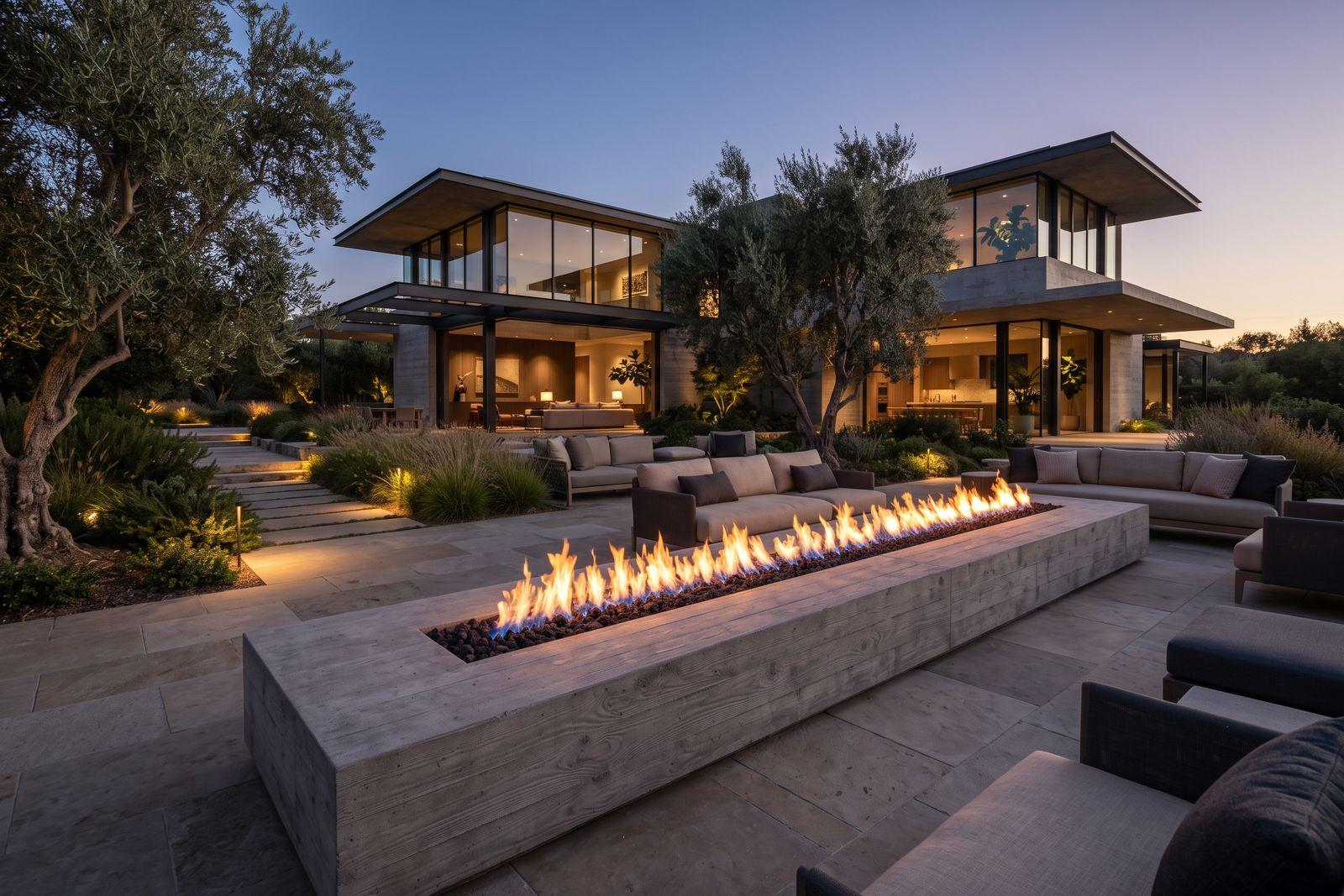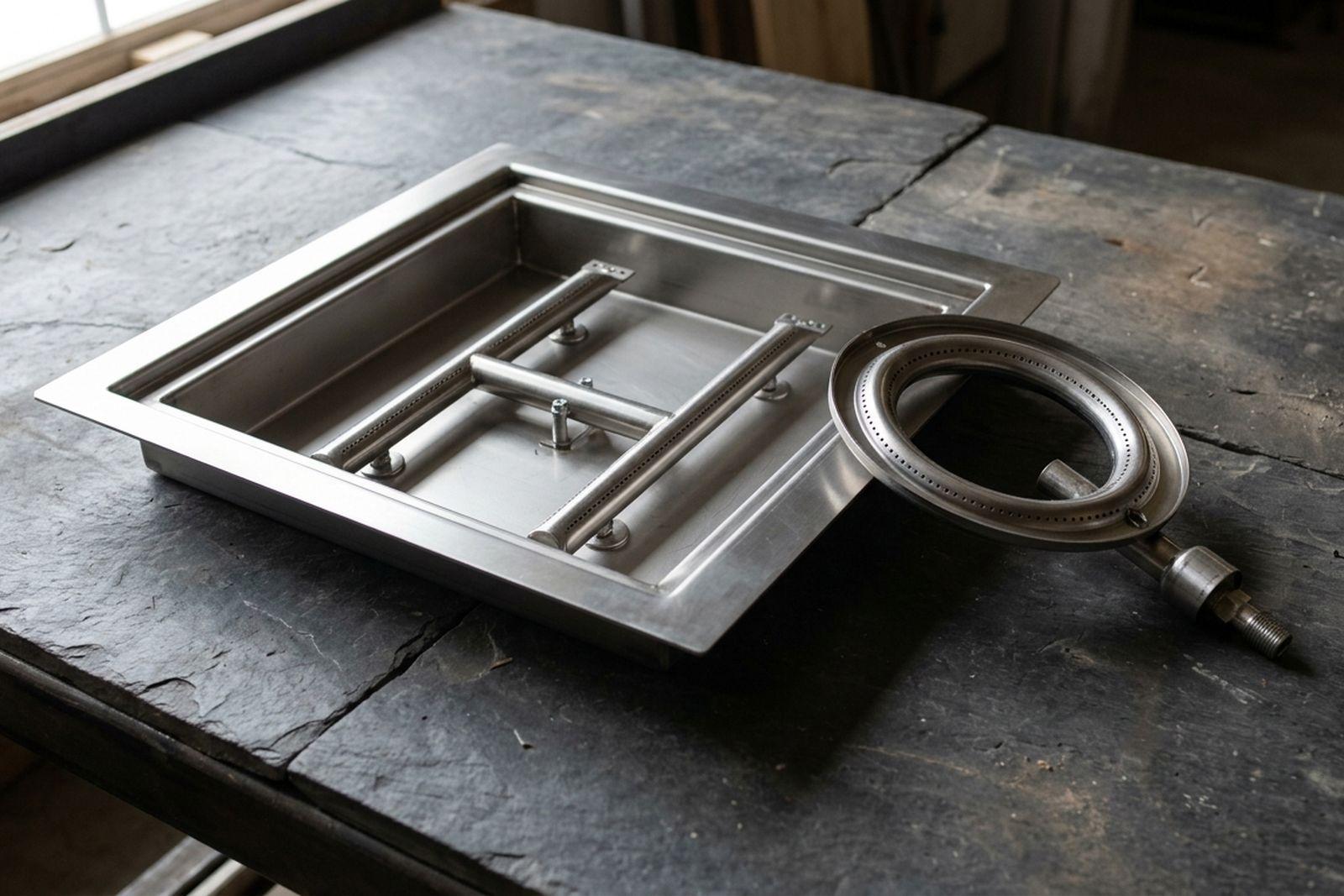

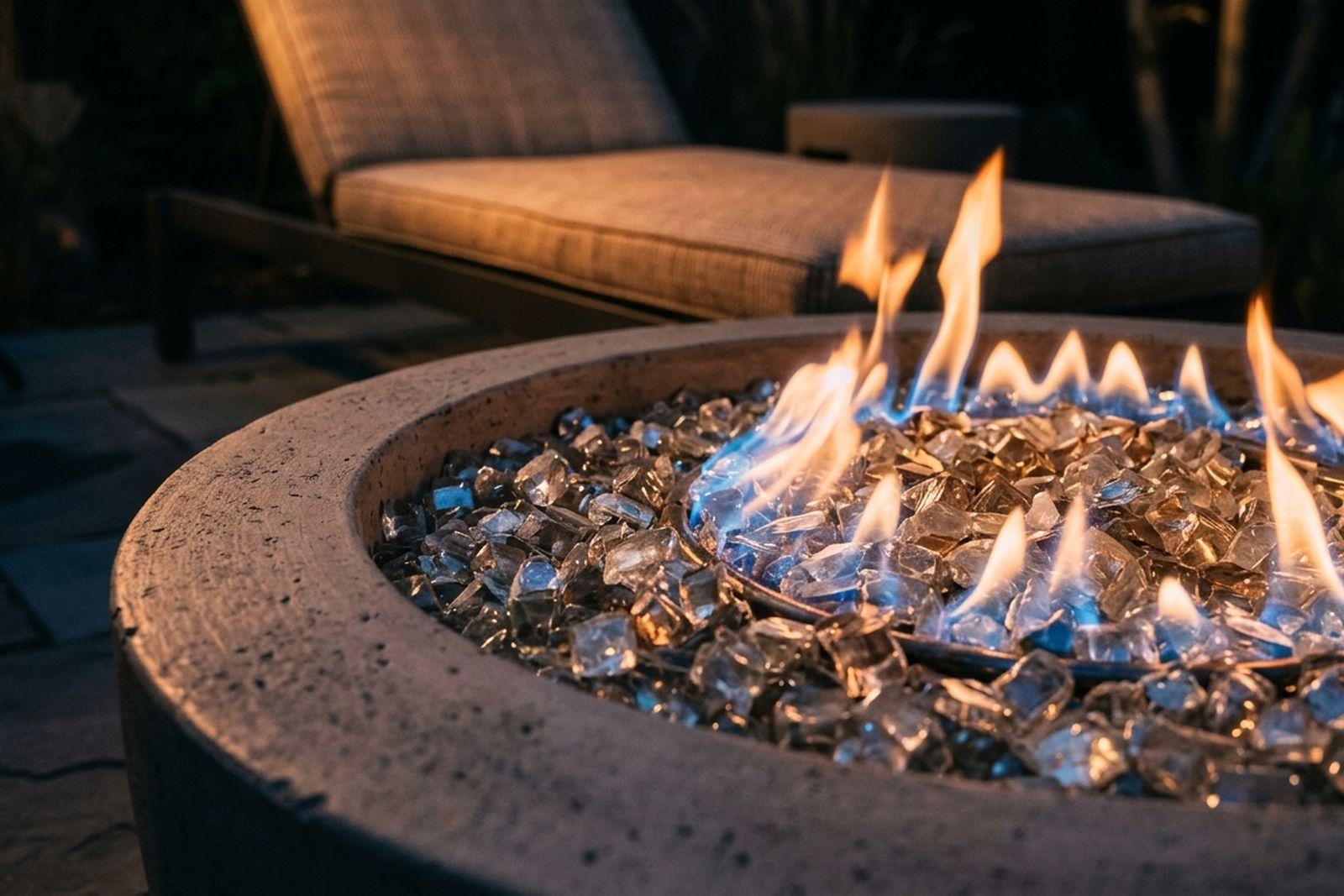
A gas fire pit does give off heat, as radiant warmth you feel when you sit close to the flame. Reading NIST's model of radiant heat, that warmth drops off quickly as you move back, and wind can push it to one side. No maker I read publishes an area that a fire pit heats, and the standard these appliances are listed to calls them decorative, so buy one for the flame and add a heater if warmth is the goal.
BTU rating, distance and wind decide how warm you feel. This guide takes each in turn, using the numbers makers, the code bodies and NIST publish. For the rating itself, start with the BTU ratings guide.
Do Gas Fire Pits Give Off Enough Heat?
No maker I read has published an answer, so the question has no number to point to. I read manuals, spec sheets and catalogs from HPC Fire Inspired, The Outdoor Plus, Prism Hardscapes, Firegear, Outdoor GreatRoom and American Fyre Designs. They give input ratings and clearances. None gives a heated area.
Patio heater makers do give one. Bromic prints 215 square feet for its 43,000 Btu/h Tungsten Smart-Heat Gas 500, and marks it "In ideal conditions". That is a claim a buyer can check against a patio. A fire pit has no equivalent.
The paperwork explains part of why. ANSI Z21.97 / CSA 2.41, the standard for these appliances, is titled Outdoor decorative gas appliances, and its published scope covers decorative gas appliances for outdoor installation. The fuel gas code uses the same word. Section 635 of the 2024 IFGC is Outdoor decorative appliances. That classification doesn't say a fire pit is cold. The scope I read says nothing about heating an area, and the makers don't fill the gap.
My reading, from the documents and not from measurements: expect warmth on the people nearest the flame, and don't expect a warm patio.
What a BTU Rating Does and Doesn't Tell You
The rating is the gas the burner can burn in an hour at full flame. It isn't a measure of heat reaching you. Prism rates most of its Moderno bowls at 65,000 Btu/h on either fuel, and a gallon of propane holds 91,500 Btu, so the burner is converting fuel at a known rate. How much of that reaches your chair as radiation is the part nobody prints.
NIST gives a sense of the split. Its method for sizing safe distances from gas fires assumes only a fraction of the heat release leaves as thermal radiation, and it uses 0.20 as a conservative estimate for gaseous fuels. That figure is for large fires and not for a fire pit, but it shows the shape of the problem. Most of the input doesn't reach your seat as radiation.
A bigger rating buys a taller flame, and it brings requirements with it. The Outdoor Plus fire bowl manual moves the side clearance from 36 inches at up to 65,000 Btu/h to 48 inches from 66,000 to 200,000, and allows no overhead structures at all from 201,000 to 400,000. HPC's EI manual gives 84 inches overhead up to 200,000. From 201,000 to 400,000 it allows only noncombustible material with at least 50% free air space directly above the pit, and puts a solid overhead structure at 120 inches. The clearance checker lists more manuals, and the gas line sizing calculator shows what pipe the larger burner needs.
How Does Heat Fall Off With Distance?
NIST's point source model, the simplest method it offers for radiant heat from a gas fire, divides the radiated energy over the surface of a sphere. The heat flux at a target falls with the square of its distance from the fire. Double the distance and, in the far field, the flux drops to a quarter.
NIST also says the model is accurate in the far field and overstates the flux within a few fire diameters. A seat 3 feet from a pit sits close to that line. Read the square law as the shape of the curve, not a prediction for your patio. I found no measured heat data for a residential fire pit.
By that reasoning, the makers' layout advice puts people where the heat is strongest. HPC says seating is typically 36 to 42 inches from the flame edge for residential installs, and adds that a larger fire feature may need a different distance. Outdoor GreatRoom says the closer you sit, the fewer BTUs it takes to keep you warm, and that some guests sit up close to feel the radiant heat while others sit farther back. The same distances show up in the manuals as clearance, so size the pit with the fire pit sizing guide in hand.
Wind, Wind Guards and Where the Heat Goes
Wind changes where the heat goes. HPC says even a smokeless gas fire can have a strong breeze direct the heat flow, leaving some guests uncomfortably hot and others chilly. Its design guide calls wind one of the most overlooked variables and says a tight corner can create swirling airflow that affects the flame.
The manuals are blunter. The Outdoor Plus insert manual says wind and gusty conditions affect the flame unpredictably and tells you to turn the fire pit off if conditions aren't safe. Prism's Moderno guide says never to use the fire feature in windy conditions. Firegear's Sanctuary manual warns that high wind can expose the finish to direct flame and crack or discolor it.
Glass wind guards are the common fix. The Outdoor Plus makes them from 1/4 inch tempered glass in square and rectangular sizes, says a guard protects against wind and keeps heat output consistent, and sizes it to the burning area plus 2 inches on each side. Its fire bowl manual's fix for a flame that keeps going out in high winds is to install a wind guard or adjust the flame height. American Fyre Designs lists guards 6 3/4 inches tall, from 19 1/4 inches square to 51 1/2 by 19 1/4 inches. HPC says tempered glass guards help stabilize the flame without costing visibility or heat retention. Outdoor GreatRoom calls a guard highly recommended on its Kenwood and Brooks tables.
Those are maker claims. None of the pages gives a figure for how much heat a guard keeps. If wind is a problem on your site, a guard, a wall or a different spot beats a bigger burner. The fire glass vs lava rock guide covers wind guards and media together.
Which Propane Fire Pit Gives Off the Most Heat?
By published input, here are the highest ratings I found, all from the makers' own documents. Most are rated the same on propane and natural gas, and Firegear doesn't say which fuel its Sanctuary figure is for.
| Product | Published input (Btu/h) | What it is |
|---|---|---|
| Outdoor Plus round bullet burner | 45,000 to 630,000 across 8 to 48 in. | Burner component for custom builds |
| Firegear Pro H-Burner, 80 in. | 240,000 propane, 250,000 natural gas | Burner component |
| Firegear Sanctuary 1-76 | Up to 150,000 | Finished table, depends on the burner you choose |
| Prism Moderno 70 | 125,000 | 70 in. bowl, propane or natural gas |
| American Fyre Designs Milan linear | 100,000 with Bluetooth control, 65,000 with manual | 72 in. linear table, tank housed separately |
| Prism Tavola 6 and 110 | 90,000 | 90 and 110 in. tables |
| Outdoor GreatRoom Kenwood linear dining table | 80,000 | 20 lb tank in the base |
Treat the list as a map of what exists, not a heat ranking. Input is fuel burned, and every step up brings requirements elsewhere. Firegear's manual puts the 80 inch burner at 120 inches of overhead clearance. The listing standard's published scope allows an integral cylinder of up to 20 lb below 60,000 Btu/h, up to 30 lb from 60,000, and two 20 lb cylinders from 80,000. The highest-rated table I found with the cylinder inside its base is that 80,000 Outdoor GreatRoom piece.
Runtime shrinks as input rises. A 20 lb cylinder holds 4.7 gallons, about 430,000 Btu. At 65,000 Btu/h that is 6.6 hours, and at 200,000 it is 2.2 hours. PERC notes that a container vaporizes more slowly when the air is colder or the liquid level is lower, so the cold night you want the most heat is the night a cylinder is weakest. A natural gas burner with the same rating has no tank to run dry, and the natural gas vs propane guide compares the two fuels.
Patio Heater vs Fire Pit: What Each Maker Publishes
Heater makers state how much space a unit covers and under what conditions. The figures are for a heater mounted overhead and aimed at a zone.
Appliance, Rated input, Area the maker states, Condition attached
Bromic Tungsten Smart-Heat Gas 500
- Rated input
- 43,000 Btu/h
- Area the maker states
- 215 sq ft
- Condition attached
- "In ideal conditions"
Schwank supremeSchwank 35K
- Rated input
- 35,000 Btu/h
- Area the maker states
- About 250 sq ft
- Condition attached
- 10 ft mounting height
Infratech C-15
- Rated input
- 1,500 W
- Area the maker states
- 5 ft by 5 ft
- Condition attached
- 6 to 7 ft mounting height
Infratech CD-60
- Rated input
- 6,000 W
- Area the maker states
- 11 ft by 11 ft
- Condition attached
- 8 to 12 ft mounting height
Gas fire pits (makers named in this guide)
- Rated input
- Varies by model
- Area the maker states
- None published
- Condition attached
- Not applicable
Sources: Bromic, Schwank, Infratech.
Don't convert those heater areas into a fire pit area. A 65,000 Btu/h pit is a bigger input than any gas heater above, but the heater is built to aim its heat at people and the pit is a low open flame. Infratech and Schwank both say their heaters can cover less than average in extremely cold or windy conditions, and a low open flame is just as exposed to wind.
Infratech also gives a target. It cites testing by Pacific Gas & Electric that put a good installation at 3 to 7 degrees of perceived heat at 60°F, with more than 7 too warm to sit in for long. Use that as a yardstick for a heater. The BTU calculator sizes a heater from published coverage, and the guide to choosing a patio heater covers mounting and fuel.
How Do I Make a Gas Fire Pit Hotter?
Work through these in order. The first two need no purchase.
- Sit closer, inside the manual's clearance. HPC gives 36 inches from combustibles up to 200,000 Btu/h, measured in its drawings from the burner edge. The Outdoor Plus gives 36 inches up to 65,000, and counts noncombustibles too. Never move seats inside your own manual's number.
- Cut the wind. Add a glass guard, build a windbreak or protective wall as HPC suggests, or move the pit out of a corner. HPC also says a slightly recessed burner can reduce flame lift, which is a maker claim.
- Think about media. Outdoor GreatRoom says its ceramic fiber log sets hold and radiate more heat than glass gems or lava rock alone. HPC says large masonry mass may need a higher input to reach the warmth you want. Neither gives a measurement.
- Raise the input only where the system allows it. The gas line, the cylinder, the clearance tier and the listing all have limits. The Outdoor Plus manual says never to alter the product or its configuration, so buy the input the maker sells and don't modify the unit.
- Add a heater. Firegear's blog lists outdoor heaters as a way to extend a patio into fall and winter.
What to Check Before You Buy for Warmth
- Ask the maker for the heated area. If none exists, treat the fire pit as a flame, not a heater.
- Check the input rating on the fuel you will burn, then run the gas line and cylinder numbers.
- Look up the clearance tier for that input in your manual and your local code.
- Plan seats 36 to 42 inches from the flame edge, and pick the sheltered side of the patio.
- Plan for a heater if the space has to stay comfortable on cold nights, and have a licensed gas fitter or electrician size the supply.
Call a licensed gas fitter before you add a burner to an existing line or raise the input, and check your local code and the installation manual for the unit you buy. The code library links the state pages. We don't sell any of the brands named here yet. Every figure above comes from the maker's own document, the code body or NIST, linked where it appears.
Common Questions
Do gas fire pits give off enough heat?
It depends on how close you sit and how much wind there is. A gas fire pit warms the people nearest the flame. None of the maker documents I read states an area a fire pit heats, while patio heater makers do. Buy a fire pit for the flame, and add a patio heater if warmth for a whole seating area is the goal.
Which propane fire pit gives off the most heat?
Among finished pieces, the highest published inputs I found were Firegear's Sanctuary 1-76 at up to 150,000 Btu/h, with no fuel stated, and Prism's Moderno 70 at 125,000 and an American Fyre Designs linear table at 100,000 on either fuel. A table with the cylinder inside its base topped out at 80,000. Input is gas burned, not heat felt, and a 20 lb cylinder lasts about 2.2 hours at 200,000.
Is a patio heater or a fire pit better for warmth?
A patio heater, if warmth is the goal. Heater makers publish heated areas, such as Bromic's 215 square feet for a 43,000 Btu/h gas model in ideal conditions, and they tie each figure to conditions or a mounting height. No fire pit maker I read states an area. Firegear's blog lists outdoor heaters as a way to extend a patio into fall and winter.
Do fire pit wind guards help?
Makers say so, but none gives a figure. The Outdoor Plus says its glass guard protects against wind and keeps heat output consistent, and HPC says tempered glass helps stabilize the flame without costing visibility or heat retention. American Fyre Designs lists guards 6 3/4 inches tall. Check your manual before adding one.
How do I make a gas fire pit hotter?
Sit closer, within the clearance your manual allows, and cut the wind with a guard or a better location. Outdoor GreatRoom says a ceramic fiber log set radiates more heat than glass or lava rock alone. Raising the input is limited by your gas line, your cylinder and the manual's clearance tiers, and The Outdoor Plus manual says never to alter the product or its configuration.
Sources
- CSA Group, ANSI Z21.97-2017 (R2022) / CSA 2.41-2017 (R2022), Outdoor decorative gas appliances, published scope: decorative gas appliances for outdoor installation; integral cylinder limits by input (under 60,000, 60,000 and over, 80,000 and over)Checked
- International Code Council, 2024 International Fuel Gas Code, Chapter 6, Section 635 (Outdoor decorative appliances), Section 635.1Checked
- NIST, NISTIR 6546, Thermal Radiation from Large Pool Fires (McGrattan, Baum and Hamins, November 2000): point source model, Eq. 7 (heat flux falls with the square of distance), accuracy in the far field, radiative fraction of 0.20 for gaseous fuelsChecked
- HPC Fire Inspired, Outdoor Fire Effects: Placement and Seating that make the Setting (dealer newsletter, June 28, 2018): wind and heat flow, fire feature width, seatingChecked
- HPC Fire Inspired, 5 Best Practices for Designing an HPC Outdoor Fire Feature: seating distance, masonry mass, tempered glass wind guards, swirling airflow in cornersChecked
- The Outdoor Plus, Fire Bowl Installation Manual, Match Lit (FB-ML-M, 2026): Clearance from Combustibles by input (PDF p. 5), never alter the product (PDF p. 4), wind guard troubleshooting (PDF p. 13)Checked
- The Outdoor Plus, Match Lit Fire Pit Insert Manual (2024): wind and gusty conditions affect the flame unpredictably (PDF p. 6)Checked
- The Outdoor Plus, Glass Wind Guards product page (1/4 in. polished tempered glass; protection against wind and consistent heat output; sizing rule of the burning area plus 2 in. each side)Checked
- The Outdoor Plus, Round Stainless Bullet Burner product page (8 to 48 in., 45,000 to 630,000 BTU)Checked
- HPC Fire Inspired, EI Series Electronic Ignition Fire Pit Insert, Installation and Operation Instructions (860-EI), Table 3.1 clearances (PDF p. 9) and Figures 1 and 2, clearances measured to the burner edge and overhead rules by input (PDF pp. 10 and 11)Checked
- Prism Hardscapes, Moderno Series product page (Moderno 70 at 125,000 BTU, propane or natural gas; other models at 65,000)Checked
- Prism Hardscapes, Moderno Series Installation Guide: never use fire feature in windy conditions (PDF p. 9)Checked
- Prism Hardscapes, Tavola Series product page (Tavola 6 and Tavola 110 at 90,000 BTU)Checked
- Firegear Outdoors, Pro H-Burners and Kits, Installation and Operating Instructions, REV. D: input ratings on the cover page, Table 1 clearances (PDF p. 4)Checked
- Firegear Outdoors, Sanctuary 1-76 product page (up to 150,000 BTU depending on burner and ignition)Checked
- Firegear Outdoors, Sanctuary 1 installation manual, REV. C: do not operate in high-wind conditions (PDF p. 1)Checked
- American Fyre Designs, 2026 Product Catalog: Milan Linear Firetable inputs (65,000 and 100,000 BTU, tank housed separately), glass wind guard sizes and 6 3/4 in. height (pp. 9 and 26)Checked
- Outdoor GreatRoom Company, Kenwood and Brooks Linear Dining Height Gas Fire Pit Table product page (80,000 BTU, 20 lb propane tank in base, optional glass wind guard highly recommended)Checked
- Outdoor GreatRoom Company, How Many BTUs Do I Need? (seating distance and BTUs; ceramic fiber log sets)Checked
- Propane Education & Research Council, The Propane Technical Pocket Guide, 4482-BR-21 v3: Table 1C (91,500 Btu per gallon) and Vaporization Rates (printed p. 9)Checked
- Manchester Tank & Equipment Co., Portable DOT Steel LP Gas Cylinders 5 lb to 100 lb, Catalog 49500 (09/2022), LPG capacity row (20 lb cylinder, 4.7 gal)Checked
- Bromic Heating, Product Cut Sheet, Tungsten Smart-Heat Gas (43,000 BTU model, heat area 215 sq ft, in ideal conditions)Checked
- Bromic Heating, Tungsten Smart-Heat Gas product page (Tungsten 500 at 43,000 BTU)Checked
- Firegear, Create Your Dream Backyard Around a Fire Pit with These Tips and Tricks (blog): outdoor heaters to extend the seasonChecked
- Schwank, Compare Schwank Patio Heater Models: coverage area at a 10 ft mounting height, coverage qualifiersChecked
- Infratech, Choosing your Infratech system chart (IN999, 2025): C-15 and CD-60 heat coverage area and mounting height; wind and cold noteChecked
- Infratech, FAQs, How much heat should I expect (perceived heat of 3 to 7 degrees at 60°F, attributed to Pacific Gas & Electric's Food Service Technology Center)Checked
About the Author
James Darren Writes the Firepit HQ guides on fire features, fuel and fire codes. Every figure in them is cited to its source with the date it was checked.