
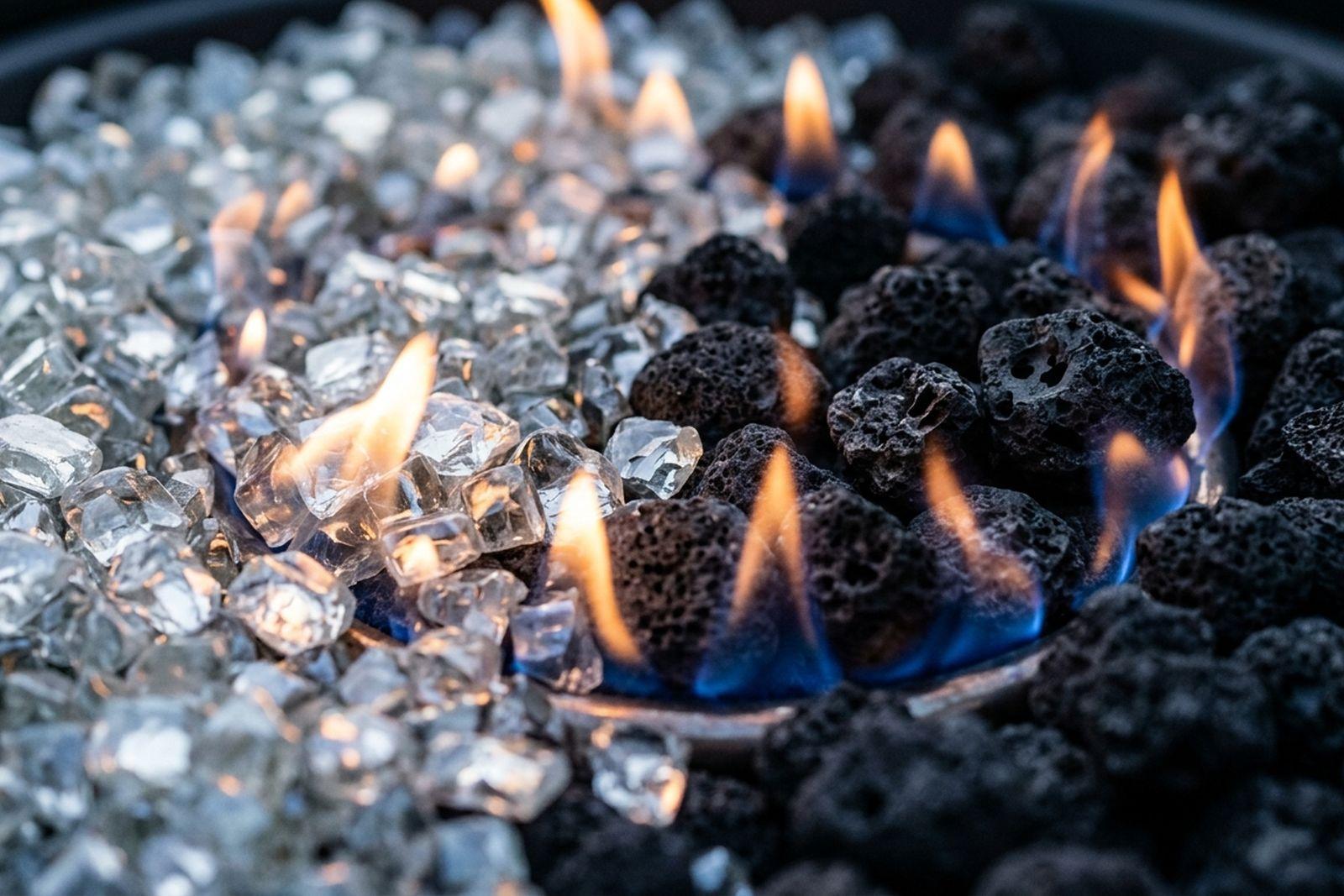
Pick the media your burner manual allows, then choose on looks. Both fire glass and lava rock are approved media, and no maker I read gives either one a heat advantage. Glass is reflective and goes on thin over the burner: 1/4 to 1/2 inch in the HPC and The Outdoor Plus manuals. Lava rock reads as natural stone and goes on deep enough to cover the burner. Either one can crack if it is wet.
The fire glass calculator turns your pan size into pounds of glass or cubic feet of lava rock. Every figure below comes from a maker's manual or product page, a media supplier's published coverage or a unit-conversion table, linked where it appears.
Fire Glass vs Lava Rock at a Glance
| Fire glass | Lava rock | |
|---|---|---|
| What it is | Color-infused tempered glass, crushed or rounded, 1/4 or 1/2 inch thick (MSI) | Volcanic stone. Lava Rock Direct lists size classes from 1/8 to 9 inches |
| Look | Reflective. HPC lists ten colors, from Clear to Cobalt Blue and Copper | A natural look (Outdoor GreatRoom). Black, red, bronze and gray tumbled |
| Over the burner | 1/4 to 1/2 inch (HPC, The Outdoor Plus). Propane: more than 1/2 inch can cause back pressure | HPC: only deep enough to cover the burner. Firegear: no more than 1 inch over the burner |
| Sold by | Weight: 10 lb jugs (Firegear), 10 or 20 lb bags (MSI), 5 lb bags (Outdoor GreatRoom) | Volume: 1/2 cubic foot increments (HPC), 1 cubic foot (Firegear). Bags of 10, 20 and 40 lb (Lava Rock Direct) |
| When wet | Can crack or pop (Firegear, Prism) | Same, plus HPC and The Outdoor Plus wait times |
| Care | Little or none, per MSI | Place by hand so dust does not plug the burner (Firegear) |
What Media Does a Gas Fire Pit Burner Allow?
The Outdoor Plus lists three acceptable media: fire-rated lava rock or other igneous rock, fire glass approved for fire features, and man-made stone for fire features. HPC's manuals give application instructions for lava rock and for decorative glass.
The ban list is just as consistent.
- River rock, gravel and pebbles. The Outdoor Plus and HPC both say not to use non-porous material that holds moisture, because the trapped moisture boils and the stone fractures. Firegear says "DO NOT USE STONE OR RIVER ROCK."
- A mesh or screen under the media. The Outdoor Plus and HPC both rule it out.
- Concrete logs. The Outdoor Plus insert manual and HPC's burner kit manual both call them not recommended.
- Anything in the enclosure cavity. The Outdoor Plus, HPC and Firegear all say the enclosure's interior void must not be filled with gravel, rock or concrete. Media goes in the pan only.
Some makers go further. Real Flame's manual for its 9750NG fire table says only Real Flame filler is certified for that table, and that other filler may increase popping, cracking or carbon monoxide emissions. Prism's guide says to use the amount of media provided, because overfilling can shrink the flame and let gas build up, and its Moderno guide lists 30 lb of media among the contents. Bull's Small Square pit includes lava rock and lists fire glass as optional. If your unit shipped with media, start there.
How Deep Can Media Go Over the Burner?
The manuals disagree with each other, and in two cases with themselves.
| Source | Glass over the burner | Lava rock and other media |
|---|---|---|
| HPC inserts and kits | 1/4 to 1/2 inch. Propane: more than 1/2 inch may cause back pressure | Only deep enough to cover the burner |
| The Outdoor Plus insert manual | 1/4 to 1/2 inch. Propane: over 1/2 inch may cause gas leakage from the air mixer | A 2 inch layer, with the media above the burner element no more than 2 inches and a drawing note of no more than 1 inch |
| The Outdoor Plus fire bowl manual | No more than 1 inch of any media over the burner (also says 2 inches elsewhere) | A 2 to 3 inch layer in the example |
| Firegear Pro burners | Top media no more than 1 inch over the burner | Base rock at least 1 inch across |
| Real Flame 9750NG | No more than 1 inch above the burner tube | Lava rock first under glass, to improve airflow |
| MSI, a glass supplier | At least 2 inches over your burner | Not covered |
A glass seller says pour at least 2 inches. The burner makers say 1 inch or less of media, and 1/2 inch or less of glass on propane. The burner manual wins over the bag. If your manual is silent or gives two numbers, ask the maker which one applies to your burner and fuel, and check your local code and the appliance's installation manual.
The 1/2 inch cap exists because of how propane burners breathe. Both HPC and The Outdoor Plus say too much glass can create back pressure and push propane out of the air mixer's venturi holes, where it pools under the fire pit. Both say a propane unit must be tested with the media in place, and both put leak testing on the qualified installer. Propane settles low, which is why venting matters; the natural gas vs propane guide covers it.
Why Lava Rock and Fire Glass Pop or Crack
The makers explain popping the same way: moisture. Firegear's caution in its burner manuals names the process, thermal spalling. Moisture gets trapped inside wet media, and rapid temperature change cracks it or pops it out of the fire feature. The caution lists "lava rock, lava stones, lava boulders and fire glass," so glass is not exempt.
What the makers tell you to do:
- Cover the feature. Firegear highly recommends it, adding that a cover can lessen spalling but heavy rain and humidity may still cause popping. The Outdoor Plus makes a cover a warranty requirement.
- Wait after rain. HPC and The Outdoor Plus say that if lava rock is wet, burn the fire pit 45 minutes before coming within 15 feet. Firegear says to light it, leave, and watch from a distance for no less than 30 minutes, until popping stops. Real Flame says to stay away at least 20 minutes at first start-up, since filler can hold moisture from manufacturing and shipping. Prism says not to light the feature when the media is wet.
- Keep water out of the burner. The Outdoor Plus says water in the burner pipe blocks gas flow, so keep the drain hole clear.
Those waiting times differ, so use the one in your own manual. The Outdoor Plus bans river rock because it is not porous enough to let heated steam out. Lava rock is approved, and the wait times show it still has to dry. For the shell and the rest of the water damage story, see the fire pit materials guide.
Heat: Does Either Media Make a Fire Pit Warmer?
I found no manufacturer or standards document that measures heat by media, or that separates glass from lava rock. The manuals treat media as part of the burner's combustion. The Outdoor Plus says media improves performance by forcing the gas to mix as it passes through, and HPC says the fire pit is designed to use approved media to achieve proper combustion. Firegear describes media as distributing heat and flame around the feature.
The one heat comparison I found is between logs and both stones: Outdoor GreatRoom says its ceramic fiber log sets hold and radiate more heat than glass gems or lava rock alone, and gives no measurement. Two supplier claims are worth knowing as claims. MSI gives its glass a 1,300 degree Fahrenheit heat rating and says that is higher than the rating of logs, lava rocks or stones. Lava Rock Direct says its rock is designed to withstand extreme temperatures without cracking. Neither number tells you how warm you will feel. "Reflective" in these documents describes the glass finish, and none of them ties it to radiant heat.
The burner's input rating sets the flame, so start with the BTU ratings guide and the guide on whether gas fire pits give off heat.
Cleaning and Upkeep
Fire glass. MSI says little or no care is needed after setting it, a sprinkle of water takes the dust off for an instant shine, and debris should be removed before lighting. It can be sharp, so MSI recommends gloves and safety glasses when handling.
Lava rock. Firegear says to place it by hand and not pour it from the bag, because dust at the bottom of the pan can plug the burner's injectors and the pan's weep holes. If water sits in the pit, its troubleshooting table says to remove the media, unplug the weep holes, and clean or replace dusty media.
Both. HPC and The Outdoor Plus put burner cleaning on a yearly schedule and say the media has to be lifted out to reach the burner holes, so that is the natural time to look it over. The Outdoor Plus also says to remove debris before each use.
No maker I found gives a replacement interval for either media. The Outdoor Plus does not warrant ornaments and media because of direct heat.
How Much Fire Glass or Lava Rock Do I Need?
Fire glass is sold by weight and lava rock by volume, so the math differs.
- Fire glass. HPC's calculator uses 12 pounds per gallon of volume, and a US gallon is 231 cubic inches. MSI says a 10 pound bag covers about 1 square foot at 1.25 inches deep. Together those put glass at about 90 to 96 pounds per cubic foot of space filled.
- Lava rock. Volume in cubic inches divided by 1,728 gives cubic feet. No maker publishes a weight per cubic foot, so the calculator reports cubic feet only.
This table runs round pans through the calculator at a 2 inch fill. The last column is HPC's own bag count for a round flat insert of the same nominal size.
Pan diameter, Fire glass, Lava rock, HPC lava rock bags
14 in.
- Fire glass
- 16 to 18 lb
- Lava rock
- 0.18 cu ft
- HPC lava rock bags
- 1
18 in.
- Fire glass
- 27 to 29 lb
- Lava rock
- 0.29 cu ft
- HPC lava rock bags
- 2
24 in.
- Fire glass
- 48 to 51 lb
- Lava rock
- 0.52 cu ft
- HPC lava rock bags
- 2
30 in.
- Fire glass
- 74 to 79 lb
- Lava rock
- 0.82 cu ft
- HPC lava rock bags
- 2
36 in.
- Fire glass
- 106 to 114 lb
- Lava rock
- 1.18 cu ft
- HPC lava rock bags
- 4
42 in.
- Fire glass
- 144 to 154 lb
- Lava rock
- 1.60 cu ft
- HPC lava rock bags
- 4
54 in.
- Fire glass
- 238 to 255 lb
- Lava rock
- 2.65 cu ft
- HPC lava rock bags
- 6
HPC sells this rock in half cubic foot increments and its chart counts bags of it. Treating one bag as one increment, the calculator matches HPC's count at five of the seven sizes and comes in one unit lower at 18 and 36 inches. That is close, with one assumption: it takes HPC's insert size as the pan's inside diameter.
Measure the inside of the pan, not the bowl or the table around it. A 2 inch fill is a common depth, not a rule, and it is separate from the cap on media over the burner. Outdoor GreatRoom's info sheet lists 25 pounds of glass for a 30 inch round burner, against 74 to 79 pounds here, so the depth you assume changes the answer by a factor of three. Sloped bowls, raised centers and stepped drop-in pans are not modeled. When your maker publishes a quantity for your pan, as HPC, Firegear and Outdoor GreatRoom do, use that.
Do You Need a Fire Pit Wind Guard?
Firegear's blog calls a wind guard optional: not required, but practical in high-wind areas. The manuals still treat wind as a real problem. The Outdoor Plus and HPC both say wind and gusty conditions affect the flame unpredictably, and to turn the fire pit off if conditions are unsafe. Prism says never to use its features in windy conditions.
Before you buy glass, look at the pan. The Outdoor Plus and HPC both say to recess the pan and burner at least 2 inches below the top of the enclosure to keep the flame from being blown out, and The Outdoor Plus adds that 4 to 6 inches is not uncommon. When a flame keeps going out, The Outdoor Plus tells you to install a wind guard or lower the flame, and HPC says to use the fire pit when it is less windy or with its wind guard.
What the makers publish about the guards themselves:
Maker, Glass, Sizes and sizing rule, Warranty
HPC
- Glass
- Clear glass
- Sizes and sizing rule
- Round 23 to 48 in.; square 25 to 49 in.; rectangle and linear
- Warranty
- Not stated on the product page
The Outdoor Plus
- Glass
- 1/4 inch polished tempered glass, chrome connectors
- Sizes and sizing rule
- Burning area plus 2 inches on each side, so a steel cover still fits
- Warranty
- 1 year, cracking not covered
Firegear
- Glass
- Tempered glass windshields
- Sizes and sizing rule
- Round 17 to 60 in. wide, 8 in. tall; rectangular and square 6 in. tall
- Warranty
- 1 year
I found no code or standard that sets a wind guard height. Firegear's windshields stand 6 or 8 inches tall, and the American Fyre Designs catalog lists its guards at 6 3/4 inches. Hot glass burns, and Firegear's windshields are not designed for wood fires. The Outdoor Plus warranty says its certified models cannot be altered, so I would ask a maker before putting glass from another source around its unit.
Before You Fill the Pan
- Find the media page in your manual and write down the depth over the burner. On propane, note any 1/2 inch cap.
- Use only fire-rated lava rock or fire glass. No river rock, gravel or pebbles, and no mesh under the media.
- Measure the inside of the pan, run the fire glass calculator, then compare with your maker's chart.
- Put media in the pan only, never in the enclosure cavity.
- After changing media on a propane unit, have a qualified installer test for back pressure with the media in place. The Outdoor Plus and HPC also suggest annual service by a technician certified by the National Fireplace Institute.
- Cover the fire pit when it is not in use, and follow your manual's wait after rain.
If you are choosing from scratch, choose on looks within what your burner allows: glass for color and shine kept thin, lava rock for a stone look. For burners and pans, see the burner kits, drop-in pans and inserts guide.
Common Questions
Can you mix lava rock and fire glass in a gas fire pit?
Where the maker allows it. Real Flame suggests a layer of lava rock under glass to improve airflow, and Firegear's manual uses lava rock as the base with a thin top layer over the burner. The Outdoor Plus lists both as acceptable media. Your manual still sets the total depth over the burner.
Do you cover the burner with fire glass?
Yes. The makers want media over the burner so the gas mixes as it passes through. HPC and The Outdoor Plus say to cover the burner with 1/4 to 1/2 inch of glass, and more than 1/2 inch on propane can push gas out of the air mixer. Test the unit with the media in place.
Is fire glass safer than lava rock?
Neither is exempt. Firegear's manuals say all media, including lava rock and fire glass, can crack or pop when wet because trapped moisture expands. Prism says not to light a feature when its rocks or glass are wet. What is unsafe is the wrong media, such as river rock or gravel, or too much of either over the burner.
Why does lava rock pop in a gas fire pit?
The makers blame moisture. Firegear calls it thermal spalling: wet media with moisture trapped inside cracks or pops under rapid heat. HPC and The Outdoor Plus say that if lava rock is wet, let the fire burn 45 minutes before coming within 15 feet. A cover helps, though heavy rain and humidity can still cause popping.
How much fire glass do I need for a fire pit?
Multiply the pan's volume by the published coverage: HPC and MSI figures work out to about 90 to 96 pounds of glass per cubic foot of pan filled. A 30 inch round pan filled 2 inches deep takes about 74 to 79 pounds. Use your burner maker's chart if it publishes one, because it overrides the estimate.
Do I need a wind guard for a gas fire pit?
Makers call it optional but useful. Firegear says wind guards are not required, yet practical in windy areas. The Outdoor Plus and HPC list a wind guard as a fix for a flame that keeps going out, and both say to recess the pan at least 2 inches below the top of the enclosure. Prism says never to use its features in windy conditions.
Sources
- The Outdoor Plus, Match Lit Fire Pit Insert Manual (2024): enclosure construction and pan recess (PDF p. 3), burning media, acceptable media and depth limits (PDF p. 5), wind and wet lava rock (PDF p. 6), maintenance (PDF p. 6)Checked
- The Outdoor Plus, Fire Bowl Installation Manual, Match Lit (FB-ML-M, 2026): acceptable media and popping warning (PDF p. 10), media depth and wet lava rock (PDF p. 11), troubleshooting table including wind guards (PDF p. 13)Checked
- HPC Fire Inspired (Hearth Products Controls), Match Lit Fire Pit Insert manual 870 (MLFPK Series): pan recess and vents (PDF pp. 12 to 13), approved media and propane glass limit (PDF pp. 20 to 21), wet lava rock (PDF p. 22), wind in troubleshooting (PDF p. 25)Checked
- HPC Fire Inspired, Burner Kits and Match Lit Kits manual 800-FP/FPS (5/21): approved media (PDF pp. 14 to 15), wet lava rock (PDF p. 16), troubleshooting (PDF p. 19), compatible accessories, wind guards (PDF p. 20)Checked
- HPC Fire Inspired, Tools page: Fire Glass Calculator (rounds on 2 inch depth, 12 lb per gallon) and Lava Rock Calculator tables for round bowl and round flat inserts (bags of SKU 657)Checked
- HPC Fire Inspired, Lava Rock for Fire Pits (SKU 657) product page: sold in 1/2 cubic foot incrementsChecked
- HPC Fire Inspired, Fire Pit Glass product page (color list)Checked
- HPC Fire Inspired, Wind Guards product page (round, square, rectangle and linear shapes and sizes)Checked
- Firegear Outdoors, Pro H-Burners and Kits, Installation and Operating Instructions, REV. D: thermal spalling caution (PDF p. 3), media installation and ventilation (PDF p. 5), enclosure requirements and river rock warning (PDF p. 7), accessories including media sizes (PDF p. 15), troubleshooting including top media depth (PDF p. 15)Checked
- Firegear Outdoors, Glass Windshields, Installation and Operating Instructions, REV. F: model sizes and heights (PDF p. 1), not for wood-burning fire pits (PDF p. 2)Checked
- Firegear Outdoors, The Anatomy of a Gas Fire Pit (blog, 2021-06-02): fire media and windshieldsChecked
- Firegear Outdoors, Limited Warranty, the two-page document embedded on its warranty page (products manufactured after 01/01/2026): windshields, 1 yearChecked
- Prism Hardscapes, Moderno Series Installation Guide: product contents including 30 lb of media (PDF p. 6), wet media and wind (PDF p. 9), amount of media (PDF p. 12)Checked
- Real Flame, Baltic Rectangle 9750NG Fire Table Owner's Manual (2021): filler material, glass over lava rock and filler warnings (PDF p. 7)Checked
- The Outdoor GreatRoom Company, Fire Media Collection info sheet (REV 01-23): media types and quantities per Crystal Fire Plus burnerChecked
- MSI Surfaces, Fire Glass: Specifications and Care Instructions (heat rating, coverage, 2 inch pour, care, thickness, bag sizes)Checked
- The Outdoor Plus, Glass Wind Guards product page: 1/4 inch polished tempered glass, sizing ruleChecked
- The Outdoor Plus, 2025 Product Warranty: wind guards (1 year, cracking not covered), ornaments and media not warrantied, certified models cannot be alteredChecked
- The Outdoor GreatRoom Company, How Many BTUs Do I Need? (blog): ceramic fiber log sets compared with glass gems and lava rockChecked
- American Fyre Designs, 2026 Product Catalog: glass wind guards, all 6 3/4 in. high (PDF p. 26)Checked
- Lava Rock Direct, Products page and Medium Black Lava Rock product page: size classes, colors, bag options, stated heat durabilityChecked
- Bull Outdoor Products, Small Square Fire Pit product page: lava rock included, optional fire glassChecked
- NIST Guide to the SI (SP 811), Appendix B.9 conversion factors: gallon (U.S.), cubic foot and cubic inch in cubic meters (231 and 1,728 cubic inches)Checked
About the Author
James Darren Writes the Firepit HQ guides on fire features, fuel and fire codes. Every figure in them is cited to its source with the date it was checked.