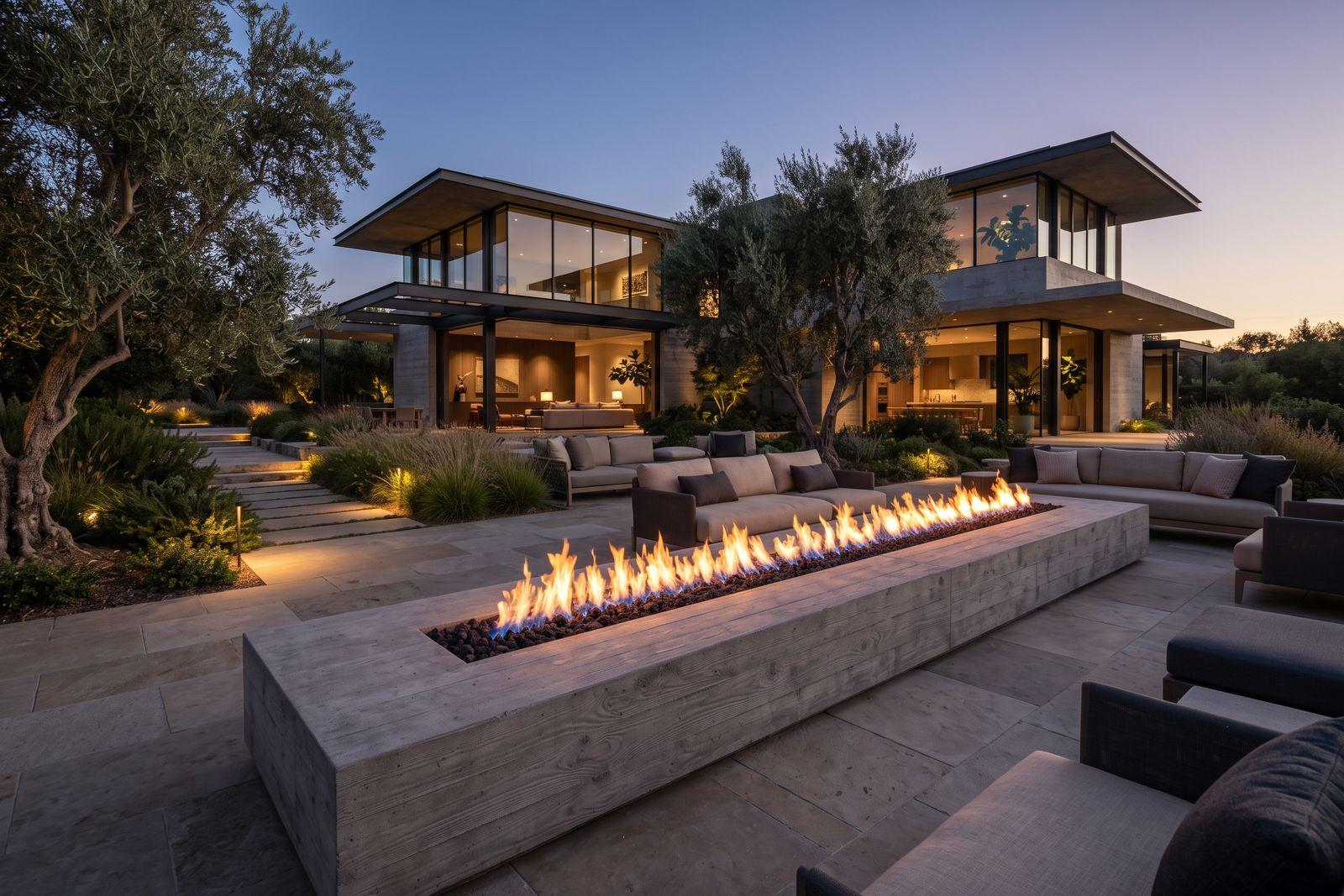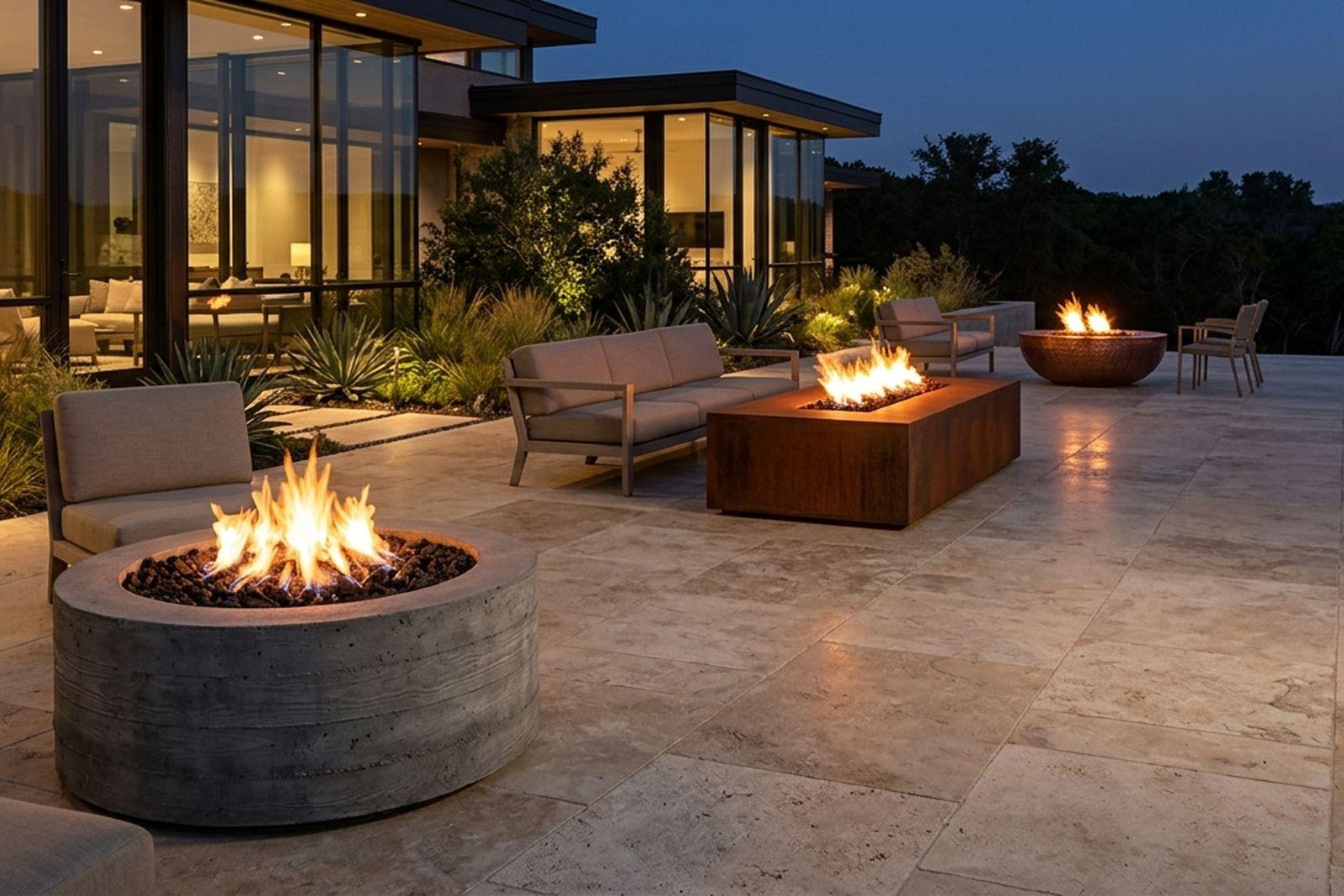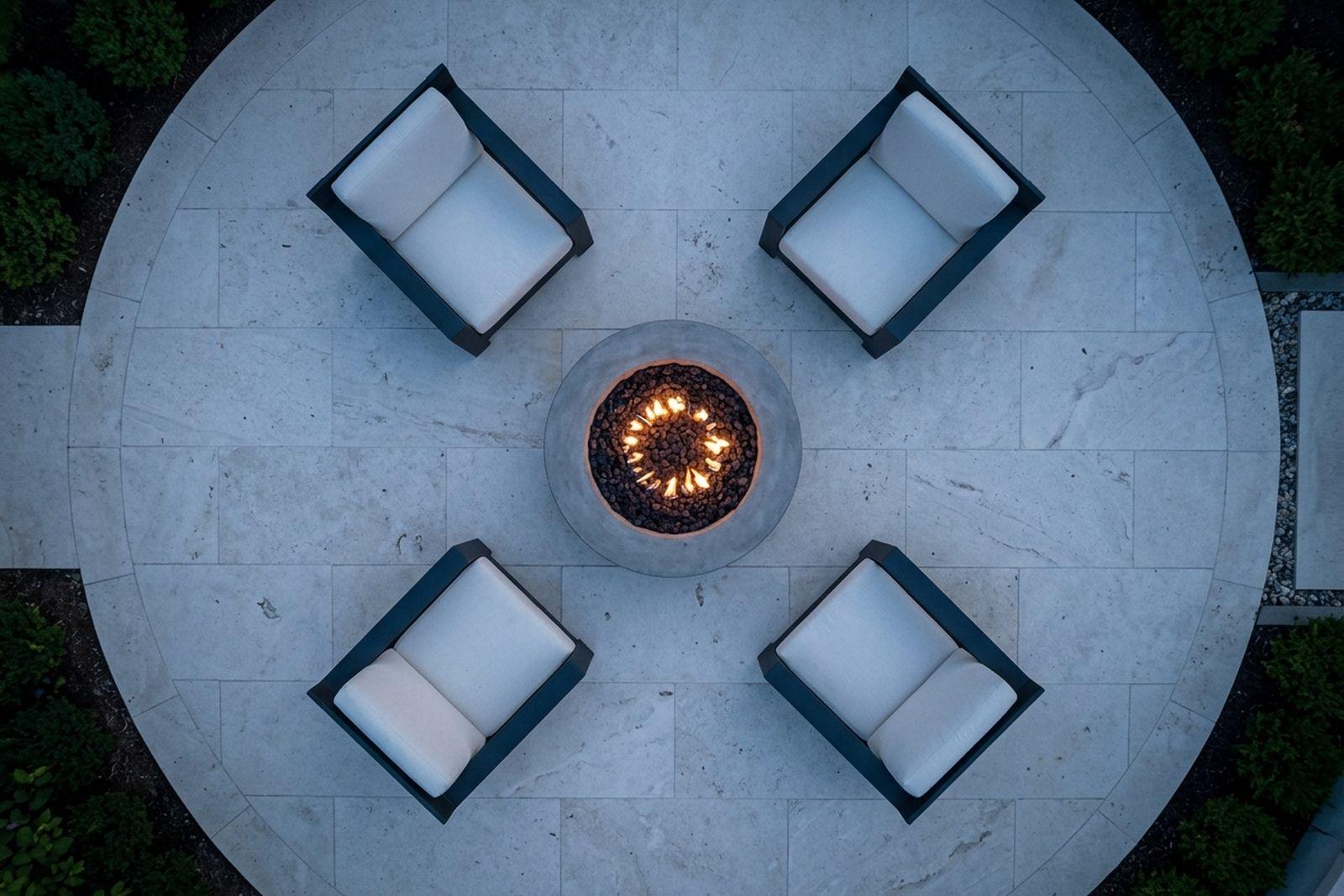

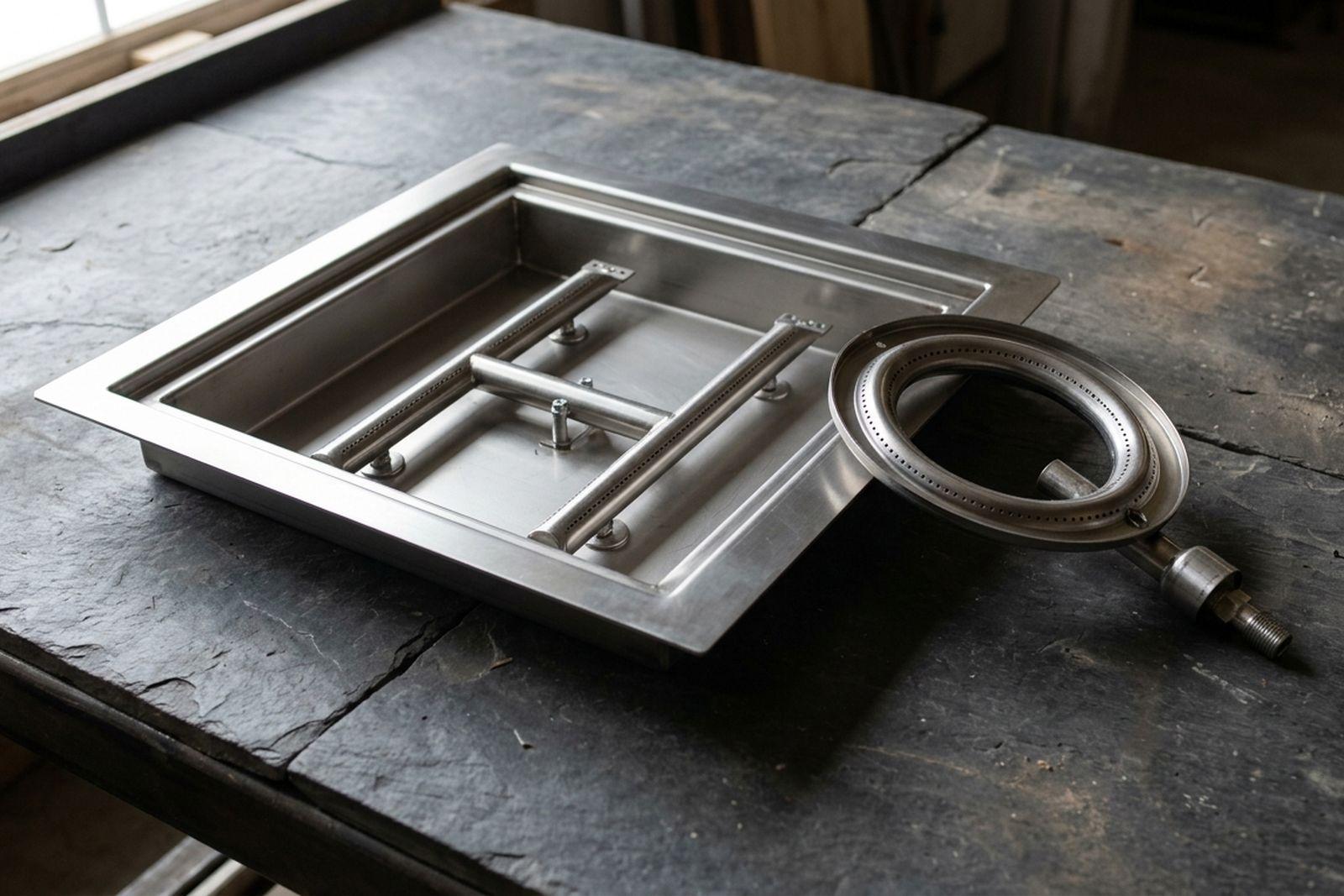
A fire pit burner kit is a burner with a valve and flex line, and a pan only if the kit says so. An insert adds the pan and the controls in one assembly, and a drop-in pan is a pan with a lip that sits in an opening in the enclosure. Choose the one that fits your enclosure, matches your fuel and carries the listing your building department asks for, then have a licensed gas fitter connect it.
This guide compares the published documents of HPC Fire Inspired, Firegear and The Outdoor Plus. Every size, output and warranty term comes from a maker's manual, drawing or product page, linked where it appears.
What Is in a Burner Kit, an Insert and a Drop-In Pan?
The names overlap between makers, so read the parts list.
| Package | What the makers include | Examples |
|---|---|---|
| Burner only | The burner and its mounting parts. No valve, no pan | Firegear Pro H-Burner Only: burner, nipple and brass supports. HPC Penta "just the burner" |
| Burner kit | The burner plus a key valve and flex line | Firegear Pro H-Burner Kit: key valve with a 12 inch key and a 46 inch flex connector. HPC Penta kit: burner, valve, polished flange and flex line |
| Pan and burner kit, or insert | Adds the pan. HPC's insert manual shows pan, burner, flex line and key valve as one unit | HPC inserts. The Outdoor Plus "Pans with Burners". Firegear systems such as a 25 inch round pan with a 21 inch Pro brass burner |
| Complete fire feature | The enclosure as well | HPC's lightweight concrete and copper fire pits, in its Complete Fire Features category |
A pan does two jobs. Firegear describes it as sitting directly under the burner to isolate it from the open cavity below and to hold the media in place. Firegear's Pro burner kits come without one, and its manuals tell you to supply a non-combustible pan, recommending 304 stainless steel at 16 gauge with 1/4 inch drain holes. They also bar stiff screen or perforated metal as a pan, because gas heavier than air could flow down into the enclosure and cause delayed ignition or an explosion.
Burner Shapes: Ring, H, Linear and Bullet-Style
Makers publish sizes and a rated or recommended output for each shape.
| Shape | Published sizes | Published output |
|---|---|---|
| Round or ring | HPC round burners, 6 to 48 in., one to four rings. The Outdoor Plus round bullet burner, 8 to 48 in., one to four rings | HPC: 60,000 to 300,000 BTU. The Outdoor Plus: 45,000 to 630,000 across the line |
| Spur | Firegear Pro Spur, 10, 14 and 21 in. Each leg carries injectors | 80,000 to 175,000 BTU on natural gas |
| Square and rectangle | HPC square, 12 to 48 in. Rectangle, 12 x 6 to 48 x 24 in. | HPC: 90,000 to 300,000 BTU |
| H | HPC H-burners, 18 x 6 to 84 x 10 in. Firegear Pro H, 24 to 80 in. long, 6 3/4 in. wide | HPC: 60,000 to 300,000 BTU. Firegear: 80,000 to 250,000 on natural gas |
| Linear and T | HPC linear, 24 to 120 in. Firegear Pro T, 24 to 122 in. | HPC: 50,000 to 250,000 BTU. Firegear: 50,000 to 200,000 on natural gas |
"Bullet" is a product family at The Outdoor Plus, sold in round, H, linear and other shapes. Its pages do not define the word, so treat it as a name and not a shape.
Shape does not set output. HPC lists a 24 inch round burner at 150,000 BTU and a 24 inch high-capacity round at 300,000, and offers a Torpedo version of its H-burner, linear and Penta burners at a higher recommended output, such as 150,000 against 90,000 for the 24 inch H-burner. The BTU ratings guide covers what the number means. If you want warmth rather than flame, the BTU calculator sizes patio heaters instead.
Sizing a Pan to Your Enclosure
No code gives pan sizes. The maker's drawing does, so get the cut sheet for the exact kit before you build.
- Firegear gives a minimum. A Pro Spur needs a pan opening of at least 12 inches for the 10 inch burner, 16 for the 14 inch and 23 for the 21 inch. A Pro H needs 26 x 10 inches for the 24 inch burner and 62 x 10 for the 60 inch. Pan depth is 2 1/2 to 3 inches.
- HPC points to cut sheets. Its manuals send you to the dimensional drawings for each insert and offer an optional installation collar that is mortared into the enclosure. It splits round and square inserts into bowl and flat versions (round bowl 13 to 43 in., round flat 14 to 54 in.) without defining their depth on its pages.
- The same six round sizes. HPC's round bowl inserts and The Outdoor Plus round drop-in pans both come in 13, 19, 25, 31, 37 and 43 inches. That says nothing about whether the openings match, so compare drawings.
- Recess and support the pan. HPC and The Outdoor Plus both say the pan and burner should sit at least 2 inches below the top of the enclosure, to keep the flame from blowing out, and that the weight rests on the pan and not on the valve box. The Outdoor Plus shows a drop-in pan recessed 4 inches and a flat pan 2 inches, and says 4 to 6 inches is not uncommon.
The Outdoor Plus makes drop-in pans in raised-lip and lipless styles, and its raised-lip rectangular pan has a standard 1 inch flange and a 2 inch depth. The fire glass calculator works out how much media a pan holds.
Ventilation Openings the Enclosure Needs
Every manual requires vents so heat and leaked gas can leave the enclosure.
| Maker | Minimum opening | Added rules |
|---|---|---|
| HPC manuals | Two vents of 18 sq in. on opposing sides, or vents totaling 36 sq in. | Mid to lower in the enclosure. A vent can double as a drain |
| HPC burner drawings | Up to 200,000 BTU, two of 18 sq in. Above 200,000, four of 18 | Copper, concrete or metal bowls up to 90,000: two of 9 sq in., or raise the bowl 3/4 in. with a 6 in. hole in the bottom |
| The Outdoor Plus | One vent on at least two sides, 18 sq in. each | Some enclosures need more. Mid to lower is recommended |
| Firegear | 18 sq in. of cross ventilation per side | Missing ventilation voids the warranty. Examples: three 2 x 3 in. slots per side, or two 6 x 12 in. vents |
HPC, The Outdoor Plus and Firegear all say not to fill the enclosure's interior cavity with gravel, rock or concrete, and to build from non-combustible materials. HPC says propane makes vents critical because it is heavier than air, and the natural gas vs propane guide covers why.
Ignition: Match-Lit, Flame-Sensing or Electronic
- HPC: match lit, push-button flame sensing, electronic on/off and electronic hi/lo with a Bluetooth app. Small-tank versions exist for the first two. The electronic series is not for small LP tanks.
- The Outdoor Plus: match lit, match lit with flame sense, flame sense with spark, 12 V low voltage and 110 V plug and play.
- Firegear: match throw with a key valve, the AWS electronic system and the TPSI thermopile system.
HPC puts electronic units on a GFCI-protected circuit and leaves hardwiring to a certified electrician working to the National Electrical Code. The match-lit vs electronic ignition guide covers the tradeoffs.
Does a Burner Kit Need a Listing?
The International Fuel Gas Code says permanently fixed-in-place outdoor decorative appliances must be listed to ANSI Z21.97 and installed per the manufacturer's instructions (Section 635.1, quoted on our Colorado code page). Intertek, a testing and certification body, says certification to the standard is typically needed for gas fire features designed for outdoor installation. Your jurisdiction adopts its own edition, so check your local code and the appliance's installation manual.
What the makers say about their own kits:
- HPC. Its insert manuals mark select models as certified to ANSI Z21.97-2014 and CSA 2.41-2014. Its round bowl inserts offer a "Non-Certified" option. Its burner kit manual shows no listing mark. HPC's own article says a listed package can simplify code review and that field modification can invalidate the listing.
- Firegear. Its Pro H, Pro Spur and match-throw manuals state no listing. Its AWS manual says the valve and control system are certified by Lab Test to ANSI Z21.97-2014. That covers a component, not the whole appliance.
- The Outdoor Plus. It labels individual ignition options "CSA Certified" or "LC Certified" on its pages, and its warranty says certified models cannot be altered.
A component certificate is not a listing for the finished appliance. Ask your building department what it will accept, and get the listing label for the exact configuration you plan to install.
HPC and Firegear Burner Lines Compared
This compares published specs and documents, not tested products, and it does not rank either maker.
| HPC Fire Inspired | Firegear | |
|---|---|---|
| Burner material | 304 stainless steel | Brass (Pro Series) and stainless steel |
| Shapes | Round, square, rectangle, H, linear, S-Fire, Penta | Spur, H, T |
| Sizes | Round 6 to 48 in.; H 18 to 84 in.; linear 24 to 120 in.; Penta 12 to 48 in. | Pro Spur 10 to 21 in.; Pro H 24 to 80 in.; Pro T 24 to 122 in. |
| Published output | Recommended BTU: 90,000 for a 24 in. H-burner, 75,000 for a 36 in. linear, 200,000 for a 24 in. Penta | Pro H 24 in.: 80,000 natural gas, 110,000 propane. Pro H 60 in.: 180,000 and 200,000. Pro Spur 21 in.: 175,000 on both |
| Fuel | Natural gas or propane. Burner drawings: fixed piping only | Pro Series sold as separate natural gas and propane models. Stainless H and T burners ship for natural gas, with propane conversion kits that are not for Pro brass |
| Pan | Inserts include one. Penta kits come as burner only, or with valve, flange and flex line | Burner kits include a key valve and flex line, no pan. Burner systems include a pan |
| Ignition | Match lit, push-button flame sensing, electronic on/off, electronic hi/lo | Match throw, AWS electronic, TPSI thermopile |
| Listing statements | Select inserts certified to ANSI Z21.97-2014 and CSA 2.41-2014. Non-Certified option. No mark in the kit manual | Pro burner manuals state none. AWS valve and control certified to Z21.97-2014 |
| Warranty, residential | Stainless burners: "Hassle Free Lifetime." Electronic components and gas valves 3 years. Pilot assembly 2 years | Stainless burners and pans, Pro Series burners: lifetime. Gas valve, spark igniter, pilot 5 years. AWS electronic 3 years. Key valve 5 years |
| Vent rule | Two 18 sq in. vents to 200,000 BTU, four above | 18 sq in. per side |
The documents are not always consistent. Firegear's Pro H manual gives the 30 inch natural gas model as 90,000 BTU on its cover and 95,000 in its specification table. HPC's burner kit manual (5/21) lists five years for a stainless burner and pan, where HPC's warranty page lists a lifetime term for stainless burners. HPC's drawings give a recommended BTU, and its manuals send the installer to the product label for the rating, so a listed unit's rating plate is the figure to design to. Firegear's warranty applies to products made after January 1, 2026, and says claims go through the dealer or distributor account.
Natural Gas and Propane Kits
HPC and The Outdoor Plus list a natural gas supply of 3.5 to 7.0 inches of water column and a propane supply of 8.0 to 11.0. Firegear's Pro burner manuals set a minimum inlet of 5.0 on natural gas and 10.5 on propane. Either way the line has to carry the burner's full load, so a licensed gas fitter sizes it. The gas line sizing calculator shows what to ask for.
Converting a Wood Fire Pit to Gas
A burner kit does not turn a wood pit into a gas appliance by itself. The makers' manuals set conditions the pit has to meet first, so check each against yours:
- Non-combustible construction for the enclosure, the gas supply and the power (The Outdoor Plus, HPC, Firegear).
- Above grade, with drainage. HPC wants the enclosure above grade. Firegear says not to place its pit directly on grass, dirt or rocks.
- Vent openings as in the table above, and an unfilled cavity.
- Room to recess the pan at least 2 inches below the rim.
- A gas shutoff outside the enclosure that is not used to adjust the flame, and access for service.
- No wood afterward. The Outdoor Plus, HPC and Firegear all say not to burn solid fuels in the gas appliance.
Ohio Flame, which makes steel wood-burning pits, says it does not make or sell gas pits or conversion kits, sells its pits for wood only, and suggests that any modification be done by a licensed professional. A gas pit built for masonry is a different product. Firegear's block burner systems cover segmental retaining wall and paver pits, with paver vent kits and control panels, and The Outdoor Plus makes paver kits in round, square and rectangular styles.
Why a licensed gas fitter. The Outdoor Plus and HPC make the installer responsible for sizing the fuel line to the burner's maximum input, and Firegear's pipe chart says to consult a licensed plumber or gas fitter. HPC recommends, and The Outdoor Plus suggests, installers locally licensed in gas piping. Firegear says gas installation should be done by a qualified installer, service agency or gas supplier. The manuals call for leak tests at every connection, with the appliance unhooked for pressure tests. HPC says a permanent gas supply typically needs a permit and that unauthorized modification can invalidate a listing. The Hearth, Patio and Barbecue Association tells owners to hire a certified professional for fireplaces, stoves and heaters. Who may legally do gas work is set by your state and city, so ask your building department before anything is cut.
What to Check Before You Choose a Kit
- Measure the enclosure opening and compare it with the cut sheet for the exact pan.
- Confirm the fuel and the supply pressure, then size the line with a licensed gas fitter.
- Count your vent area against the maker's table, including the larger rule above 200,000 BTU.
- Ask for the listing label or certificate for your exact configuration, and ask your building department what it accepts. See the fire code library for state rules.
- Choose the ignition you will use, and plan a circuit and a licensed electrician if it is electronic.
- Read the warranty for who files the claim, who is covered, and what it excludes.
Common Questions
What is the best fire pit burner kit?
No document ranks burner kits, and I won't. The best kit for you fits your enclosure opening, runs on your fuel, lights the way you want and carries the listing your building department accepts. Compare makers on pan size, published output, ignition, listing statement and warranty, as the HPC and Firegear comparison in this guide does.
Does a fire pit need an insert?
No. An insert is a pan, burner and controls sold as one assembly. A burner kit gives you the burner, valve and flex line, and Firegear's manuals tell you to supply a non-combustible pan, preferably 304 stainless steel. Either route needs a non-combustible, vented enclosure and a gas connection made by a licensed professional.
What are the different types of fire pit inserts?
By shape, makers offer round, square, rectangle, H-burner and linear styles. HPC also splits its round and square inserts into bowl and flat versions, with round bowl inserts from 13 to 43 inches. By ignition, HPC lists match lit, push-button flame sensing, electronic on/off and electronic hi/lo with an app.
What is a drop-in fire pit pan?
It is a pan with a flange or lip that sits down into an opening in the enclosure, holding the burner and media below the surface. The Outdoor Plus sells raised-lip and lipless drop-in pans, and its manual shows a drop-in pan recessed 4 inches against 2 inches for a flat pan.
Can you convert a wood-burning fire pit to gas?
Sometimes, but it is not a weekend job. The pit needs a non-combustible, vented, above-grade enclosure, a pan and burner sized to it, and a gas line sized and leak-tested by a licensed gas fitter. Ohio Flame sells its steel pits for wood only and suggests a licensed professional for any modification. Ask your building department first.
Does a gas fire pit burner kit need to be listed?
The fuel gas code requires a permanently installed outdoor gas fire pit to be listed to ANSI Z21.97 and installed per the maker's instructions. Not every kit carries a listing: HPC offers a non-certified option, and its burner kit manual shows no listing mark. Ask your building department what it accepts before you choose.
Sources
- HPC Fire Inspired (Hearth Products Controls), burner drawings: Penta Burners (rev. 7/9/2024), H-Burners (rev. 3/30/2026), Linear Burners, Round Burners, Rectangle Burners, Square Burners (rev. 7/9/2024): sizes, recommended BTU, hub sizes, enclosure vent notes and supply pressuresChecked
- HPC Fire Inspired, H-Burners drawing (rev. 3/30/2026)Checked
- HPC Fire Inspired, Linear Burners drawing (rev. 7/9/2024)Checked
- HPC Fire Inspired, Round Burners drawing (rev. 7/9/2024): sizes, ring counts, recommended BTUChecked
- HPC Fire Inspired, Rectangle Burners and Square Burners drawings (rev. 7/9/2024)Checked
- HPC Fire Inspired, Penta Burner Kits product page: sizes 12 to 48 in., Standard and Torpedo, natural gas or propane, package stylesChecked
- HPC Fire Inspired, CSA Certified Round Bowl Inserts product page: sizes, burner types, ignition options including Non-CertifiedChecked
- HPC Fire Inspired, Tools page: lava rock tables listing round bowl and round flat insert sizesChecked
- HPC Fire Inspired, Complete Fire Features category page: lightweight concrete, copper and aluminum familiesChecked
- HPC Fire Inspired, Burner Kits and Match Lit Kits manual 800-FP/FPS (5/21): enclosure requirements (PDF pp. 10 to 11), installation (PDF pp. 12 to 13), media (PDF pp. 14 to 15), licensed installer (PDF p. 4), no listing markChecked
- HPC Fire Inspired, Match Lit Fire Pit Insert manual 870 (MLFPK Series): select models certified to ANSI Z21.97-2014 / CSA 2.41-2014 (PDF p. 5), parts of the insert (PDF p. 8), pan recess, weight and vents (PDF pp. 12 to 13), small-tank models (PDF p. 14)Checked
- HPC Fire Inspired, Electronic Ignition Fire Pit Insert, EI Series On/Off Models (860-EI): certification mark (PDF pp. 4 and 6), no small LP tanks (PDF p. 6), GFCI circuit and certified electrician (PDF p. 7)Checked
- HPC Fire Inspired, Warranty Information page (outdoor fire effects table)Checked
- HPC Fire Inspired, Key Code Considerations for Outdoor Gas Fire Pits (article, 2026-05-19): permits, listed appliance packages, field modificationChecked
- Firegear Outdoors, Pro H-Burners and Kits, REV. D: model table (PDF p. 1), specifications, minimum pan sizes and minimum inlet pressures (PDF p. 4), enclosure requirements and pans (PDF pp. 4 to 7), pipe sizing note (PDF p. 6)Checked
- Firegear Outdoors, Pro Spur Burners and Kits, REV. D: model table (PDF p. 1), specifications and minimum pan openings (PDF p. 4)Checked
- Firegear Outdoors, Pro T-Burners and Kits: model table (PDF p. 1)Checked
- Firegear Outdoors, Stainless Steel H-Burners and Kits and T-Burners and Kits: natural gas from the factory, propane by conversion kit (PDF p. 1)Checked
- Firegear Outdoors, LP Conversion Kits instruction: kits not for Pro Series brass burners (PDF p. 1)Checked
- Firegear Outdoors, Pro Series Spur Burners with Match Throw (MT) Ignition, round and square pan models (PDF pp. 1 and 4)Checked
- Firegear Outdoors, Pro Spur Burners with All Weather System (AWS), drop-in round and square models: valve and control system certified by Lab Test to ANSI Z21.97-2014 (PDF p. 7)Checked
- Firegear Outdoors, Limited Warranty, the two-page document embedded on its warranty page (products manufactured after 01/01/2026): burner systems, burners, components and accessories; claims through the distributor or dealer accountChecked
- Firegear Outdoors, Block Burner Systems page: stainless and Pro Series block burner systems, Flexframe, paver control panels, paver vent kitsChecked
- Firegear Outdoors, The Anatomy of a Gas Fire Pit (blog, 2021-06-02): what the pan doesChecked
- The Outdoor Plus, Match Lit Fire Pit Insert Manual (2024): licensed installer and supply pressures (PDF pp. 1 to 2), enclosure, vents and pan recess (PDF p. 3), no solid fuels (PDF p. 1)Checked
- The Outdoor Plus, Round Drop In Pan and Round SS Burner and Raised Lip Rectangular Drop in Pan and SS H Burner product pages: sizes, pan depth and flange, ignition choices and certification labelsChecked
- The Outdoor Plus, Round Stainless Bullet Burner product page: 8 to 48 in., one to four rings, 45,000 to 630,000 BTUChecked
- The Outdoor Plus, Pans, Burners and Paver Kits category page: pan and burner kit types, burner-only, bullet burnersChecked
- Ohio Flame, Frequently Asked Questions: wood-burning only, no conversion kits, licensed professional for modificationsChecked
- Intertek, Standard: ANSI Z21.97 Outdoor Decorative Gas Appliances (certification typically needed for outdoor gas fire features)Checked
- Colorado Division of Oil and Public Safety and Plumbing Board, 3 CCR 720-1 Rule 1.2(B): adopts International Fuel Gas Code chapters 2 to 8, which include the outdoor decorative appliance sectionChecked
- International Code Council, 2024 International Fuel Gas Code, Section 635.1 (permanently fixed-in-place outdoor decorative appliances listed to ANSI Z21.97, installed per the manufacturer's instructions), as quoted and cited on Firepit HQ's Colorado code pageChecked
- Hearth, Patio and Barbecue Association, How to Select a Fireplace, Stove, or Heater Installer (hire a certified professional; National Fireplace Institute)Checked
About the Author
James Darren Writes the Firepit HQ guides on fire features, fuel and fire codes. Every figure in them is cited to its source with the date it was checked.