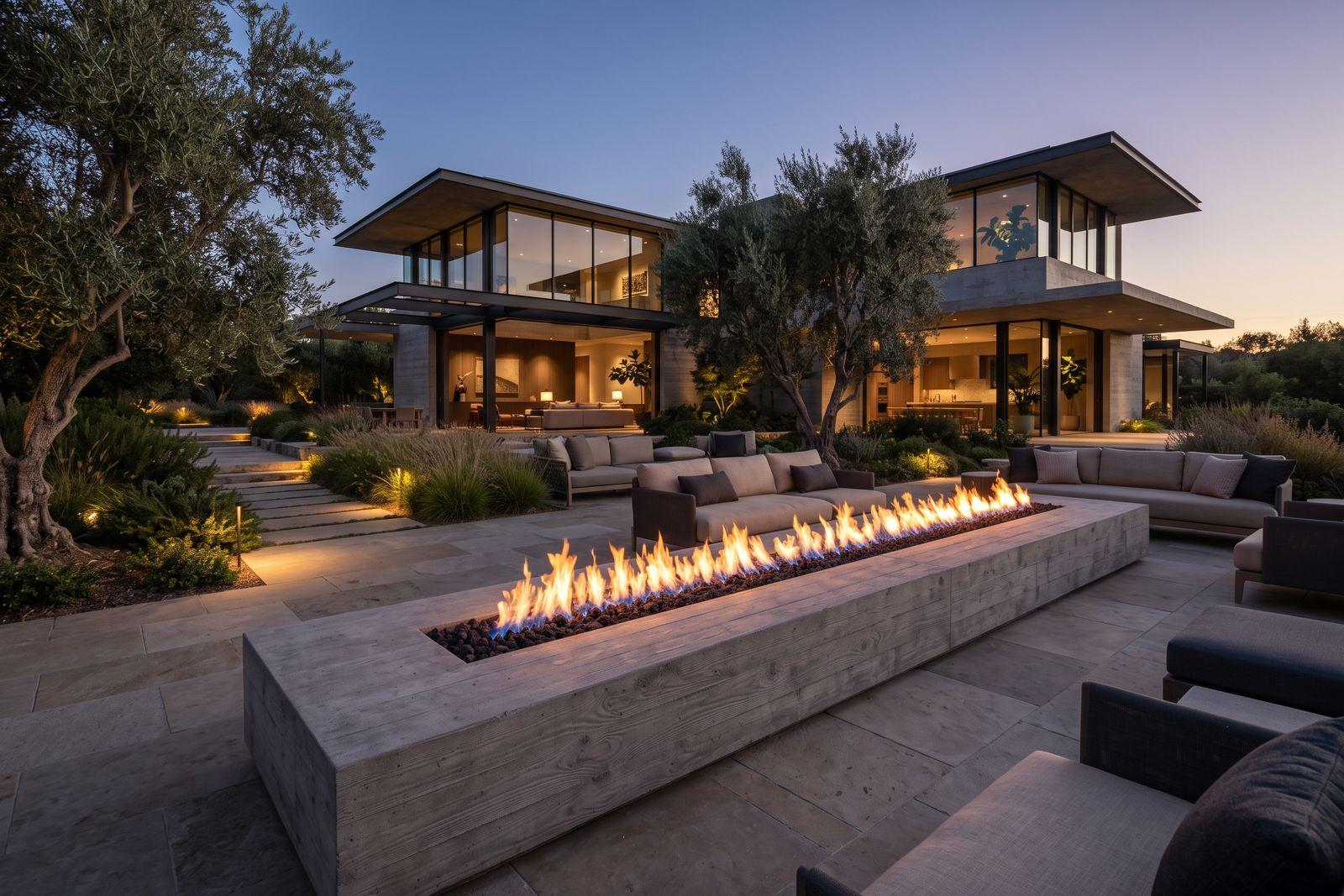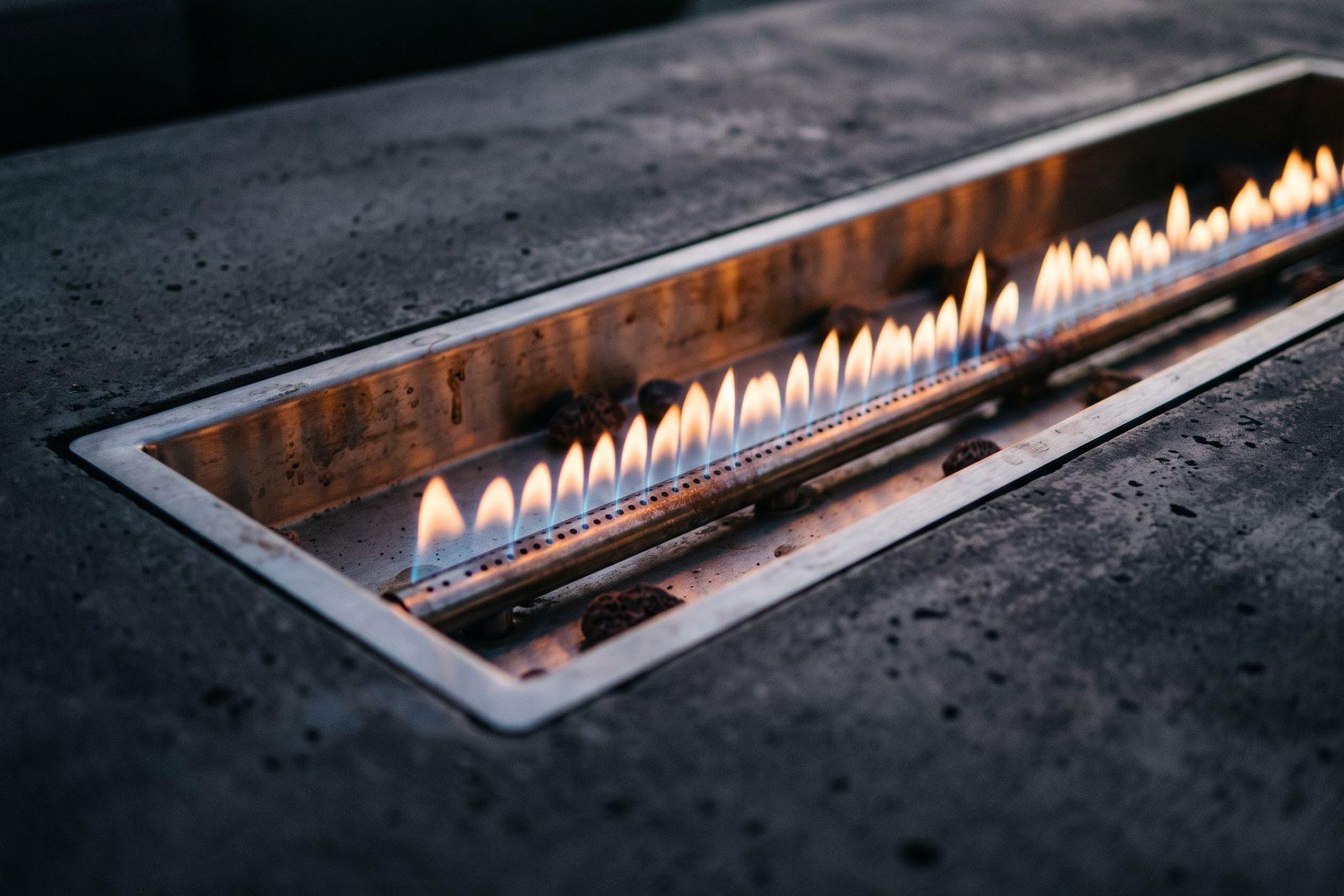

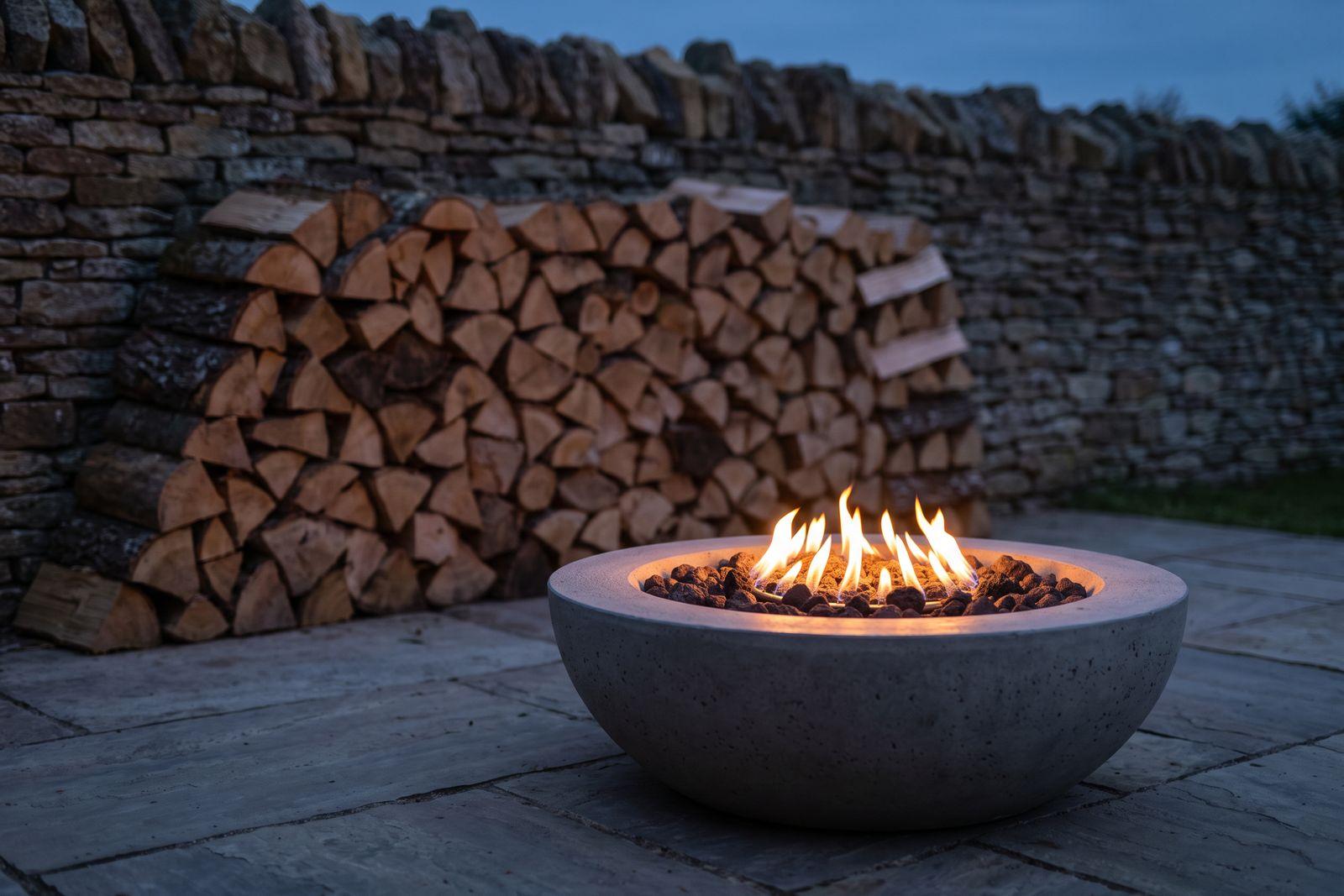
Choose gas if you want a fire that lights with a key or an igniter, leaves no ash and burns no wood. Choose wood if you want a real log fire and can live with smoke, ash and the open burning rules that come with it. Where an air district or city restricts wood fires, a gas pit can be treated differently, but the rule is local, so read yours before you buy either.
This guide compares published documents: maker manuals, the model fire code, air district rules and federal research. Nothing here comes from running a pit.
Gas Fire Pit vs Wood Fire Pit at a Glance
| Gas fire pit | Wood fire pit | |
|---|---|---|
| Fuel | Propane from a cylinder, or natural gas from a line | Firewood, which EPA says to stack covered with airflow so it dries |
| Published heat figure | Input in Btu/h: 35,000 to 65,000 for the pits in this guide | None on the product page cited here; size and weight only |
| Smoke | No wood smoke. EPA: switching to natural gas or propane reduces harmful air pollutants | Fine particles. Low-smoke pits cut them, and still burn wood |
| Ash | None | Must cool, then go in a covered metal container |
| Model fire code | An appliance: listed and installed per the manual | A recreational fire (25 ft) or a portable outdoor fireplace (15 ft, with an exception at one- and two-family homes) |
| Clearances in the manuals cited here | 4 ft to the sides and 5 to 8 ft overhead | Set by the model code or your city |
| Air district burn days | Outside Maricopa's P-26 and, by definition, the South Coast No-Burn rule | Restricted where those rules apply |
| Wind | Real Flame: winds above 10 mph may put the flame out | USFA: use a metal screen to keep sparks from floating out |
The sections below source each row.
Heat: What the Specs Say
Gas pit makers publish input. Bull's Small Square fire pit is rated 35,000 Btu/h on propane, Real Flame's Forest Ridge 50,000 and Prism Hardscapes' Moderno bowls 65,000. A rating is the gas the burner can burn in an hour. It does not measure how warm you feel. Real Flame's manual gives a flame height of 8 to 14 inches, adjusted with a control knob.
Wood pit makers publish size. Ohio Flame's Patriot page lists diameters from 24 to 48 inches, heights, bowl depths and weights from 46 to 255 lb, and no heat figure. How much heat a wood fire gives depends on the wood. EPA and the USDA Forest Service both say to burn seasoned wood, EPA at about 20 percent moisture and USDA at less than 20 percent.
The documents cited here give no heated-area figure for either kind of pit, so no number settles this. If the job is a warm seat, a patio heater is rated for an area, and a BTU calculator can size one. The guide on whether gas fire pits give off heat takes the question further.
Cleanup: Ash Versus Burner Care
Wood leaves ash, and the ash has to cool before it goes anywhere. EPA says to remove ashes into a covered metal container stored outdoors on a nonflammable surface. The U.S. Fire Administration says to let ashes cool first, keep the covered metal container at least 10 feet from the home and other buildings, and never empty ashes into a trash can. Its pictograph shows ashes from a fireplace, and a backyard pit leaves the same hot ash.
Ohio Flame's Patriot has a rain drain, and a blocking plate closes it if you do not want ash falling through. Its natural steel finish develops an iron oxide patina and darkens over time, which the maker's warranty page says to expect.
Gas leaves no ash and still needs upkeep.
- Real Flame warns that spiders and other insects can nest in the burner tube, block the gas flow and cause a flashback, and tells you to clean the tube with a pipe brush and compressed air. It says soot can form on some surfaces and usually wipes off with water and mild soap.
- Prism says to wipe the unit before every use, check hoses and fittings monthly, and never to light the media while it is wet. It also says an NFI certified gas technician should service the appliance annually.
- The Outdoor Plus says to clean the appliance at least annually and have a qualified field service person inspect it.
Smoke, Smokeless Pits and Gas
EPA says wood smoke is a mixture of gases and fine particles, and that fine particles, PM2.5, are its biggest health threat. EPA's backyard fire page adds that outdoor recreational fires can become a considerable source of fine-particle pollution, especially in some metro areas.
Low-smoke wood pits do cut smoke. USDA Forest Service scientists measured two self-advertised smokeless pits and a campground pit in a lab, over 31 burns. The average was 2.2 grams of fine particulate per kilogram of firewood, which they report as 80 percent below the 11.3 grams the EPA national inventory uses for traditional pits. The three pits tested had similar emissions, probably because of their similar barrel design. The USDA writes that pits like those tested can give robust fires with much less smoke if you follow the maker's instructions and burn firewood below 20 percent moisture.
Two limits matter. The study measured wood pits only, so it gives no comparison with gas. And a smokeless pit is still a wood fire. Firegear describes its LUME as a smoke-less insert for wood-burning pits, and its page gives no emissions figures. The burn rules below draw the line at the fuel. South Coast Rule 445 covers any portable outdoor device burning wood-based fuel on residentially zoned property, Maricopa's P-26 bars a fire pit or similar outdoor fire on restricted days, and Denver's page says wood fire pits are prohibited. None of those texts carves out a low-smoke pit.
Local Burn Rules for Wood and Gas
The model fire code treats the two differently. A recreational fire is an outdoor fire not contained in an incinerator, outdoor fireplace, portable outdoor fireplace, barbeque grill or barbeque pit, with a fuel area no more than 3 ft across and 2 ft high, and the code keeps it 25 feet from a structure or combustible material (IFC 307.4.2). A portable outdoor fireplace is a solid-fuel-burning fireplace that may be built of steel, concrete, clay or other noncombustible material. It is used per the maker's instructions and kept 15 feet from a structure or combustible material, with an exception for one- and two-family dwellings (IFC 307.4.3). Whether a steel fire bowl counts as one or the other is a question for your fire official. Both rules sit under an attendance rule: the fire must be constantly attended until it is out (IFC 307.5).
A permanently installed gas fire pit is an appliance. The International Fuel Gas Code requires permanently fixed-in-place outdoor decorative appliances to be listed to ANSI Z21.97 and installed per the manufacturer's instructions (IFGC 635.1), so the distance that applies is the one in the manual. The manuals give 4 ft to the sides and 6 ft overhead for Prism, 48 inches and 60 inches for Real Flame, and 48 inches and 96 inches for The Outdoor Plus. Run yours through the clearance checker and read your own manual, which controls. Your city's adopted code can change any of this.
Air rules add a second layer, and they are where gas and wood part ways.
| Place | Wood | Gas |
|---|---|---|
| South Coast Air Basin (Los Angeles area), California | South Coast AQMD Rule 445 bars operating a wood-burning device, portable outdoor devices such as burn bowls and chimineas included, on a declared No-Burn day. The wood-burning season for fine particles is November through February, below 3,000 ft | Rule 445 defines wood-based fuel as wood, wood products or any non-gaseous, non-liquid fuel, so a gas burner is outside the No-Burn rule as written |
| Maricopa County, Arizona | P-26 bars a fire pit or similar outdoor fire during a restricted-burn period, and otherwise allows only seasoned wood | P-26 does not apply to devices designed and used to burn natural gas, propane or LP gas exclusively |
| Denver, Colorado | The health department says open burning, including wood fire pits, is prohibited in Denver County, and bars solid-fuel devices on high-pollution days unless approved | The page names solid fuel (wood) pits and does not mention gas; gas appliance rules sit in the fire code, covered on the state page |
| Counties in Texas | A county can prohibit or restrict outdoor burning in its unincorporated area for up to 90 days per order, on a drought determination or a public safety finding | Whether an order reaches a gas pit depends on its wording, so read your county's order |
EPA notes that some local governments have adopted ordinances to restrict backyard recreational fires. Ask your fire department and your air district, and check your local code and the appliance's installation manual.
Can One Fire Pit Burn Both Gas and Wood?
No. Five makers' documents say not to burn solid fuel in their gas fire features. Prism says at no time are solid or alternative fuels to be used, and that using wood voids the warranty. Real Flame lists natural or treated wood among what not to burn. The Outdoor Plus says not to use solid fuel such as wood or charcoal, HPC Fire Inspired says solid fuels shall not be burned, and Firegear says not to burn any solid fuels in the appliance.
Ohio Flame makes wood-burning pits and rings, and its Gas Burners collection page says products are coming soon and lists none. EPA notes that kits exist that convert existing fire pits to natural gas or propane burners. That is a separate project with its own rules, covered in our burner kits and inserts guide.
Are Gas Fire Pits Worth It?
Here is what the documents show you gain and give up.
For gas:
- No ash and no wood smoke, and EPA says switching reduces harmful air pollutants.
- A simple start. Prism's table lights with a key valve and a fireplace lighter, and Real Flame's with an igniter button.
- A different footing under some burn rules, as the table above shows.
- Clearances set by the manual, 4 ft to the sides in these manuals, where a wood recreational fire carries the model code's 25 ft.
Against gas:
- Fuel logistics. A 20 lb cylinder runs a 50,000 Btu/h burner about 8.6 hours and a 65,000 Btu/h burner about 6.6 hours at full flame, and Real Flame says cold outdoor temperatures can lower tank pressure and the flame. Natural gas removes the cylinder and needs a line from a licensed gas fitter.
- Wind. Real Flame says winds above 10 mph may extinguish the flame, and Prism says never to use its fire feature in windy conditions.
- Upkeep. Prism says, and HPC suggests, that an NFI certified gas technician service the appliance every year.
- No log fire. A gas pit burns gas over media, and none of these manuals allow wood in it.
As I read it, gas is worth it for someone who lights a fire often and wants it to start from a valve or an igniter, lives where wood fires are restricted, or does not want to manage ash. Wood is worth it for someone who wants the real thing and has the yard, the firewood and a city that allows it.
Which Fire Pit Fits Your Yard
Ohio Flame fits a buyer who wants a real wood fire in a heavy steel pit. The Patriot uses 3/16 inch steel in the 24 to 36 inch sizes and 1/4 inch in the 42 and 48 inch sizes, and the maker's lifetime warranty on registered bowls covers structural integrity and welds and excludes screens, grates, paint and finishes. The Patriot page gives no clearance or fuel instructions, so ask Ohio Flame and your fire official. Prism's Falo 21 and Falo 33 are portable wood-burning bowls of 30 and 40 lb.
Gas pits suit the buyer who wants a pit that works without wood. Prism and The Outdoor Plus make finished gas pieces, and Firegear and HPC Fire Inspired mostly make burners and inserts for pits you build. These are the makers cited above, and this guide compares what their documents say.
Before you choose, check these.
- Your city's burn rules and your air district's burn-day rules.
- The clearance in your manual or, for wood, in the code your city adopted.
- Where the fuel comes from: a cylinder, a gas line or a firewood stack.
- Who does the work. Gas piping goes to a licensed gas fitter, and a fuel conversion takes the maker's kit and a qualified installer.
- Attendance. Real Flame says never to leave its table unattended, and the model fire code says the same of wood fires.
Common Questions
Is a gas fire pit better than a wood fire pit?
It depends on what you want from it. Gas leaves no ash, burns no wood and lights with a key or an igniter, but it needs a cylinder or a gas line and sits under a listing and the maker's clearances. Wood gives a real log fire but brings smoke, ash and open burning rules that vary by city and air district.
Are gas fire pits worth it?
They can be, if you want no ash or wood smoke, a fire that lights quickly and a pit that may still run when wood fires are restricted. The tradeoffs are fuel logistics, since a 20 lb cylinder runs a 65,000 Btu/h burner about 6.6 hours at full flame, sensitivity to wind, and yearly upkeep.
Are smokeless fire pits really worth it?
USDA Forest Service lab tests of two smokeless pits and a campground pit averaged 2.2 grams of fine particulate per kilogram of firewood, about 80 percent below the figure EPA's national inventory uses for traditional pits. All three emitted about the same, which the researchers tie to their similar barrel design. They still burn wood, and the burn rules cited here regulate by fuel.
What are the downsides of using a propane fire pit?
You manage a cylinder. A 20 lb one lasts about 8.6 hours on a 50,000 Btu/h burner and 6.6 hours on a 65,000 Btu/h burner at full flame, and cold can weaken the flame. Real Flame says winds above 10 mph may put the flame out, and the makers cited here call for clearances and yearly service.
Can you burn wood in a gas fire pit?
No. Prism Hardscapes, Real Flame, The Outdoor Plus, HPC Fire Inspired and Firegear all say not to burn solid fuel in their gas fire features, and Prism says using wood voids its warranty. A wood fire needs a pit built for wood, such as Ohio Flame's steel bowls.
Can I use a gas fire pit on a no-burn day?
Possibly, and the rule is local. Maricopa County's ordinance exempts fire pits designed and used to burn only natural gas, propane or LP gas, and South Coast AQMD's Rule 445 covers wood-based fuel, which it defines to exclude gaseous fuels. Check your own air district or city before you light one.
Sources
- International Code Council, 2024 International Fire Code, Chapter 3: Section 307.4.2 (recreational fires, 25 feet), Section 307.4.3 (portable outdoor fireplaces, 15 feet, exception for one- and two-family dwellings), Section 307.5 (attendance)Checked
- International Code Council, 2024 International Fire Code, Chapter 2 Definitions: Portable Outdoor Fireplace and Recreational FireChecked
- International Code Council, 2024 International Fuel Gas Code, Section 635.1 (permanently fixed-in-place outdoor decorative appliances listed to ANSI Z21.97 and installed per the manufacturer's instructions)Checked
- South Coast Air Quality Management District, Rule 445 Wood-Burning Devices (amended September 5, 2025): definitions (c)(13), (c)(19), (c)(22), subdivision (e) No-Burn daysChecked
- Maricopa County, Air Pollution Control Ordinance P-26, Residential Burning Restriction (revised 10/23/2019): Sections 1.C.2, 3.A and 3.B.2Checked
- City and County of Denver, Department of Public Health and Environment, Air Quality page: open burning and solid fuel fire pits, high-pollution daysChecked
- Texas Local Government Code, Section 352.081 Regulation of Outdoor Burning, subsections (c), (d) and (h)Checked
- U.S. Environmental Protection Agency, Burn Wise, Backyard Recreational Fires (page dated December 2, 2025)Checked
- U.S. Environmental Protection Agency, Burn Wise, Wood Smoke and Your Health (page dated November 3, 2025)Checked
- U.S. Environmental Protection Agency, Burn Wise, Best Wood-Burning Practices (page dated November 3, 2025): ash removal and disposalChecked
- U.S. Fire Administration, Pictograph: Discard Ashes Safely (last reviewed October 20, 2021)Checked
- U.S. Fire Administration, Outdoor Fire Safety (metal screen over wood-burning fires)Checked
- USDA Forest Service, Rocky Mountain Research Station, Urbanski et al., Pollutant emission factors for outdoor recreational fire pits, General Technical Report RMRS-GTR-449 (2025), abstractChecked
- USDA Forest Service, Missoula Fire Sciences Laboratory, Measuring the smoke from smokeless recreational fire pits (December 4, 2025)Checked
- Ohio Flame, Patriot Fire Pit product page (sizes, weights, steel thickness, finish, rain drain and blocking plate)Checked
- Ohio Flame, Lifetime Warranty page (coverage, exclusions, patina)Checked
- Ohio Flame, Gas Burners collection page (coming soon; no products listed)Checked
- Firegear Outdoors, LUME Insert product page (smoke-less insert for wood-burning pits)Checked
- Prism Hardscapes, Wood Burning Collection page (Falo 21 and Falo 33)Checked
- Prism Hardscapes, Porto Series Installation, Operation, & Maintenance Manual: Section 2 (propane or natural gas only, no solid fuels; wet media; monthly hose check; annual service), Section 3.1 (clearances), Section 4.1.1 (manual light with a fireplace lighter and key), Section 6 (warranty and wood use)Checked
- Prism Hardscapes, Moderno Series product page (65,000 BTUs orifice, propane or natural gas)Checked
- Real Flame, Forest Ridge Fire Table Owner's Manual, model C1600LP: Specifications (50,000 BTUs/hr), Important Safety Information (clearances, no solid fuels, winds above 10 mph), Lighting Instructions (flame height), Care and Cleaning (soot), Spider and Insect Warning, Tips and Troubleshooting (Cold Temperatures)Checked
- The Outdoor Plus, Fire Pit Manual (PDF modified 2024-09-30): Operating the Fire Pit (no solid fuel), Cleaning, Maintenance and Storage (annual cleaning and inspection), Set-Up Step 1 and Clearance from CombustiblesChecked
- HPC Fire Inspired (Hearth Products Controls Co.), MLFPK Series Match Lit Fire Pit Insert, Installation & Operation Instructions, 870-MLFPK: Section 8 Adding Approved Media (solid fuels shall not be burned in the fire pit) and Section 10 Maintaining the Fire Pit (annual service by an NFI Gas Specialist suggested)Checked
- Firegear Outdoors, Outdoor Fire Pit Pro H-Burners & Kits, Installation and Operating Instructions, REV. D: cover page input ratings and warnings (do not burn any solid fuels in this appliance)Checked
- Bull Outdoor Products, Small Square Fire Pit product page (liquid propane, 35,000 BTU)Checked
About the Author
James Darren Writes the Firepit HQ guides on fire features, fuel and fire codes. Every figure in them is cited to its source with the date it was checked.