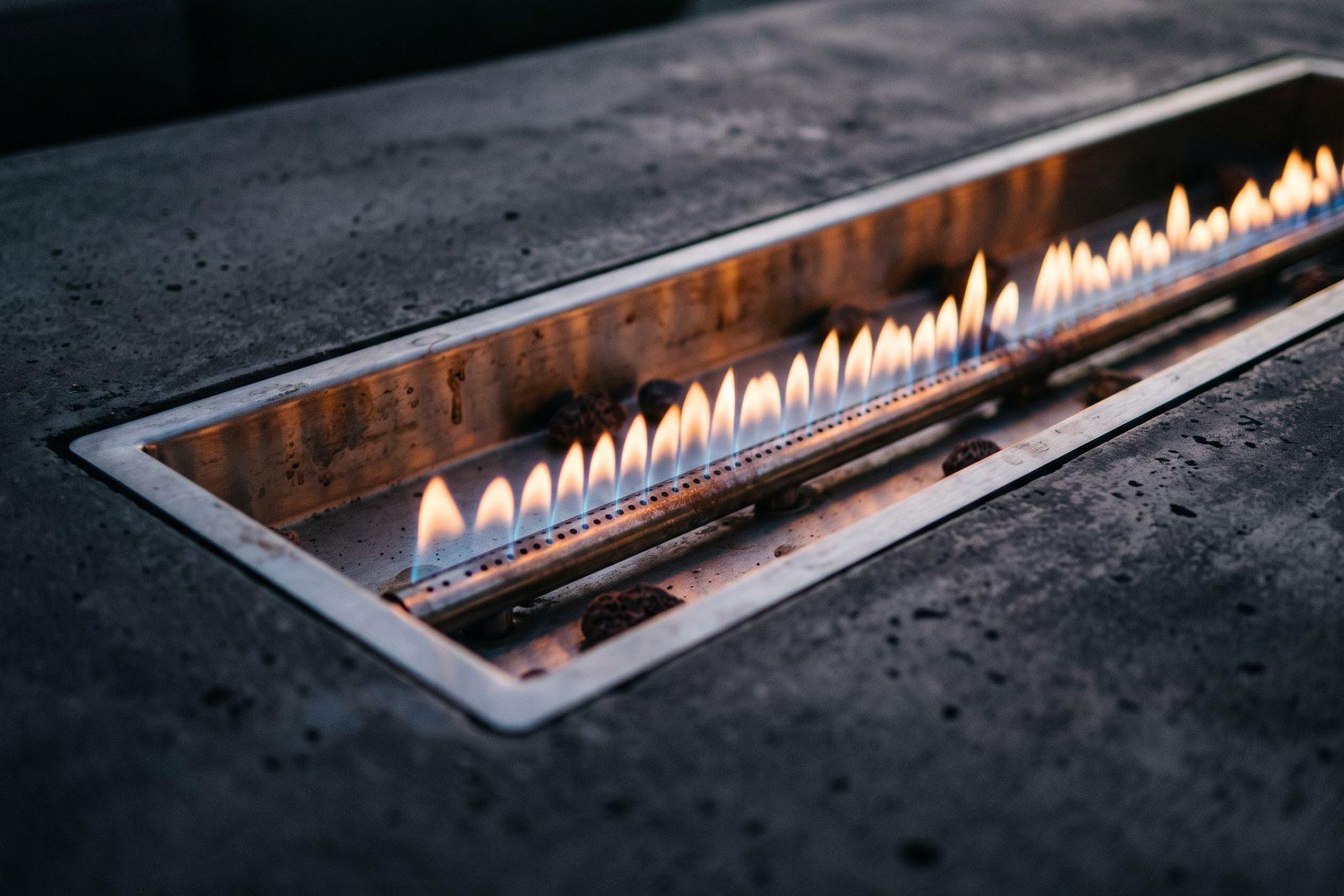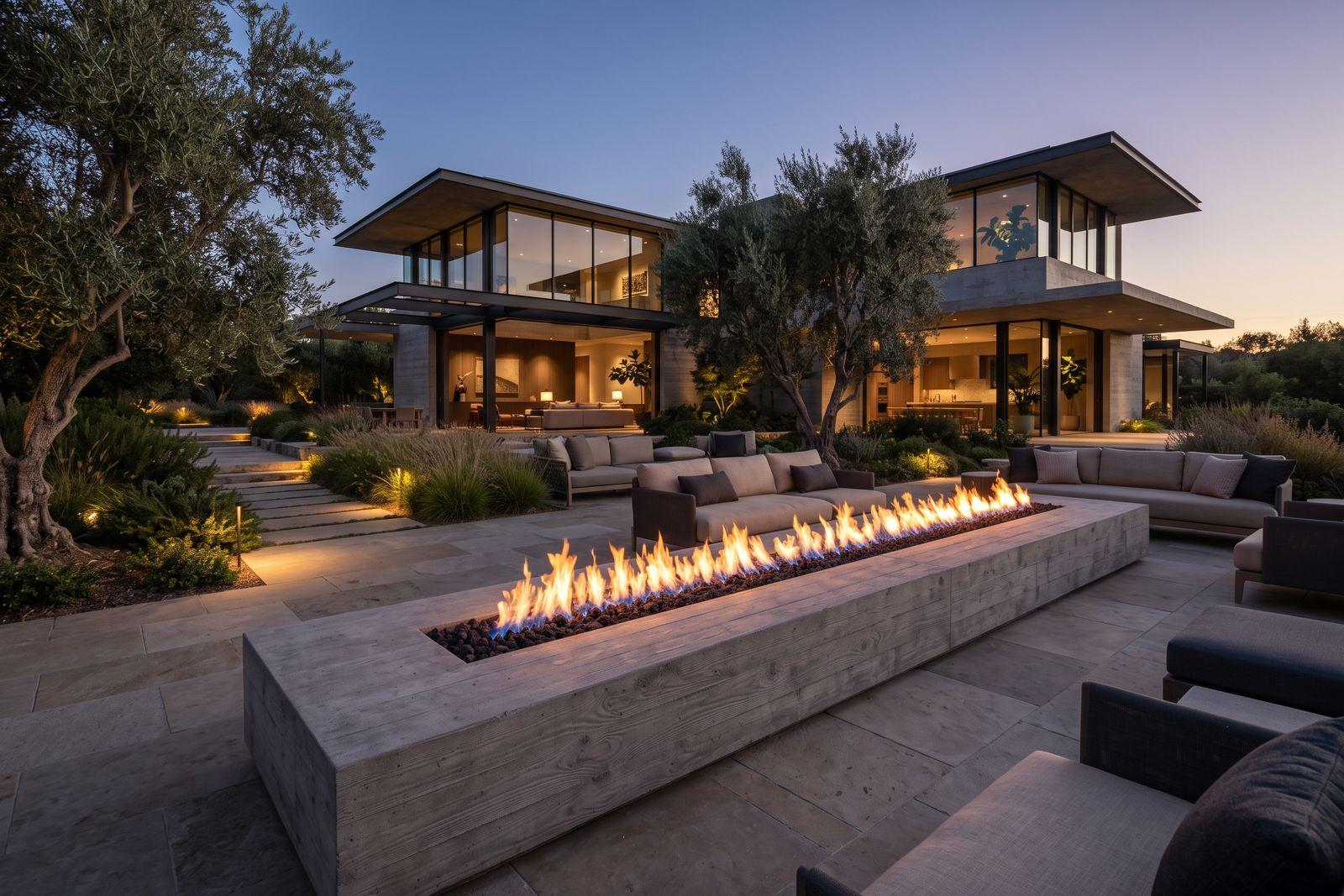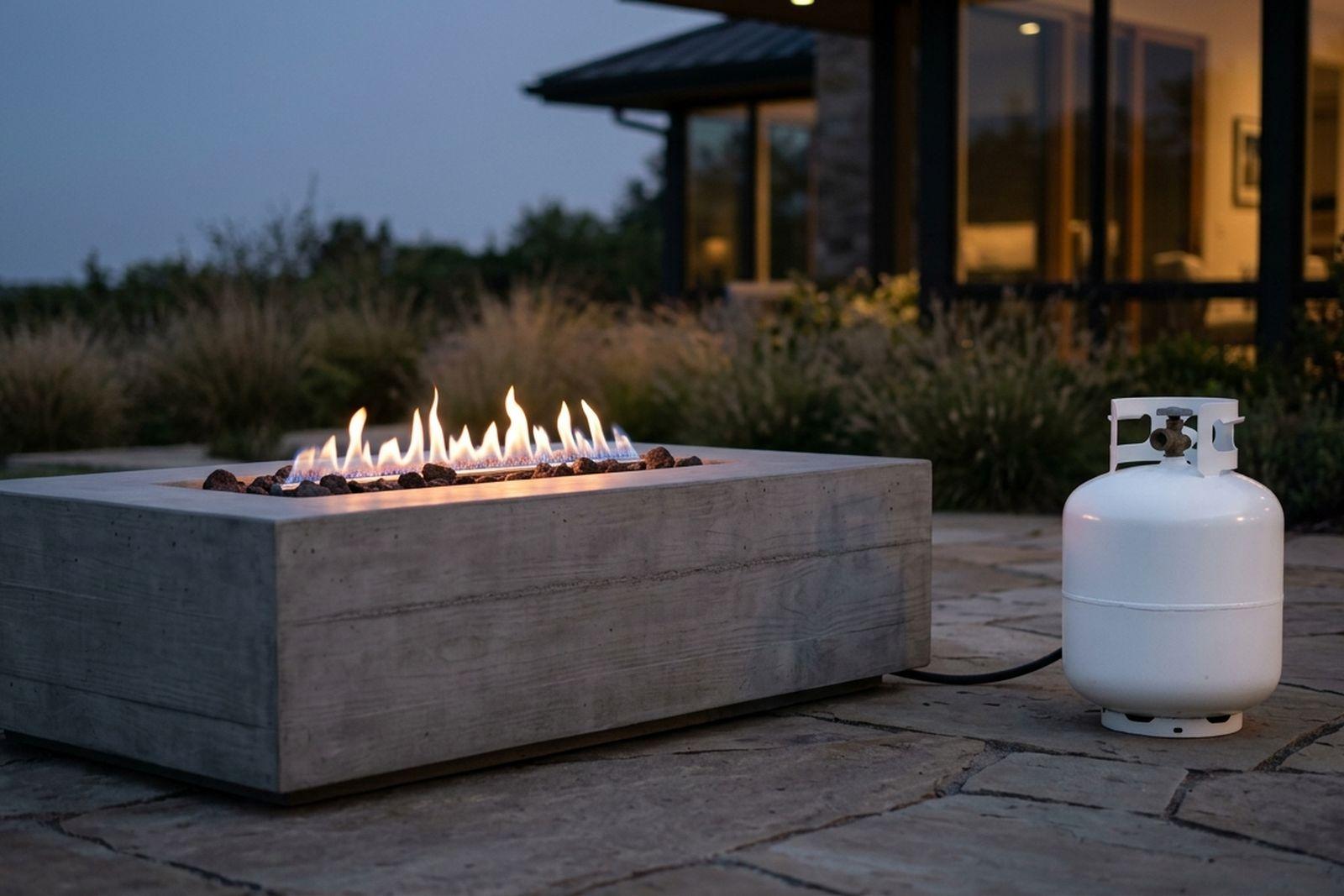

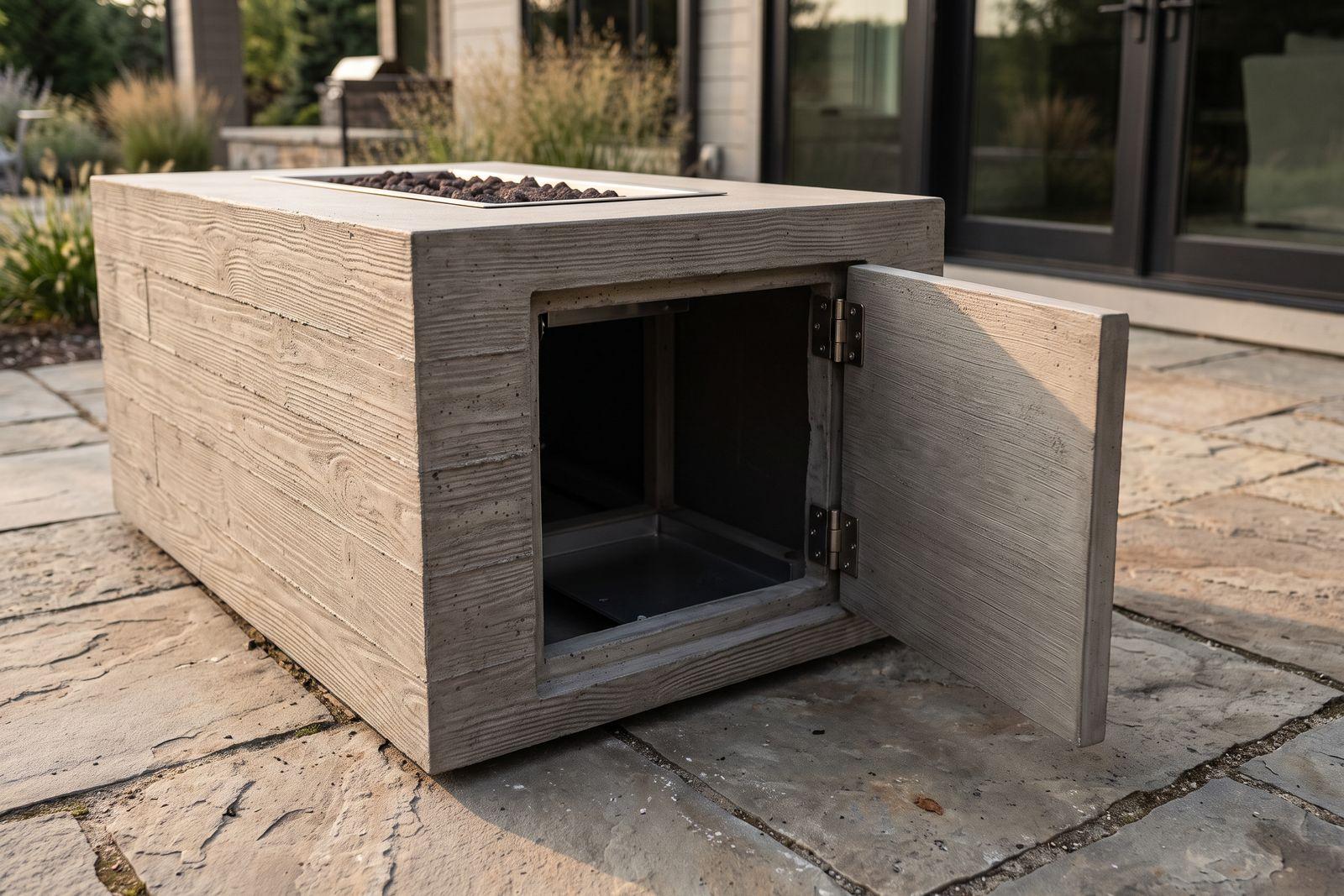
A fire pit table with a propane tank inside holds the cylinder in a compartment in the base, usually behind a side door, and feeds the burner through a regulator and hose. The maker sets the cylinder size: Real Flame's Forest Ridge takes a 20 lb cylinder, and the Prism Hardscapes Porto guide draws an 11 lb tank for one model and a 15 lb tank for two others.
Before you buy, check the cylinder size the manual names, the vents, the regulator and hose, and how you reach the valve. This guide compares published manuals and specs. Nothing here comes from running a table.
How a Propane Tank Fits Inside a Fire Pit Table
A tank-in-table design has a compartment with a door or lid, a regulator and hose that carry gas to the burner, and vents low in the base. Of the five makers below, two build the cylinder into the table, one does on models with a door, and two say to keep it outside.
| Maker and document | Where the cylinder goes | Cylinder the document names |
|---|---|---|
| Real Flame, Forest Ridge manual | In the table body on a metal tank holder, reached through a door | 20 lb; table rated 50,000 Btu/h |
| Prism Hardscapes, Porto manual | Enclosed compartment with a propane access door; the hose runs from the key valve through a vent underneath to the tank | 11 lb drawn for the Porto 60, 15 lb for the Porto 58 and 68; 65,000 Btu/h |
| The Outdoor Plus, Fire Pit Manual | In the base on units with access doors; on units without a door you may have to place the tank externally | 20 lb, about 12 in. across and 18 in. high |
| Firegear, Sanctuary 1 manual | Outside the fire feature, in a separate enclosure at least 60 in. away | 20 lb; the manual lists a 20 in. by 21.5 in. tall concrete enclosure as an optional accessory |
| HPC Fire Inspired, MLFPK manual | In a remote enclosure at least 54 in. from the fire pit, on the select models HPC permits for small tank use | 20 lb or 30 lb |
Firegear's manual says not to place an LP tank inside any fire feature enclosure. These are different design choices, and the manual for the table you own decides which applies.
Two national codes split the propane system. NFPA's fact sheet says NFPA 58, the propane code, applies outside the home and before the final pressure regulator, and NFPA 54, the National Fuel Gas Code, applies inside the home and after the point of delivery. The code text sits behind an NFPA login, so this guide cites the makers and the propane industry instead.
What Size Propane Tank Fits a Fire Pit Table?
Start with the standard. The scope of ANSI Z21.97 / CSA 2.41, the outdoor decorative gas appliance standard, sets the largest cylinder an appliance may be designed to hold.
- Below 60,000 Btu/h: one integral cylinder of up to 20 lb of propane.
- At 60,000 Btu/h or more: one integral cylinder of up to 30 lb.
- At 80,000 Btu/h or more: up to two integral cylinders of 20 lb each.
- A cylinder remote from the appliance: one 30 lb cylinder or two 20 lb cylinders.
Those are ceilings for the maker's design, not a size you choose. Use the size in your table's manual. Manchester Tank's catalog gives the physical sizes.
Cylinder, Propane capacity, Overall height, Diameter, Empty weight
11 lb
- Propane capacity
- 2.6 gal
- Overall height
- 12.4 in.
- Diameter
- 12.2 in.
- Empty weight
- 14 lb
20 lb
- Propane capacity
- 4.7 gal
- Overall height
- 18 in.
- Diameter
- 12.2 in.
- Empty weight
- 18 lb
30 lb
- Propane capacity
- 7.1 gal
- Overall height
- 23.4 in.
- Diameter
- 12.2 in.
- Empty weight
- 25 lb
40 lb
- Propane capacity
- 9.5 gal
- Overall height
- 29.4 in.
- Diameter
- 12.2 in.
- Empty weight
- 32 lb
The Outdoor Plus describes its 20 lb cylinder as about 12 inches across and 18 inches high, and about 38 lb full. Manchester's figures agree: 18 lb empty plus 20 lb of propane. Each step up in cylinder size adds 5 to 6 inches of height, so a compartment built for an 11 lb cylinder may not take a 20 lb one.
Size sets how long an evening lasts. An 11 lb cylinder holds 2.6 gallons. At 91,500 Btu per gallon and the Porto's 65,000 Btu/h, that is 2.6 x 91,500 ÷ 65,000, about 3.7 hours at full flame. A 20 lb cylinder at the same rating gives about 6.6 hours, and Real Flame's Forest Ridge, a 20 lb table rated 50,000 Btu/h, gets about 8.6 hours from a full cylinder. A lower flame stretches those hours. The propane tank runtime calculator lists the 11 lb cylinder along with the 20, 30, 40 and 100 lb sizes and runs the same formula for your burner. Manchester does not list a 15 lb cylinder, so there are no hours here for the other two Portos. The full method is in the runtime guide.
Does the Tank Compartment Need Vents?
Every manual in this guide says to keep the vents clear.
- Prism says fresh air must pass through the unit and not to block any vents on the lower and upper parts of the table. The vents ensure proper combustion and no buildup of residual gases.
- Real Flame says not to remove the feet and not to set the table on anything that blocks or seals the gap between the table and the ground.
- The Outdoor Plus says to set the unit on a solid platform such as concrete so air can flow through the vents in the bottom, and warns that gas can build up if a leak happens and the vents are blocked.
- Firegear says not to set a fire feature directly on grass, dirt or rocks, because that can prevent proper ventilation.
Low vents make sense because propane is heavier than air. Real Flame's manual says it settles in pools in low areas, and the NFPA fact sheet calls it a heavier-than-air gas.
The Prism, Real Flame and Outdoor Plus documents give no vent area for the tank compartment, so ask the maker for it before you buy.
HPC does publish vent areas, for its remote tank enclosure. They scale with the cylinder.
| Cylinder | Upper openings, total free area | Floor-level openings, total free area |
|---|---|---|
| 20 lb | 20 sq in. | 10 sq in. |
| 30 lb | 30 sq in. | 15 sq in. |
That works out to 1 square inch per pound of stored fuel in openings within 5 inches of the top, and half a square inch per pound at floor level, with at least two openings of each kind, equally sized, spaced 180 degrees apart and unobstructed. An enclosure with one side completely open also meets HPC's rule. HPC calls these recommended specifications for its remote enclosure and tells you to follow local codes.
Regulator and Hose: What the Manuals Say
Four of the five makers supply the regulator and hose with the table, and the fifth sells its regulator separately.
| Maker | Supply pressure | Rule on the regulator and hose |
|---|---|---|
| Real Flame | 11.0 in. water column normal | Hose and regulator come in the box; a damaged hose is replaced only with the assembly Real Flame specifies |
| Prism Hardscapes | 11 in. water column | Propane units ship with a flex hose and regulator; the troubleshooting note says to use only the hose the maker supplies |
| The Outdoor Plus | 11.0 in. water column nominal | Use the supplied regulator and hose; the burner orifice is sized for the pressure the regulator delivers |
| HPC Fire Inspired | 11 in. water column | Use the regulator and hose provided or the replacement the maker specifies |
| Firegear | 11.0 in. water column normal inlet on propane (10.5 minimum, 13.0 maximum) | The Sanctuary 1 manual requires its FG-LPRK regulator, which is not included, and a quick-disconnect kit is a separate part |
Do not swap in a regulator from another appliance. The pressure is part of how the burner was sized.
How you handle the hose matters as much as the part. Real Flame says to inspect the hose assembly before each use, with a mirror for the stretch under the unit, to keep it out of contact with hot surfaces, and not to coil it under the table or bury it. Prism says to check hoses and fittings for cracks, abrasions and leaks at least once a month.
The connection itself varies. The Outdoor Plus, HPC and Real Flame all say to tighten the cylinder connection by hand, with no tools. Prism's guide says to tighten its fittings with a wrench, not by hand. Follow the manual in the box.
PERC says to test for leaks before the first use each season and each time you connect a cylinder, with thick soapy water on the valve and the connection. The Outdoor Plus says to test at least once a year and whenever the cylinder is connected, and never to use a flame. Prism also says the appliance should be serviced annually by a gas technician certified by the National Fireplace Institute.
Lid Weight, Doors and Reaching the Valve
The compartment has to let you reach the valve and swap the cylinder without a struggle. HPC writes that into its enclosure rules.
- The cylinder valve must be readily accessible for hand operation.
- An access door must be non-locking and open without tools.
- A cover design needs handles at least 180 degrees apart to make lifting easy.
- The cylinder can be connected, disconnected, inspected and tested outside the enclosure, and any connection disturbed during installation can be leak-tested inside it.
Real Flame's table has a door and a metal tank holder inside. Prism's Porto drawings label a propane access door. Firegear's separate enclosure has a removable lid and weighs 141 lb, and Firegear says it can double as an end table. Firegear gives no separate lid weight, so what it takes to lift that lid is unknown.
The table's own weight matters too. The Porto 60 weighs 317 lb, the Porto 58 weighs 380 lb and the Porto 68 weighs 470 lb. Prism's guide says never to move the fire feature by yourself. A full 20 lb cylinder weighs about 38 lb and you will be lifting it through a door low in the base, so check the opening before you check the finish.
How Far Should the Tank Be From the Fire?
In a tank-in-table design the cylinder shares the piece with the burner, so how the maker separates them matters. HPC's enclosure rules say the cylinder enclosure must isolate the cylinder from the burner compartment, with shielding from radiation, a flame barrier and protection from foreign material.
Heat is the reason. PERC says added heat from a heating appliance or a fire can raise pressure inside a cylinder, and the pressure relief device might then release propane. HPC's cylinder label gives the same warning: do not use or store a cylinder where high temperatures could open the relief valve.
When the maker wants the cylinder outside the fire feature, the distances are 54 inches from HPC and 60 inches from Firegear. They differ, so use the distance in your own manual.
Spare cylinders do not belong in the compartment. Real Flame says not to store extra LP tanks under the fireplace. HPC says not to store a spare under or near the appliance, and PERC says the same about grills and other propane appliances. Some cities cap what you may keep. Denver's fire code lets a one- or two-family home built under the Denver Residential Code keep a maximum of 40 pounds of propane on the premises, which it describes as two 20 lb cylinders, one in use and one spare. The same code prohibits LP-gas containers where a natural gas source is within 300 feet of the property line, with exceptions, so ask Denver Fire how that applies to a propane table. See the Colorado code page and ask your own fire department.
In-Base Tank or Separate Tank Enclosure?
This comparison reasons from the published documents, not from use.
An in-base tank gives you one object with the cylinder out of sight and a door to reach it. The tradeoffs are a smaller cylinder, so fewer hours per fill, and a cylinder close to the burner that depends on the maker's vents and shielding. It suits short evenings, a small patio and someone happy to swap cylinders often.
A separate enclosure keeps the cylinder 54 to 60 inches from the fire, lets you use a 30 lb cylinder where the maker allows it, and leaves the table alone when you refill. The tradeoffs are a second object, a hose run to keep out of the walkway, and its own vent openings. It suits longer burns, bigger burners and a layout with room for an end table.
If you plan to use a natural gas line instead, the natural gas and propane guide covers what changes.
Building Your Own Table Around a Tank
HPC's Section 6 reads like a specification for a cylinder enclosure, and Firegear's LP enclosure shows a finished version. If you build a table around a burner kit, size the enclosure to the manual's rules and have your propane supplier or a licensed gas fitter look at the setup. HPC suggests installers who are licensed in gas piping by the local authority, and Prism's guide says its units are to be installed and serviced by a qualified installer who is licensed or certified where the unit stands. Never run a new gas line yourself.
What to Check Before You Buy
- Cylinder size. The manual names it. Read the dimensions and compare them with Manchester's table.
- Runtime. Divide the cylinder's Btu by the burner's rated Btu/h, or use the runtime calculator linked above.
- Vents. Ask for the vent area of the tank compartment, and plan a surface that leaves the base vents open.
- Regulator and hose. Confirm the maker supplies them and sells the replacement.
- Access. The door should open without tools, and you should reach the valve by hand.
- Isolation. Ask how the tank compartment is separated from the burner.
- Clearances. Prism lists 4 ft to the sides and 6 ft overhead, Real Flame 48 inches to the sides and 60 inches overhead, and The Outdoor Plus 48 inches to the sides and back and 96 inches overhead. Run your piece through the clearance checker.
- Local code. Check your local code and the appliance's installation manual. Your fire marshal's reading governs.
Common Questions
How far should a fire pit be from a propane tank?
It depends on the maker. HPC Fire Inspired's manual puts a remote cylinder enclosure at least 54 inches from the fire pit, and Firegear's Sanctuary 1 manual says at least 60 inches. A table with the tank in its base is designed to hold the cylinder inside, so follow that table's manual and your local code.
Can you put a propane tank inside a fire pit table?
Some makers design for it. Real Flame's Forest Ridge holds a 20 lb cylinder on a tank holder behind a door, and Prism Hardscapes' Porto tables have an enclosed tank compartment. Firegear and HPC Fire Inspired say to keep the cylinder in a separate enclosure instead. Use only what the manual for your table allows.
What size propane tank does a fire pit table use?
The manual names it. Real Flame specifies a 20 lb cylinder, and The Outdoor Plus describes one about 12 inches across and 18 inches high. Prism's Porto drawings show 11 lb and 15 lb tanks. The outdoor appliance standard caps an integral cylinder at 20 lb below 60,000 Btu/h and 30 lb at 60,000 Btu/h or more.
How long will a 20 lb propane tank last in a fire pit table?
A full 20 lb cylinder holds 4.7 gallons, enough to run a 50,000 Btu/h table about 8.6 hours and a 65,000 Btu/h table about 6.6 hours at full flame. A lower flame lasts longer. The propane tank runtime calculator works it out for your burner's rating, including the 11 lb cylinder some tables are drawn for.
Does a propane tank inside a fire table need ventilation?
The manuals say yes. Prism says not to block the vents on the lower and upper parts of the table, Real Flame says not to block the gap under it, and The Outdoor Plus says not to block the vents near the base. Propane is heavier than air and settles low. Ask the maker for the vent area of the tank compartment.
Sources
- Prism Hardscapes, Porto Series Installation, Operation, & Maintenance Manual: Section 1.2 (product drawings naming the tank size and the propane access door), Section 2 (safety instructions), Section 3.1 (clearances, liquid propane requirements), Section 3.2.2 (propane tank unit), Section 4.1.1 (vents, valve), Section 5 (hose note)Checked
- Prism Hardscapes, Porto Series product page (dimensions, weights, 65,000 BTU, enclosed propane tank storage)Checked
- Real Flame, Forest Ridge Fire Table Owner's Manual, model C1600LP: Specifications (20 lb LP gas tank, 50,000 BTUs/hr), Important Safety Information, Propane (LP) Gas Dangers and Warnings, Assembly Instructions steps 2 and 3, Care and Cleaning (Storage), Tips and Troubleshooting (Cold Temperatures)Checked
- HPC Fire Inspired (Hearth Products Controls Co.), MLFPK Series Match Lit Fire Pit Insert, Installation & Operation Instructions, 870-MLFPK: cylinder label (high temperatures and the relief valve), Section 6 Remote LP Tank System Enclosure Requirements (small tank use on select models only; 54 inches, ventilation, Tables 6.1 and 6.2, access, isolation from the burner compartment, cylinder specifications)Checked
- Firegear Outdoors, Sanctuary 1 Outdoor Fire Feature Installation and Operating Instructions, REV. C: printed p. 5 (ventilation, placement surface, LP tank outside the enclosure at least 60 inches away), printed p. 15 (optional LP Tank Enclosure SANCTUARY-LPTE)Checked
- The Outdoor Plus, Fire Pit Manual (PDF modified 2024-09-30): Gas Requirements (regulator and hose, cylinder specification), Set-Up Steps 1 to 3 (placement, connection, leak test), Cleaning, Maintenance and Storage, Clearance from CombustiblesChecked
- CSA Group, ANSI Z21.97-2017 (R2022) / CSA 2.41-2017 (R2022), Outdoor decorative gas appliances, published Preface/Scope, Clauses 1.2 and 1.6 (integral and remote cylinder sizes by appliance input)Checked
- Propane Education & Research Council, Safety Guide for Portable Propane Cylinders (storing cylinders outside, heat, spare cylinders, leak testing)Checked
- National Fire Protection Association, Liquefied Petroleum Gas fact sheet (March 2018): when to use NFPA 58 and NFPA 54, LP-gas hazardsChecked
- Manchester Tank & Equipment Co., Portable DOT Steel LP Gas Cylinders 5 lb to 100 lb, Catalog 49500 (09/2022): LPG capacity, overall height, cylinder diameter and tare weight rows (nominal at 60°F)Checked
- Propane Education & Research Council, The Propane Technical Pocket Guide, 4482-BR-21 v3, Table 1C (91,500 Btu per gallon of propane)Checked
- City and County of Denver, 2025 Denver Fire Code (2nd printing, November 2025), Chapter 61 amendments, Section 6101.4 (LP-gas prohibited where natural gas is within 300 feet, with exceptions) and Section 6104.2 (maximum propane on the premises of one- and two-family dwellings constructed under the Denver Residential Code)Checked
About the Author
James Darren Writes the Firepit HQ guides on fire features, fuel and fire codes. Every figure in them is cited to its source with the date it was checked.