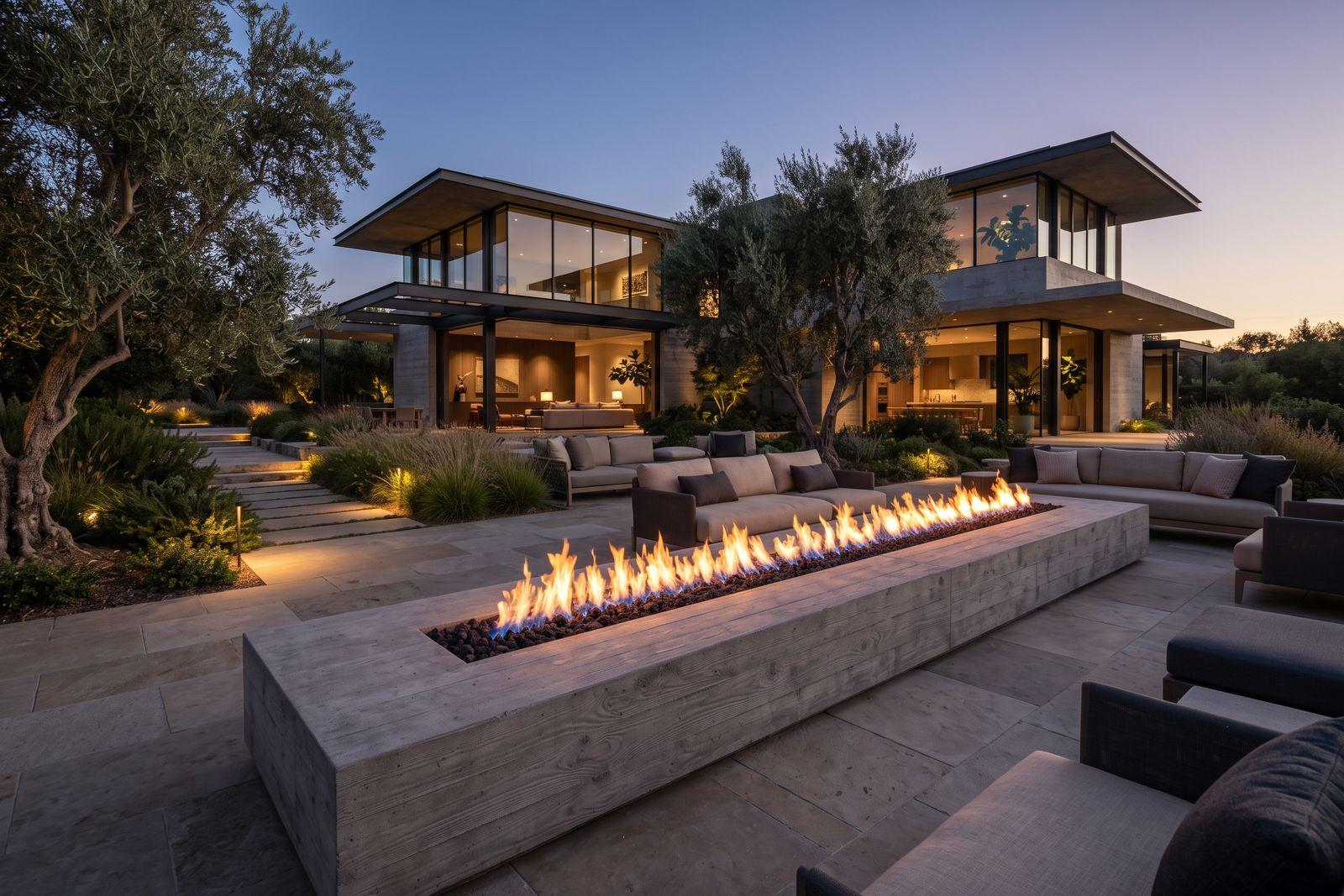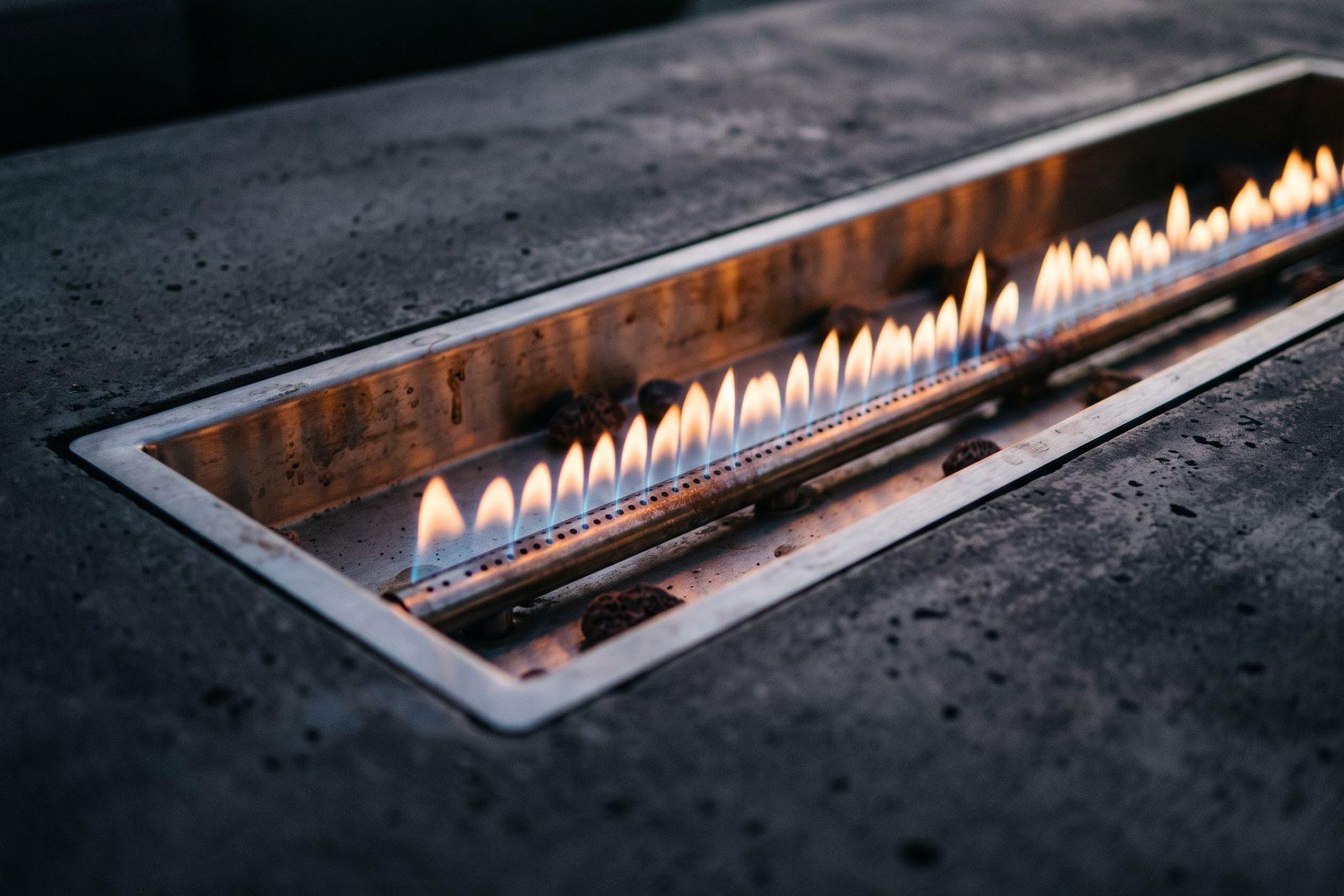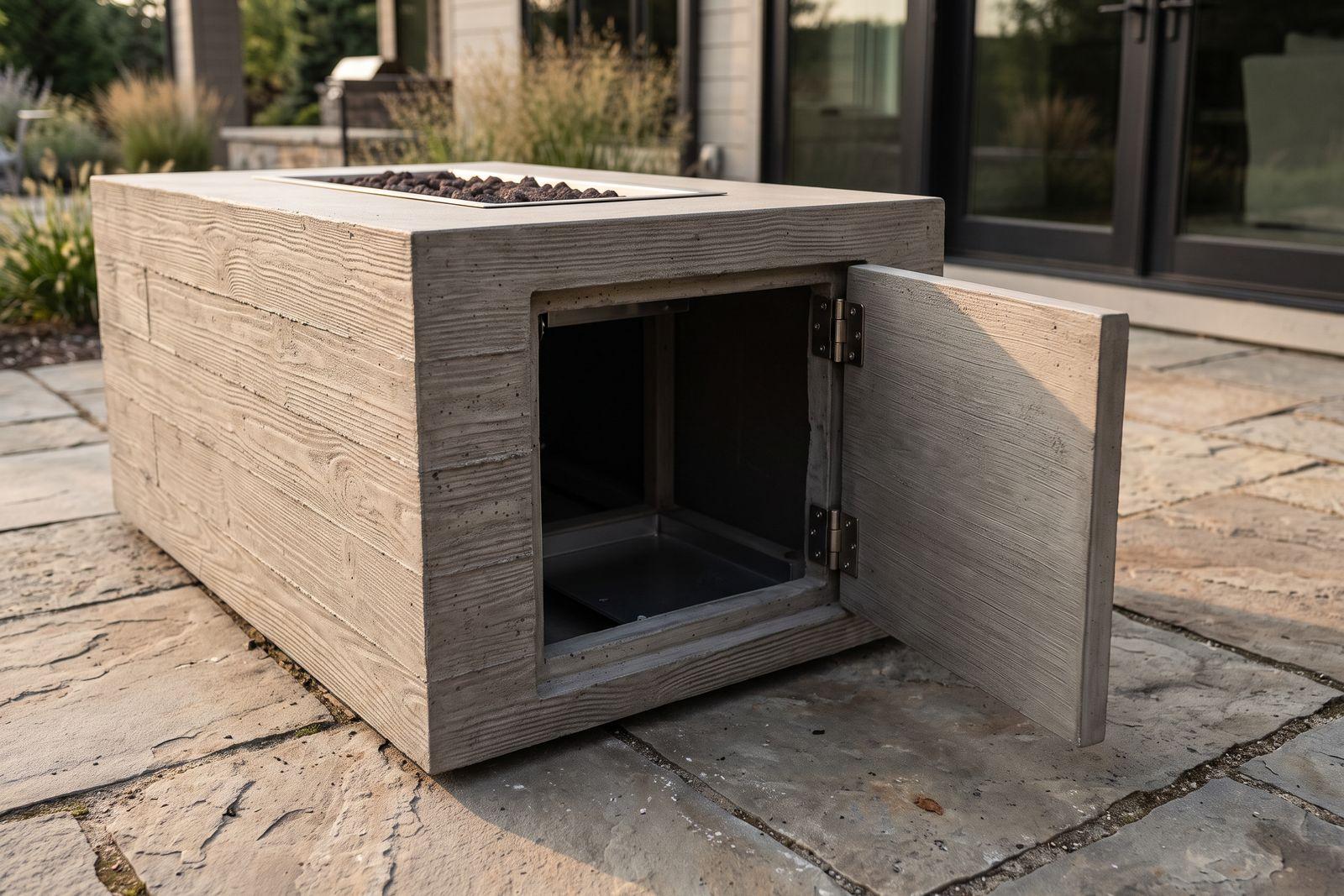

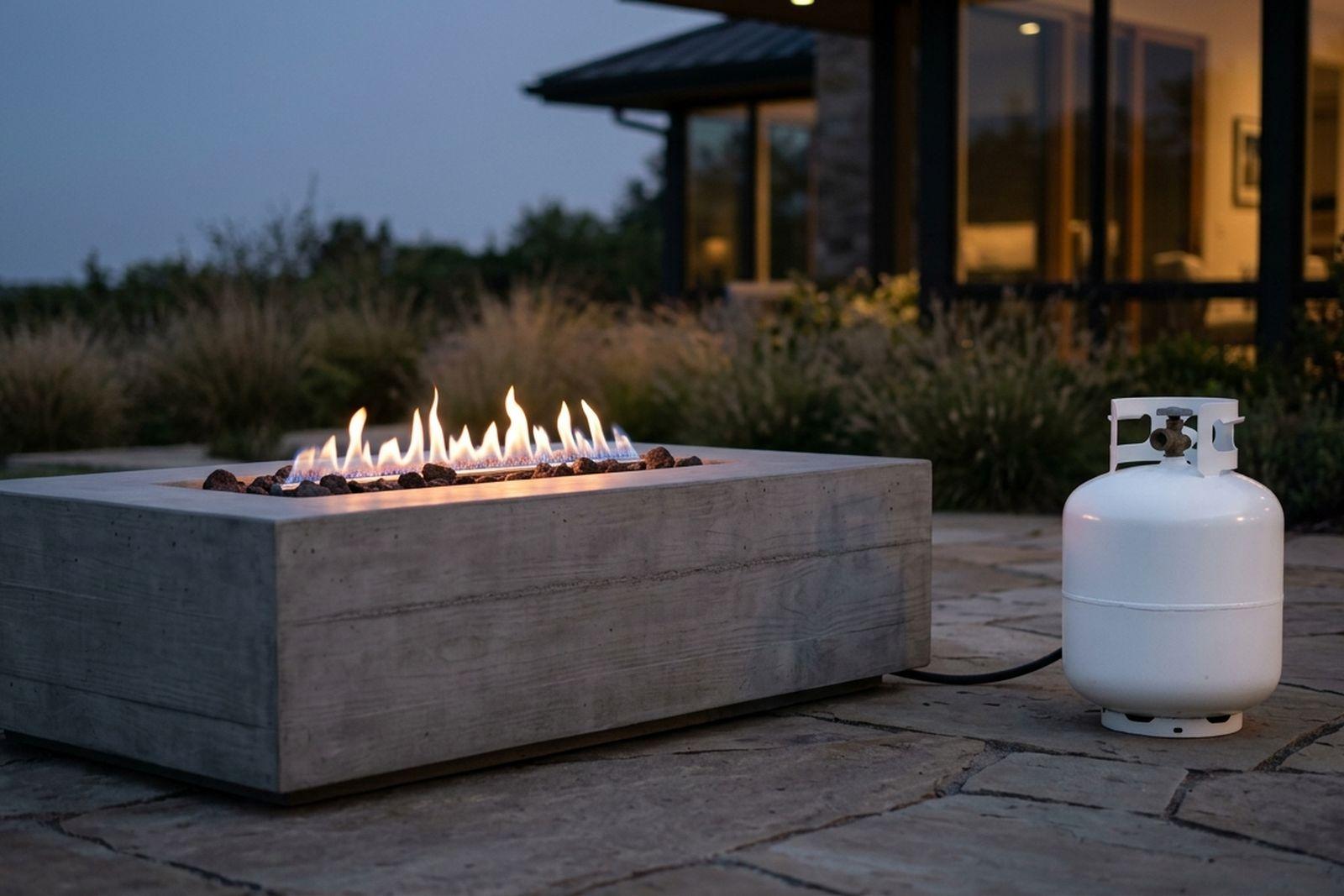
A full 20 lb propane cylinder holds 4.7 gallons, or 430,050 Btu. At full flame that runs a 50,000 Btu/h fire pit for about 8.6 hours and a 65,000 Btu/h pit for about 6.6 hours. Divide 430,050 by your burner's rated Btu/h to get your own number, and expect more hours on a lower flame.
Below are the formula, a runtime table for 11, 20, 30, 40 and 100 lb cylinders, and what the manuals and the propane industry say about cold weather and larger cylinders.
The Propane Tank Runtime Formula
Runtime in hours is the gallons of propane in the cylinder times the Btu in a gallon, divided by the burner's rated Btu per hour. The Propane Education & Research Council (PERC) puts a gallon of propane at 91,500 Btu, and the U.S. Energy Information Administration lists 91,452, a gap of under 0.1 percent. Manchester Tank's catalog gives a 20 lb cylinder 4.7 gallons, so a full one carries 4.7 x 91,500, or 430,050 Btu. That is 8.6 hours at 50,000 Btu/h and 6.6 hours at 65,000 Btu/h. The cylinder itself is about 12 inches across and 18 inches high, which is how The Outdoor Plus describes it and close to what Manchester lists, 12.2 and 18.
Every figure here is at full flame. The formula assumes the burner runs at its full rated input from a full cylinder to empty. This guide uses PERC's constant and Manchester's capacities because they are the ones in our propane tank runtime calculator, so the table below matches what the tool returns.
Runtime by Burner Size
Hours from one full cylinder, run at full flame. Cylinder capacities are Manchester's nominal figures at 60°F.
Burner rating, 11 lb (2.6 gal), 20 lb (4.7 gal), 30 lb (7.1 gal), 40 lb (9.5 gal), 100 lb (23.8 gal)
35,000 Btu/h
- 11 lb (2.6 gal)
- 6.8 h
- 20 lb (4.7 gal)
- 12.3 h
- 30 lb (7.1 gal)
- 18.6 h
- 40 lb (9.5 gal)
- 24.8 h
- 100 lb (23.8 gal)
- 62.2 h
50,000 Btu/h
- 11 lb (2.6 gal)
- 4.8 h
- 20 lb (4.7 gal)
- 8.6 h
- 30 lb (7.1 gal)
- 13.0 h
- 40 lb (9.5 gal)
- 17.4 h
- 100 lb (23.8 gal)
- 43.6 h
65,000 Btu/h
- 11 lb (2.6 gal)
- 3.7 h
- 20 lb (4.7 gal)
- 6.6 h
- 30 lb (7.1 gal)
- 10.0 h
- 40 lb (9.5 gal)
- 13.4 h
- 100 lb (23.8 gal)
- 33.5 h
80,000 Btu/h
- 11 lb (2.6 gal)
- 3.0 h
- 20 lb (4.7 gal)
- 5.4 h
- 30 lb (7.1 gal)
- 8.1 h
- 40 lb (9.5 gal)
- 10.9 h
- 100 lb (23.8 gal)
- 27.2 h
100,000 Btu/h
- 11 lb (2.6 gal)
- 2.4 h
- 20 lb (4.7 gal)
- 4.3 h
- 30 lb (7.1 gal)
- 6.5 h
- 40 lb (9.5 gal)
- 8.7 h
- 100 lb (23.8 gal)
- 21.8 h
125,000 Btu/h
- 11 lb (2.6 gal)
- 1.9 h
- 20 lb (4.7 gal)
- 3.4 h
- 30 lb (7.1 gal)
- 5.2 h
- 40 lb (9.5 gal)
- 7.0 h
- 100 lb (23.8 gal)
- 17.4 h
150,000 Btu/h
- 11 lb (2.6 gal)
- 1.6 h
- 20 lb (4.7 gal)
- 2.9 h
- 30 lb (7.1 gal)
- 4.3 h
- 40 lb (9.5 gal)
- 5.8 h
- 100 lb (23.8 gal)
- 14.5 h
200,000 Btu/h
- 11 lb (2.6 gal)
- 1.2 h
- 20 lb (4.7 gal)
- 2.2 h
- 30 lb (7.1 gal)
- 3.2 h
- 40 lb (9.5 gal)
- 4.3 h
- 100 lb (23.8 gal)
- 10.9 h
Some of these ratings are real products. Bull's Small Square fire pit is rated 35,000 Btu/h on propane. Real Flame's Forest Ridge fire table is rated 50,000 and takes a 20 lb cylinder. Prism Hardscapes rates its Moderno bowls at 65,000 and its Moderno 70 at 125,000, and its Porto tables also list 65,000. Firegear rates its 40 inch Pro H-Burner at 150,000 on propane and its 60 inch at 200,000.
If your rating falls between two rows, use the calculator. Hours vary with the inverse of the rating, so averaging two rows only approximates the answer.
Working Out Your Own Fire Pit
- Find the rated input. It is on the data plate or in the manual, in Btu per hour. Use the rating for the fuel you burn. Firegear rates its 60 inch H-burner at 180,000 on natural gas and 200,000 on propane, while Prism rates its Moderno bowls at 65,000 on either fuel.
- Divide. For a 20 lb cylinder, 430,050 divided by the rating gives hours.
- Scale it to a season. Multiply hours per use by uses per week by weeks, multiply by the rating and divide by 91,500 to get gallons. Divide the gallons by 4.7 to count 20 lb fills.
Two examples from the calculator, using the same constants. A 50,000 Btu/h table lit for 2 hours twice a week for 26 weeks burns 104 hours and 56.8 gallons, which is 12.1 fills, so 12 refills if you start the season full. A 65,000 Btu/h bowl lit for 3 hours twice a week for 26 weeks burns 156 hours and 110.8 gallons, which is 23.6 fills and 23 refills. These patterns are examples, not statistics, so enter your own.
Lower Flame, Longer Runtime
Turning the flame down stretches the runtime, so the table is a ceiling on fuel use. No manual cited here says how much a lower flame saves. Real Flame's manual gives a flame height of 8 to 14 inches from low to high and no input at the low setting, and the Real Flame and Prism manuals each print one rated input. Without a low-flame rating, there is nothing to calculate low-flame hours from.
How Much Propane Is Left in the Cylinder?
A cylinder is marked with its empty weight, the tare weight, as TW. PERC's example is a TW of 18 lb plus 20 lb of propane, a full weight of 38 lb. Weigh your cylinder and subtract the TW to get the propane left. A cylinder with an 18 lb TW that weighs 28 lb holds 10 lb of propane, half of a 20 lb fill, so roughly half the hours in the table.
A low cylinder also shows up in the flame. Real Flame's manual says a low tank can mean lower flames. Prism's troubleshooting table lists a low or empty tank as a cause when the burner will not light or will not stay lit, and says to inspect the tank and hose when the flame is too high or too low.
Does Cold Weather Cut Runtime?
Yes. PERC says the vaporization rate of a container falls when the outside air is colder or the container holds less liquid, and lists wetted surface area, liquid level, temperature, humidity and aboveground or underground placement as the factors. PERC's consumer safety guide describes the mechanism: propane turns from liquid to gas as it leaves the cylinder, and that cools what is left.
Real Flame's manual describes the symptom. Cold outdoor temperatures can lower the tank's pressure and make the flame lower. The manual says to let the cylinder warm up on its own, and never to heat it.
So a cylinder can fall behind a large burner on a cold night before it is empty. No U.S. primary source we found gives limits for 20 to 40 lb cylinders, so there is no number here and none in the calculator. For large aboveground tanks PERC does publish one. PERC's Table 5 lets a half-full aboveground 250 gallon tank supply 180,600 Btu/h of intermittent load without frosting when the lowest outdoor temperature, averaged over 24 hours, reaches 0°F, and PERC says to multiply by 0.25 for continuous loading, which is 45,150 Btu/h. The calculator warns when your burner's rating is above that figure for a 250, 500 or 1,000 gallon tank.
Plan around it. On a cold night, swap cylinders before you reach empty. Keep the spare away from the pit. Real Flame says not to store extra tanks under the table, and HPC and PERC say not to keep a spare under or near an appliance.
Larger Cylinders: 30, 40 and 100 lb
Larger cylinders add hours in proportion to their capacity. At 65,000 Btu/h a 30 lb cylinder gives 10.0 hours, a 40 lb gives 13.4 and a 100 lb gives 33.5. The physical size grows too. Manchester lists the 30 lb cylinder at 23.4 inches tall, the 40 lb at 29.4 inches and the 100 lb at 47.5 inches tall and 14.9 inches across, with an empty weight of 70 lb.
Whether you can use one depends on the manual and the appliance.
- What the manuals name. HPC's insert manual says its appliance is designed for a 20 lb or 30 lb cylinder. Real Flame, The Outdoor Plus and Heatstrip name 20 lb, and Heatstrip says never to connect its heater to a tank larger than 20 lb, giving the maximum size as about 12 inches across and 18 1/2 inches high. A few tables are built for less: Prism's Porto drawings show an 11 lb tank for the Porto 60 and a 15 lb tank for the Porto 58 and 68.
- What the standard allows. The scope of ANSI Z21.97 / CSA 2.41 caps an integral cylinder at 20 lb below 60,000 Btu/h and 30 lb at 60,000 or more, up to two 20 lb cylinders from 80,000, and a remote cylinder at one 30 lb or two 20 lb.
- What the valve says. Manchester equips its 5 to 40 lb cylinders with an overfill prevention device (OPD) and lists the 100 lb with a POL multi-valve for vapor or liquid. Real Flame, HPC and Heatstrip call for an OPD and a vapor withdrawal setup, so do not assume a 100 lb cylinder takes the hose that came with your table.
- What your city allows. Denver's fire code lets a one- or two-family home built under the Denver Residential Code keep a maximum of 40 pounds of propane on the premises. A 100 lb cylinder is over that cap, and a 40 lb cylinder would use all of it. See the Colorado code page.
- How it gets home. PERC lists U.S. legal limits for a closed vehicle: no more than four 20 lb cylinders, no cylinder over 45 lb capacity and no more than 90 lb of propane in all.
For anything bigger than a 30 lb cylinder, ask a propane supplier. The hidden tank guide covers which sizes fit inside a fire table.
Regulator and Hose
The manuals agree on the pressure. Real Flame, Prism, The Outdoor Plus and HPC all give 11 inches of water column for propane, and HPC and The Outdoor Plus connect to the cylinder with a QCC1 fitting. The regulator and hose come with the unit. The Outdoor Plus says the burner orifice is sized for the pressure its regulator delivers, and says to hand tighten the QCC1 nut and never use a wrench.
Replace a damaged hose with the one the maker specifies. Test for leaks with thick soapy water before the first use each season and each time you connect a cylinder, as PERC advises.
A 20 lb Cylinder on a Patio Heater
The same arithmetic runs a patio heater. Heatstrip rates its portable gas heater at a nominal 32,225 Btu/h and designs it for a standard 20 lb cylinder that sits on a holder behind a cart door, held with a strap. A full cylinder gives 4.7 x 91,500 ÷ 32,225, about 13.3 hours at full output, and a heater turned down runs longer. To size a heater for a space, use the BTU calculator. Our BTU ratings guide explains what a rating measures.
When to Call a Propane Supplier
Swapping a cylinder is the owner's job. Setting a larger tank, running a line from it, choosing regulators and placing the tank relative to buildings and openings is licensed propane work, so call a propane supplier or licensed installer. Converting a natural gas appliance to propane, or the reverse, needs the maker's conversion kit and a qualified installer, and a converted appliance should not be sized from its original rating. The natural gas and propane guide covers the tradeoffs. Check your local code in the fire code library and the appliance's installation manual.
Common Questions
How long will a 20 lb propane tank last for a fire pit?
A full 20 lb cylinder holds 4.7 gallons, or 430,050 Btu, so at full flame it runs a 50,000 Btu/h fire pit about 8.6 hours and a 65,000 Btu/h pit about 6.6 hours. Divide 430,050 by your burner's rated Btu/h for your own figure. A lower flame lasts longer.
How long will a 20 lb propane tank last in a patio heater?
It depends on the heater's rating. Heatstrip's portable gas heater is rated 32,225 Btu/h and takes a 20 lb cylinder, so a full cylinder runs it about 13.3 hours at full output. A heater turned down runs longer. Divide 430,050 by your heater's rated Btu/h to check another model.
What size propane tank does a fire pit use?
Most of the manuals cited here name a 20 lb cylinder, about 12 inches across and 18 inches high. HPC's inserts are designed for 20 lb or 30 lb, and Prism's Porto drawings show 11 lb and 15 lb tanks. Use the size in your manual and ask a propane supplier before trying anything larger.
Does cold weather affect how long a propane tank lasts?
Yes. PERC says a container vaporizes propane more slowly when the air is colder or the liquid level is lower, and Real Flame says cold can lower tank pressure and shrink the flame. No U.S. primary source with limits for 20 to 40 lb cylinders turned up, so the calculator gives none. Let a cold cylinder warm up on its own and never heat it.
How do I know how much propane is left in my fire pit tank?
Weigh the cylinder and subtract the tare weight stamped on it as TW. PERC's example is an 18 lb TW plus 20 lb of propane for a 38 lb full cylinder. A cylinder weighing its TW plus 10 lb is half full, so expect about half the hours. A low tank also lowers the flame.
Can I use a bigger propane tank on my fire pit?
Only if the manual allows it. HPC's manual covers 20 lb or 30 lb cylinders, while Real Flame, The Outdoor Plus and Heatstrip name 20 lb. Manchester equips its 5 to 40 lb cylinders with an overfill prevention device and lists the 100 lb with a different valve. Ask your propane supplier before connecting a larger cylinder.
Sources
- Propane Education & Research Council, The Propane Technical Pocket Guide, 4482-BR-21 v3: Table 1C (91,500 Btu per gallon, printed p. 5), Vaporization Rates (printed p. 9), Table 5 and its 0.25 continuous-loading factor (printed p. 10)Checked
- U.S. Energy Information Administration, Energy Explained, Units and calculators: sample Btu conversion factors (1 gallon of propane = 91,452 Btu)Checked
- Manchester Tank & Equipment Co., Portable DOT Steel LP Gas Cylinders 5 lb to 100 lb, Catalog 49500 (09/2022): LPG capacity, overall height, cylinder diameter, tare weight and valve rows (nominal at 60°F)Checked
- Propane Education & Research Council, Safety Guide for Portable Propane Cylinders (liquid to gas cooling, spare cylinders, overfill prevention device, transport limits, leak testing)Checked
- Propane Education & Research Council, Measurements and Calculations with Propane, Lesson 5, Objective 3 (tare weight, TW; 18 lb TW plus 20 lb propane = 38 lb)Checked
- Real Flame, Forest Ridge Fire Table Owner's Manual, model C1600LP: Specifications (20 lb LP gas tank, 50,000 BTUs/hr), Important Safety Information, Propane (LP) Gas Dangers and Warnings, Lighting Instructions (flame height 8 to 14 in.), Tips and Troubleshooting (Out of Gas, Cold Temperatures)Checked
- Prism Hardscapes, Moderno Series Installation Guide, Section 3.1.2 (liquid propane, 11 in. water column, Gas Input Flow 65,000 BTU/HR)Checked
- Prism Hardscapes, Moderno Series product page (65,000 BTUs for Moderno 1 to 8, 125,000 BTUs for Moderno 70)Checked
- Prism Hardscapes, Porto Series Installation, Operation, & Maintenance Manual, Section 1.2 (tank sizes drawn for the Porto 60, 58 and 68), Section 3.1.2 (65,000 BTU/HR, 11 in. water column) and Section 5 (troubleshooting: low or empty tank)Checked
- Bull Outdoor Products, Small Square Fire Pit product page (liquid propane, 35,000 BTU)Checked
- Firegear Outdoors, Outdoor Fire Pit Pro H-Burners & Kits, Installation and Operating Instructions, REV. D: cover page input ratings (60 in. H-burner 180,000 Btu natural gas, 200,000 Btu propane; 40 in. H-burner 150,000 Btu propane)Checked
- Heatstrip, X-DGR32PLP head and stand US manual: LPG cylinder use and safety (20 lb cylinder, 12 in. by 18-1/2 in. maximum), specifications (nominal gas consumption 32,225 BTU/HR, QCC1), securing the tankChecked
- HPC Fire Inspired (Hearth Products Controls Co.), MLFPK Series Match Lit Fire Pit Insert, Installation & Operation Instructions, 870-MLFPK: Section 6 Propane Cylinder: Safety Requirements (designed for a 20 lb or 30 lb cylinder, 11 in. water column, QCC1, OPD, vapor withdrawal) and spare cylinder warningsChecked
- The Outdoor Plus, Fire Pit Manual (PDF modified 2024-09-30): Gas Requirements (20 lb cylinder about 12 in. by 18 in., supplied regulator and hose, orifice sized for regulator pressure), Set-Up Step 2.1 (QCC-1, hand tighten)Checked
- CSA Group, ANSI Z21.97-2017 (R2022) / CSA 2.41-2017 (R2022), Outdoor decorative gas appliances, published Preface/Scope, Clauses 1.2 and 1.6 (cylinder size ceilings by appliance input)Checked
- City and County of Denver, 2025 Denver Fire Code (2nd printing, November 2025), Chapter 61 amendments, Section 6104.2 (maximum propane on the premises of one- and two-family dwellings)Checked
About the Author
James Darren Writes the Firepit HQ guides on fire features, fuel and fire codes. Every figure in them is cited to its source with the date it was checked.