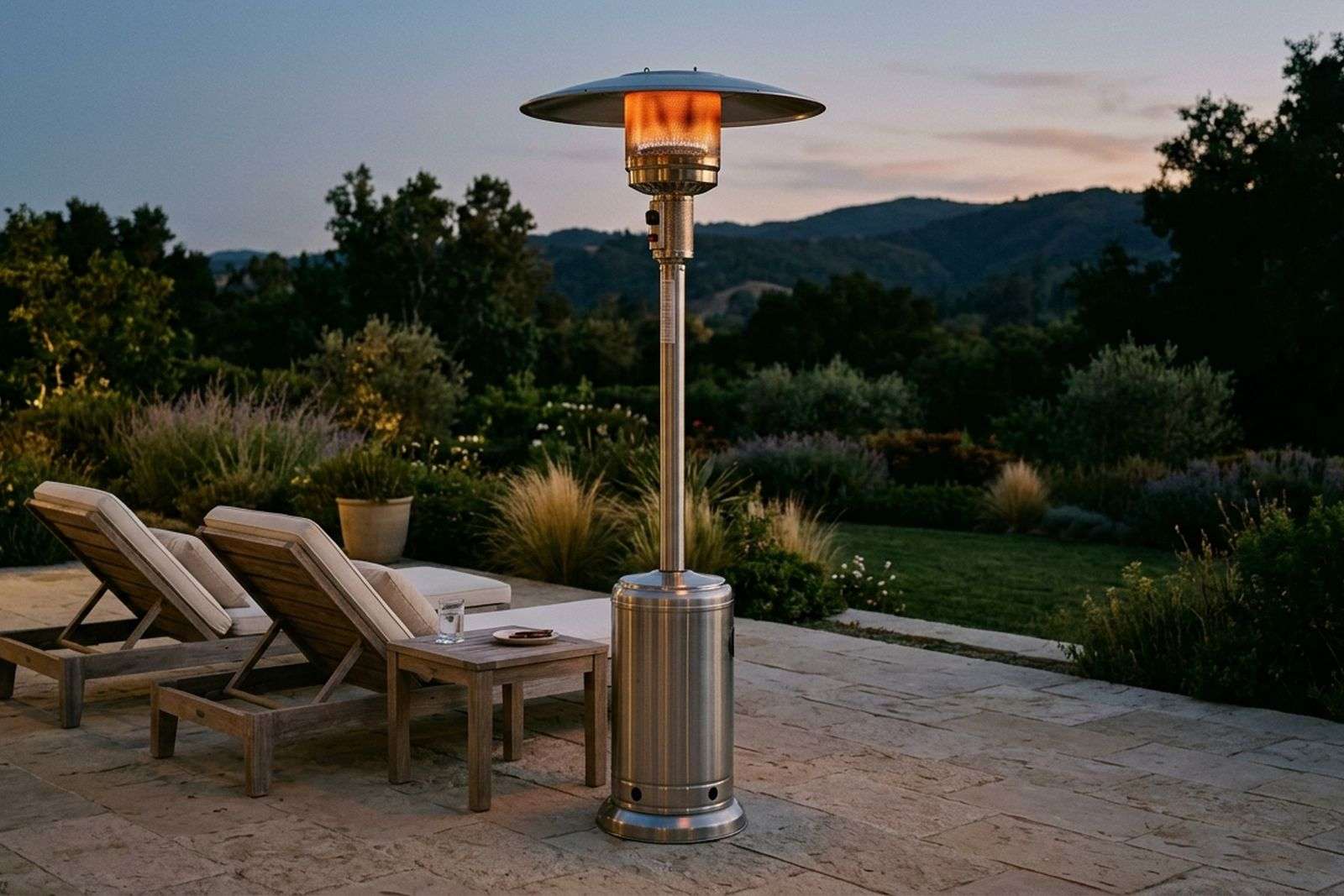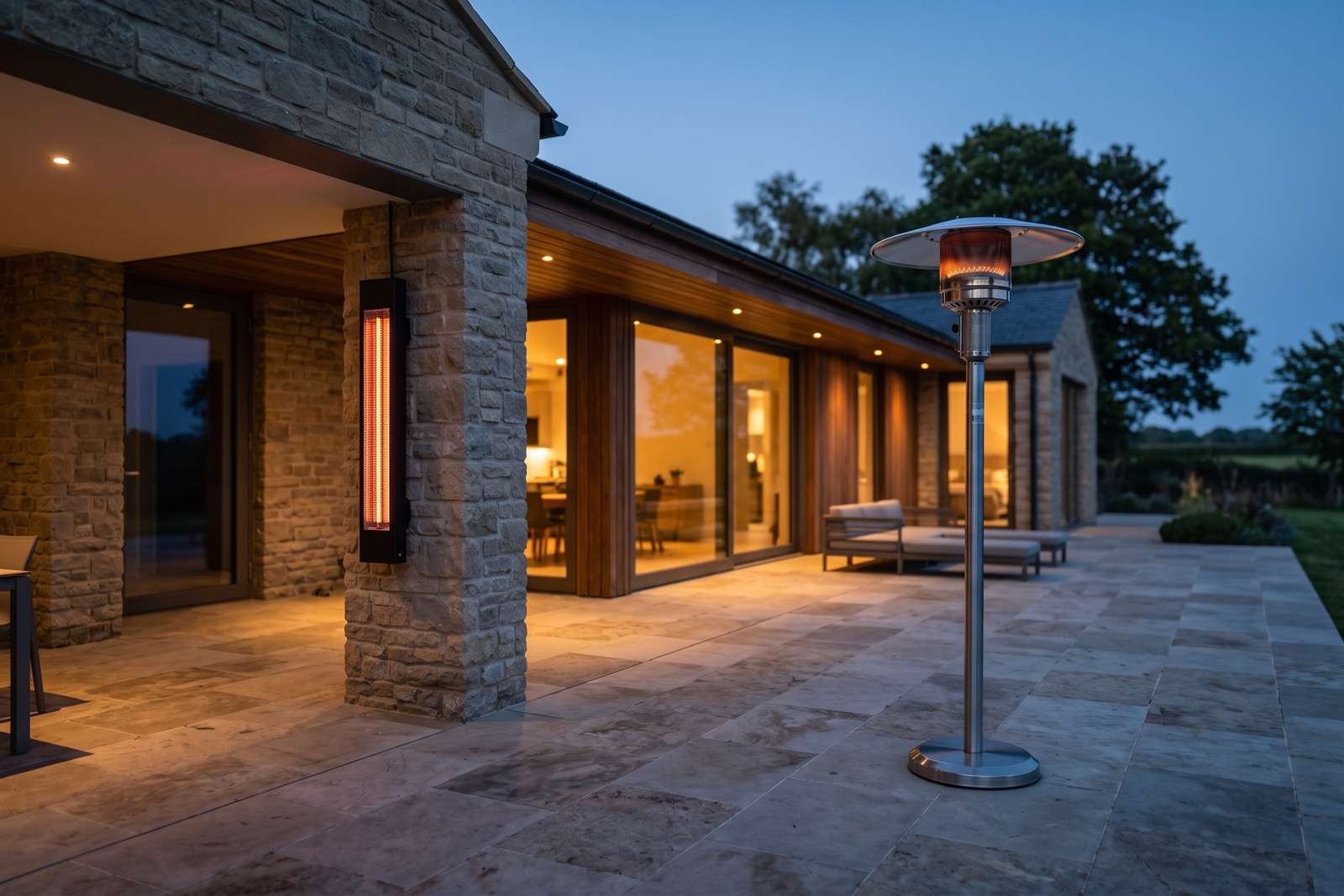

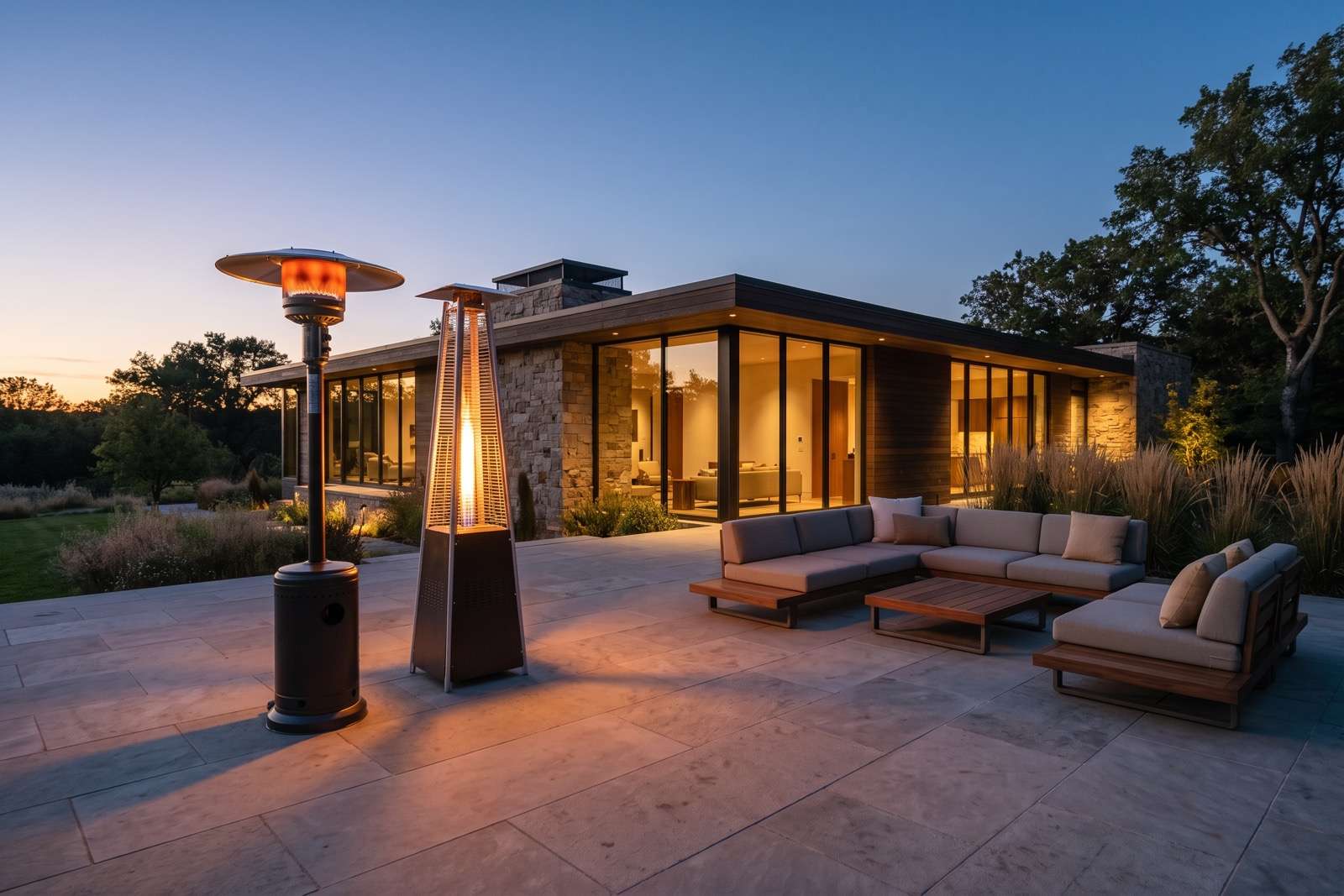
Neither shape is documented as the better heater. No standard and no maker document read for this guide publishes a heat comparison between a mushroom heater (a round reflector on a post) and a pyramid heater (a flame tube in a four-sided frame). The differences that are on paper are height, overhead clearance, input, the listing label and the wind and tip-over limits. This guide compares those published documents. Firepit HQ has not tested any heater.
What Are the Different Types of Patio Heaters?
Start with the split that matters most, which is fuel and mounting: electric, propane or natural gas, on a wall, a ceiling or a stand. How to choose a patio heater covers that split. This guide covers one slice of it, the freestanding propane heater with the cylinder in its base.
Inside that slice, three shape names come up:
- Mushroom: a tall post with a round reflector over the burner. The name is informal. The manuals read for this guide call these a "Patio Heater," and none uses the word mushroom.
- Pyramid: Fire Sense names one model a "Pyramid Heater" in its manual. Its parts list shows a glass flame tube, an emitter screen, four protection guards and a reflector on top, over a base that holds the tank.
- Flame tower or glass tube: a column of flame inside a borosilicate glass tube. Lava Heat Italia makes the Positano line with a triangular column and the Ravello line with a round one.
Those names overlap. Fire Sense's pyramid has a glass flame tube, so it is also a flame tower. That is why a model number and a manual tell you more than the shape word in a listing.
Which Is Better, a Mushroom or a Pyramid Patio Heater?
By the documents, neither. Makers describe heat distribution in a sentence or two and attach no test to it:
- Mi-T-M's product page lists a "360° heat radius for even heating."
- Fire Sense's page for its pyramid says it heats in every direction.
- Lava Heat Italia's Positano page says its triangular column throws evenly on all three faces. Its Ravello page says a rolled-edge hood redirects heat downward across a 360° zone.
Each is a description of intent. None gives a test method, a distance or a temperature. ASTM F2644 is a test method for commercial radiant patio heaters, covering temperature distribution and effective heated area, and none of the maker documents read cites its results for these models. Its scope is commercial heaters, and this guide read only the scope on ASTM's page, not the standard itself.
Without a published basis, a claim that a round reflector throws heat farther down or that a pyramid heats more evenly is a guess. Pick on the numbers that are published, which follow.
Mushroom, Pyramid and Flame Tower Specs Side by Side
Heater, Shape, Input, Height, Maker's stated area, Clearance to combustibles
Fire Sense 60523
- Shape
- Pyramid, glass flame tube
- Input
- 40,000 BTU
- Height
- 88 in, 21 by 21 in footprint
- Maker's stated area
- None stated
- Clearance to combustibles
- 36 in above, 24 in at the sides
Fire Sense Commercial Series 61130
- Shape
- Round reflector, 33 in
- Input
- 48,000 BTU
- Height
- 87 in, 18 in base
- Maker's stated area
- None stated
- Clearance to combustibles
- 36 in from the head, 24 in from base and sides
Mi-T-M MH-0042-PM11
- Shape
- Four-piece reflector
- Input
- 22,500 low, 50,000 high
- Height
- 88 in
- Maker's stated area
- 290 sq ft
- Clearance to combustibles
- Differs by page of the manual
Lava Heat Italia Positano Capri
- Shape
- Triangular glass tube
- Input
- 42,000 BTU
- Height
- 72.5 in
- Maker's stated area
- Not compared here
- Clearance to combustibles
- 24 in at the sides and overhead on the Positano page (see note)
Lava Heat Italia Positano 2G
- Shape
- Triangular glass tube
- Input
- 66,000 BTU
- Height
- 92.5 in
- Maker's stated area
- Not compared here
- Clearance to combustibles
- 24 in at the sides and overhead on the Positano page (see note)
Lava Heat Italia Ravello Opus
- Shape
- Round glass tube with hood
- Input
- 56,000 BTU
- Height
- 81.5 in
- Maker's stated area
- Not compared here
- Clearance to combustibles
- Not stated on the page
These are the makers' own numbers from the sources below. Three notes on them:
- Area: Mi-T-M does not state the basis for its 290 sq ft. At 50,000 BTU/h that works out to about 172 BTU/h per square foot, which sits inside the 105 to 205 range in the guide to choosing a patio heater linked above. Fire Sense prints no area for either model. Lava Heat Italia's Positano page lists 400 sq ft for the 42,000 BTU Capri and 350 sq ft for the 56,000 BTU Lava Lite, which do not line up, so this table leaves its coverage figures out. The BTU calculator covers sizing.
- Lava Heat Italia clearances: the Positano page gives 24 in at the sides and overhead. The brand's troubleshooting page gives 36 in from the sides and 24 in from the top. Both pages agree on 24 in overhead, so the ceiling totals below hold either way, but ask Lava Heat Italia which side figure applies to your model.
- Fire Sense Commercial Series: the manual covers 26 item numbers, and the 48,000 BTU figure is from the product page for one of them, 61130. Read the plate on the model you are buying.
How Much Ceiling Does Each Design Need?
Overhead clearance is where the published numbers diverge most, and it matters on a covered patio. Add the heater's height to its clearance above:
Heater, Height, Clearance above, Total
Fire Sense 60523
- Height
- 88 in
- Clearance above
- 36 in
- Total
- 124 in, or 10 ft 4 in
Fire Sense Commercial Series 61130
- Height
- 87 in
- Clearance above
- 36 in
- Total
- 123 in, or 10 ft 3 in
Lava Heat Italia Positano 2G
- Height
- 92.5 in
- Clearance above
- 24 in
- Total
- 116.5 in, or 9 ft 8.5 in
Lava Heat Italia Positano Capri
- Height
- 72.5 in
- Clearance above
- 24 in
- Total
- 96.5 in, or 8 ft 0.5 in
The Positano totals match the minimum ceiling heights on Lava Heat Italia's page. The Fire Sense totals are this guide's arithmetic. The pyramid manual says 36 in "from top" and "on top," and the Commercial Series manual says 36 in from the heater's head. Neither says where on the heater to measure from, so the totals assume the topmost point. Confirm that with the maker.
Fire Sense's manuals say outdoor use only, and both pre-use checklists list the heater as outdoors, outside any enclosure. Mi-T-M's manual says two different things on shelter. Its checklist (PDF p. 20) has the same line. Its operation page (p. 19) allows three kinds of shelter: walls on all sides with no overhead cover, keeping 47 in (1.2 m) from combustibles at the top and sides; an overhead cover with no more than two side walls; or an overhead cover with three side walls if at least 30 percent of the horizontal periphery is permanently open.
Mi-T-M's clearance figures also differ by page. Pages 9, 10 and 18 give 2 ft from the sides and 3 ft from the top. The checklist on page 20 gives at least 2.3 ft on top and at least 3.3 ft on the sides, so the larger figure moves from the top to the sides. When a manual disagrees with itself, ask the maker which figure is right before you place the heater. Outdoor heaters for covered patios goes through roofs and walls in more detail.
Which Listing Should the Label Show?
The 2024 International Fire Code says portable outdoor gas-fired heating appliances "shall be listed and labeled in accordance with ANSI Z83.26/CSA 2.37" (Section 4103.1.2.2.1). The same section allows only listed and approved heaters whose fuel gas container is integral to the appliance. The Fire Sense and Mi-T-M models carry their cylinder inside the base.
The standard's title is Gas-Fired Outdoor Infrared Patio Heaters. Intertek, a listing lab, issued a notice in June 2022 covering the 2020 third edition, and says its revised requirements took effect June 1, 2023. Intertek's summary of the marking clause gives the wording a label carries, in the form "CSA/ANSI Z83.26-(year) • CSA 2.37-(year), Gas-Fired Outdoor Infrared Patio Heater."
Here is what each maker's documents state:
- Mi-T-M: the manual cover says the heater conforms to CSA/ANSI Z83.26-2020/CSA 2.37-2020.
- Fire Sense: both manuals show an ETL Listed mark. Neither names the standard on the pages read.
- Lava Heat Italia: its Positano page says CSA certified. Neither the Positano nor the Ravello page names a standard.
Naming no standard on a page is not a finding that a heater lacks the listing. The rating plate on the heater decides it. A separate standard, ANSI Z21.97 / CSA 2.41, is titled Outdoor decorative gas appliances. This guide could not verify which standard a given flame tower carries, so read the plate for the Z83.26 wording before you count on any heater meeting the IFC's listing line.
What Does the Fire Code Say About Both Designs?
The IFC sections do not mention shape. They apply to the category. The 2024 text of Section 4103.1.2 sets these rules for portable outdoor gas-fired heating appliances:
- Not inside tents, canopies or membrane structures, not on exterior balconies except as Chapter 61 permits, and not inside any occupancy while connected to the fuel container (4103.1.2.1.1).
- At least 5 ft from buildings (4103.1.2.1.2).
- Not beneath, or within 5 ft of, combustible decorations or combustible overhangs, awnings and sunshades (4103.1.2.1.3).
- At least 5 ft from exits and exit discharges (4103.1.2.1.4).
- A tilt or tip-over switch that shuts off the gas if the heater tilts more than 15 degrees from the vertical (4103.1.2.2.3).
- The heating element or combustion chamber permanently guarded against contact (4103.1.2.2.4).
- A fuel container of 20 lb or less (4103.1.2.3.3).
That is the model code. Your state or city may adopt a different edition or amend it, and a fire official decides whether it reaches a home patio. Start at the state fire code library, and read patio heater on a deck if the heater will sit on boards.
Wind, Tip-Over and the Tilt Switch
Both makers whose manuals set a wind figure use the same one. Fire Sense and Mi-T-M list wind below 10 mph in their checklists before use, and both note reduced efficiency below 40°F. Fire Sense's Commercial Series manual adds a caution that an unsecured heater can be blown over in moderate to high wind, recommends filling a base weight or sand box where the model has one, and says damage from weather is not covered under warranty.
The standard adds a marking rule. As Intertek summarizes it, a heater whose burner has a safety shut-off device of the type the standard's clause 5.20.3 describes must carry the statement that the appliance "may shut down in windy conditions in excess of 3 miles per hour." That is a labeling requirement. Read alongside the tilt rule, a gust that puts the flame out and a gust that tips the heater are two different events, and the tilt switch responds only to the second.
The 2024 IFC sets the tilt switch at more than 15 degrees from the vertical. The Fire Sense, Mi-T-M and Positano pages list a tip-over or anti-tilt shut-off without stating its angle, so ask the maker for the angle in the installation manual.
Fuel, Run Time and the Cylinder
The Fire Sense and Mi-T-M heaters run from a 20 lb cylinder in the base, which fits the IFC's 20 lb container limit. Mi-T-M's product page lists 2.3 lb per hour and 8.5 hours on a 20 lb cylinder for its 22,500 to 50,000 BTU heater, without naming the setting. Fire Sense's page estimates about 10 hours on a 20 lb tank for its 40,000 BTU pyramid, also without a setting. A heater burns more propane per hour at a higher input, so a lower setting runs longer.
Both Fire Sense manuals and Mi-T-M's say the cylinder must have a listed overfilling prevention device and must never be filled beyond 80 percent full. The propane tank runtime calculator works the hours for your own input.
What Does Not Change Between Designs?
The safety instructions line up across Fire Sense's two manuals and Mi-T-M's:
- All three say outdoor use only, and warn that the heater consumes oxygen and produces carbon monoxide.
- Fire Sense and Mi-T-M say to wait at least 5 minutes before relighting a hot heater.
- All three call for a leak test with soapy water at every connection, never a flame.
- Fire Sense and Mi-T-M call for inspection by a qualified service person at least annually.
If a heater will not light, the troubleshooting guide for propane patio heaters reads the makers' own tables. Gas work stays with a licensed gas fitter.
What to Check Before You Buy
- Ceiling height: the heater's height plus its clearance above, from the maker's manual.
- The rating plate: the standard named on it, including Z83.26 if the IFC applies where you live.
- Clearances: the figures in the manual for your exact model, and whether they agree with each other.
- Stated area and its basis: a number with no conditions attached cannot be compared to one with conditions.
- Wind exposure: a base weight or sand box for the model, and a sheltered spot, since the makers cite 10 mph.
- Tilt switch angle: the figure in the installation manual.
- Local rules: your fire official and the state fire code library.
Common Questions
Which type of patio heater is better, a mushroom or a pyramid?
No document read for this guide ranks them. No standard and no maker publishes a heat comparison between a round reflector head and a pyramid flame tube. Their published differences are height, overhead clearance, input, and what the label says. Compare the exact models on those numbers, and size by the maker's stated area for your conditions.
Is a flame tower the same as a pyramid patio heater?
The names overlap. Fire Sense's pyramid heater has a glass flame tube inside a four-sided frame, and Lava Heat Italia's Positano flame tower is a triangular column around a borosilicate glass tube. Lava Heat Italia's Ravello towers use a round tube. Because the shape names overlap, compare model numbers and manuals rather than the shape word in a listing.
How much clearance does a pyramid or mushroom patio heater need?
It depends on the maker. Fire Sense lists 36 in to combustibles above and 24 in at the sides for its pyramid and its round-reflector Commercial Series. Lava Heat Italia's Positano page lists 24 in at the sides and overhead, while its troubleshooting page says 36 in from the sides. Mi-T-M's manual states different figures in different places. The 2024 IFC adds 5 ft from buildings and combustible overhangs for portable gas heaters.
Do patio heaters have to be listed to ANSI Z83.26?
The 2024 International Fire Code says portable outdoor gas-fired heating appliances shall be listed and labeled to ANSI Z83.26/CSA 2.37. That is the model code. Whether your jurisdiction adopted it, and which edition, is a local question. Look for the standard on the heater's rating plate, and ask your fire official if you are unsure.
Can you use a mushroom or pyramid patio heater in wind?
Both Fire Sense and Mi-T-M list wind below 10 mph in their pre-use checklists, and Fire Sense warns that an unsecured heater can be blown over in moderate to high wind. The ANSI Z83.26 marking rules, as Intertek summarizes them, call for a label on heaters with certain safety shut-off devices saying the appliance may shut down in winds above 3 mph.
How long does a 20 lb tank last in a mushroom or pyramid patio heater?
Mi-T-M's product page lists 8.5 hours on a 20 lb cylinder for its 22,500 to 50,000 BTU heater, and Fire Sense's product page estimates about 10 hours for its 40,000 BTU pyramid. Neither names the setting, and a lower setting runs longer. The propane tank runtime calculator works the figure for your own heater's input.
Sources
- Fire Sense (Balkene Home), Pyramid Heater Item 60523/62263 instruction manual (cover dated 02282022): ETL Listed mark and parts list, PDF pp. 1 and 4; safety information, 36 in from top and 24 in from sides, soapy-water leak check, p. 3; leak test, re-lighting wait and annual inspection, p. 10; overfilling prevention device and 80 percent fill limit, p. 11; operation checklist with wind below 10 mph, outside any enclosure, clearances and reduced efficiency below 40 degrees F, p. 13Checked
- Fire Sense (Balkene Home), Commercial Series Outdoor LPG Patio Heater assembly, care and use instructions (cover dated 09182023, models including 61130): 26 item numbers, ETL Listed mark and base weight caution, PDF p. 1; clearances of 3 ft from the head and 2 ft from base and sides, soapy-water leak check, annual inspection, p. 3; overfilling prevention device, 80 percent fill limit, re-lighting wait and annual inspection, p. 10; re-lighting wait, p. 11; wind below 10 mph, outside any enclosure and reduced efficiency below 40 degrees F, p. 12Checked
- Balkene Home (Fire Sense), Stainless Steel Pyramid Flame Heater, SKU 60523 product page: 40,000 BTU, 88 in height, 21 by 21 in footprint, 65 lb, 20 lb LPG cylinder, about 10 hours per tank, heat in every direction, tilt-protection shutoff with no angle stated, ETL safety-certified, no coverage area statedChecked
- Balkene Home (Fire Sense), Commercial Series Patio Heater, SKU 61130 product page: 48,000 BTU, 87 in height, 33 in reflector diameter, 18 in base, 38 lbChecked
- Mi-T-M Corporation, Propane Patio Heaters Operator's Manual MH-0042-PM11 (37-1494-E-071322): conformity statement to CSA/ANSI Z83.26-2020/CSA 2.37-2020, PDF p. 1; 2 ft side and 3 ft top clearances, soapy-water leak check, outdoor use, oxygen and carbon monoxide warnings, p. 9, repeated pp. 10 and 18; overfilling prevention device and 80 percent fill limit, p. 17; shelter rules including 47 in clearance with walls on all sides, re-lighting wait and annual inspection, p. 19; operation checklist with wind below 10 mph, reduced efficiency below 40 degrees F, outside any enclosure and 2.3 ft top and 3.3 ft side clearances, p. 20Checked
- Mi-T-M Corporation, MH-0042-PM11 Propane Radiant Outdoor Patio Heater product page: 22,500 to 50,000 BTU, 2.3 lb per hour, 8.5 hours on a 20 lb cylinder, 290 sq ft heating area, 88 in height, four-piece reflector assembly, 360 degree heat radius line, ETL Intertek mark, tip-over switchChecked
- Lava Heat Italia, Positano Flame Tower Collection page: 66,000, 56,000 and 42,000 BTU, heights, 24 in clearance on every side and overhead, minimum ceilings, anti-tilt and flame-failure protection, triangular column, CSA certifiedChecked
- Lava Heat Italia, Troubleshooting page: minimum clearances of 36 in from the sides and 24 in from the top to combustible materialsChecked
- Lava Heat Italia, Ravello Collection page: round flame towers, Opus and Opus Lite 56,000 BTU at 81.5 in, Ember and Milano 36,000 BTU at 70 in, rolled-edge hood, borosilicate tube, no clearance or standard statedChecked
- Intertek, Standards Update Notice for ANSI Z83.26/CSA 2.37 (issued June 17, 2022; effective June 1, 2023): standard title Gas-Fired Outdoor Infrared Patio Heaters, 2020 third edition, label wording in clause 4.21, windy-conditions marking for heaters with a safety shut-off, tabletop marking (PDF pp. 1 to 3)Checked
- International Code Council, 2024 International Fire Code (Version 2.1), Chapter 41, Sections 4103.1.2 through 4103.1.2.3.4: prohibited locations, 5 ft clearances, integral fuel container and listing to ANSI Z83.26/CSA 2.37 (4103.1.2.2.1), tip-over switch at 15 degrees (4103.1.2.2.3), guard, 20 lb container limit. This is the model code; adoption is localChecked
- CSA Group, ANSI Z21.97-2017 (R2022)/CSA 2.41-2017 (R2022), Outdoor decorative gas appliances, store page (title and edition only; standard text not read)Checked
- ASTM International, F2644-07(2019), Standard Test Method for Performance of Commercial Patio Heaters, active edition store page (scope only: commercial gas and electric radiant patio heaters; energy input rate, preheat, temperature distribution, effective heated area; standard text not read)Checked
About the Author
James Darren Writes the Firepit HQ guides on fire features, fuel and fire codes. Every figure in them is cited to its source with the date it was checked.